Electric Forklift UK Specification: Confirming Wheelbase And Turning Radius Against Your Yard Layout
News 07/11/2026
Wheelbase and turning radius decide whether a four-wheel counterbalance electric forklift can work inside your yard before load capacity ever becomes the limiting factor. In the UK, where yards are often tight, shared with delivery vehicles and bounded by fencing or public highway, the practical question is not the catalogue figure alone. It is whether the machine can turn, park, charge and manoeuvre within the space you actually control. This guide explains which dimensions to confirm, how to measure your layout, and what to ask a supplier before ordering a four-wheel counterbalance electric forklift.
Why Wheelbase and Turning Radius Matter in a UK Yard
A four-wheel counterbalance electric forklift steers with its rear wheels, so the rear end swings outward as the truck turns. A short wheelbase tightens the turning circle but can make the truck less stable at height and more sensitive to load centre. A longer wheelbase usually improves longitudinal stability and ride quality but demands wider aisles and more open yard space.
UK sites add their own constraints. Yards may be bounded by kerbs, drainage channels, gates, weighbridges, fuel or charging compounds, and pedestrian routes. Some sites sit close to a public highway, where gate radii and sight lines limit how far a truck can swing. Older industrial estates may have narrow entrances, uneven concrete and tight corner radii that were never designed around modern equipment.
Turning radius figures are usually quoted to the outside of the truck body or to the outside of the front tyre, depending on the manufacturer. A single number rarely tells the whole story. The usable aisle width also depends on load length, how the truck approaches the rack, and whether the operator can reverse in a straight line. Treat published radii as a starting point, then verify against your own layout.
Which Dimensions to Confirm Before You Buy
Start with the dimensions that change how much space the truck occupies during a turn. Ask the supplier to confirm each one against the specific model and configuration you are considering, since values vary between models and battery options.
- Wheelbase: the horizontal distance between front and rear axle centres. A longer wheelbase generally means a larger turning envelope.
- Overall length: including the fork carriage and any attachment. Fork length changes the space needed to approach a rack or trailer.
- Overall width: affects aisle width and gate clearance, and may differ with tyre type.
- Turning radius: confirm whether the figure is measured to the outside body, the outside tyre, or the fork tip. These are not interchangeable.
- Right-angle stacking aisle: the aisle width needed to turn a load into a rack at right angles. This is the figure most relevant to warehouse and yard racking.
- Overhead guard height and mast collapsed height: relevant to doorways, canopies and covered loading bays.
- Ground clearance: matters where yard surfaces include ramps, kerbs or drainage covers.
Do not assume that a specification sheet lists every relevant dimension in the same way. Ask the supplier to state the measurement basis and the configuration it applies to. If a figure is described as “approximately” or is missing, treat it as unconfirmed.
Load Centre and Attachments Change the Envelope
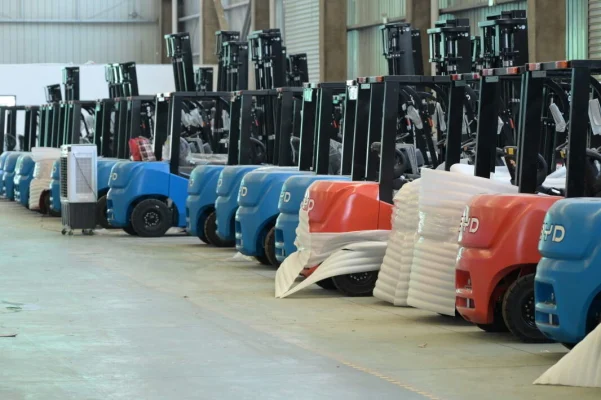
Rated capacity is normally stated at a specific load centre, often 500 mm or 600 mm. If your loads sit further forward, or you add a side-shift or other attachment, the remaining capacity at height may be lower than the headline rating. The attachment also adds length and can change the turning envelope. Confirm the derated capacity and the revised dimensions with the supplier before committing to a model.
Measuring Your Yard and Matching It to the Truck
Measure the layout you actually operate in, not the layout on a drawing. Use a tape or laser measure and record the narrowest points, because those govern whether the truck fits.
Step 1: Map the Tightest Movements
Walk the route a truck takes during a normal shift. Identify every place where it must turn, reverse, queue or pass another vehicle. Typical pinch points include gate entrances, corners between buildings, loading bay aprons, charging areas and rack ends. Record the clear width at each point, measured between fixed obstacles rather than between painted lines.
Step 2: Record Surface and Slope Conditions
Note the surface type, any potholes or broken joints, drainage channels, ramps and slopes. A four-wheel counterbalance electric forklift is a common general-purpose choice on firm, prepared surfaces, but gradients and poor surfaces affect stability, braking and the space needed to stop. If your yard includes a slope, tell the supplier the gradient and where it occurs, and ask what the truck is rated to handle.
Step 3: Check the Turning Envelope Against the Aisle
Compare the right-angle stacking aisle figure with your narrowest turning aisle. Add a margin for operator error, load overhang and any pedestrian segregation. If the calculated space is marginal, consider whether the operation can be reorganised: re-siting racking, widening a gate, changing the approach direction, or using a different load presentation. Do not assume that a smaller truck automatically solves the problem, because capacity and stability requirements may rule it out.
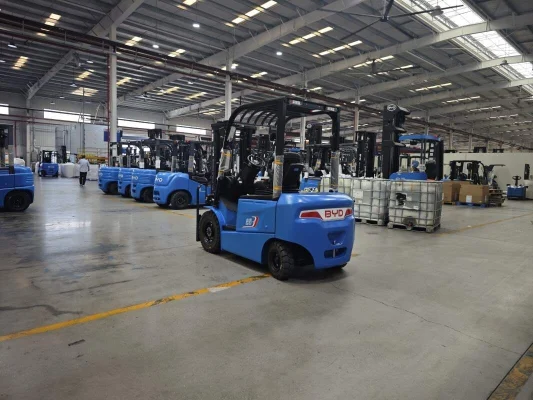
Step 4: Plan Charging and Parking Space
A lithium battery truck still needs space to park, charge and, if required, change batteries. Confirm the charging position, cable routing, ventilation and fire safety arrangements with your site and the supplier. Charging space is part of the layout, not an afterthought.
| Parameter | Why the yard layout cares | What to confirm with the supplier | Typical status |
|---|---|---|---|
| Wheelbase | Sets the basic turning envelope and stability | Exact value and measurement basis | Model-specific |
| Turning radius | Determines whether tight corners are passable | Whether measured to body, tyre or fork tip | Model-specific |
| Right-angle stacking aisle | Governs rack and yard turning space | Figure with the intended attachment and load length | Model-specific |
| Rated capacity and load centre | Affects stability and usable load at height | Capacity at your actual load centre and lift height | Model-specific |
| Ground clearance and tyre type | Affects performance on uneven or sloped surfaces | Recommended surface conditions and tyre options | Confirm with supplier |
| Charging and parking footprint | Needs dedicated space and services | Charger requirements and site conditions | Confirm with supplier |
The table is a checklist, not a specification. Values depend on the model, battery, attachment and tyre configuration. Where a figure is not available in the supplier’s documentation, request it in writing rather than estimating.
Common Questions About Yard Fit and Specification
Is turning radius measured the same way by every manufacturer?
No. Some quote the radius to the outside of the truck body, others to the outside of the front tyre, and some to the fork tip. Always ask which basis applies and confirm the figure against the configuration you intend to buy. Comparing two numbers without knowing the measurement basis can lead to the wrong choice.
Can a shorter wheelbase always fit a tighter yard?
A shorter wheelbase generally reduces the turning envelope, but it can affect stability and ride quality, especially with high lifts or long loads. The right answer depends on your load centre, lift height, surface and aisle width together. Ask the supplier to confirm stability and capacity for your actual duty rather than assuming shorter is better.
What should I measure before requesting a quotation?
Record the narrowest gate and aisle widths, the tightest corner radii, the surface type and any slopes, the maximum load weight and dimensions, the lift height required, and the space available for charging and parking. These details let a supplier match a four-wheel counterbalance electric forklift to your site rather than to a generic example.
Does the UK climate affect the choice?
Outdoor yards in the UK face rain, wind and occasional frost. Surface grip, drainage and the condition of painted lines all affect safe operation. Ask the supplier about tyre options and recommended operating conditions, and keep charging equipment protected from the weather. Do not assume a standard specification suits every outdoor site.
Can I confirm fit from a brochure alone?
A brochure gives model-level data, but your yard has its own constraints. Use the brochure to shortlist, then verify the critical dimensions and capacity against your measured layout. If a figure is missing or ambiguous, ask the supplier to confirm it in writing before you order.
What to Prepare Before You Contact a Supplier
A productive conversation starts with your own data. Compile a simple layout sketch showing gate widths, aisle widths, turning points, rack positions, slopes, surface type and the proposed charging area. Add the load weights, load dimensions, lift heights and the number of shifts per day. Then ask the supplier to confirm the wheelbase, turning radius measurement basis, right-angle stacking aisle, rated capacity at your load centre, and the charging requirements for the specific four-wheel counterbalance electric forklift they propose.
If your measured aisle is narrower than the truck’s turning envelope, say so early. The answer may be a different configuration, a layout change, or an honest conclusion that this type of truck is not the right fit. Our team can review your yard details and discuss suitable BYD four-wheel counterbalance electric forklift configurations, but the final decision should rest on verified dimensions and your site conditions, not on a single catalogue number.