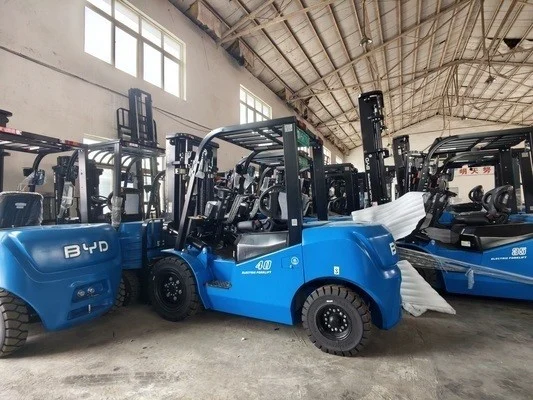
Mast Free-Lift and Overhead Guard Height: Fitting a Four-Wheel Counterbalance Electric Forklift to Low-Clearance Doorways and Racking
News 01/11/2026
Two vertical dimensions decide whether a four-wheel counterbalance electric forklift can enter a building and work inside it: the lowered mast height (often called the collapsed or nested height) and the overhead guard height. A doorway that clears the overhead guard can still be blocked by a mast that does not collapse low enough, and a racking aisle that accepts the truck body can still leave no room to raise the inner mast channel. This article explains how free-lift masts behave, which measurements to collect before ordering, and how to verify the numbers against real doorways and rack beams.
How Free-Lift Masts and Overhead Guard Height Affect Clearance
What a free-lift mast actually does
On a conventional simplex or duplex mast, the inner channel starts rising as soon as the forks leave the floor, so the overall mast height grows with lift. A free-lift section lets the carriage and forks travel upward inside the outer channels before the inner mast telescopes. The practical result is that the truck can place a pallet at a modest height while the mast stays close to its collapsed height.
Free-lift is described as full or partial depending on how much carriage travel occurs before the inner channel moves. Full free-lift is the version that keeps the overall height nearly constant through the free-lift range; partial free-lift gives less. The exact free-lift stroke, collapsed height, and extended height belong to the mast specification, not to the truck family as a whole, so they must be read from the manufacturer’s data sheet the supplier provides.
Why the overhead guard is a separate limit
The overhead guard protects the operator and is usually the highest fixed point on the truck when the mast is down. Doorway headers, roller shutters, mezzanine edges, sprinkler piping, and low-hanging cable trays are all checked against this dimension. The guard height is fixed by the truck’s structure, so it cannot be reduced by choosing a different mast. If the guard does not fit, no mast option will solve the problem, and the doorway, the route, or the truck class must change.
Two further heights matter inside the building: the extended mast height when the forks reach the top beam of the highest racking level, and the free-lift height the task actually requires. A truck can pass the door with the mast down and still strike a sprinkler head or a roof truss at full lift.
Where the two dimensions interact
A low doorway is a pass-through check performed with the mast fully collapsed. Racking work is a working-height check performed with the forks raised. Free-lift matters most when the truck must lift inside a low-clearance zone, such as under a mezzanine, inside a container, or beneath a rack beam that sits lower than the mast’s extended height. In those places, the ability to raise the forks without extending the mast is the deciding feature.
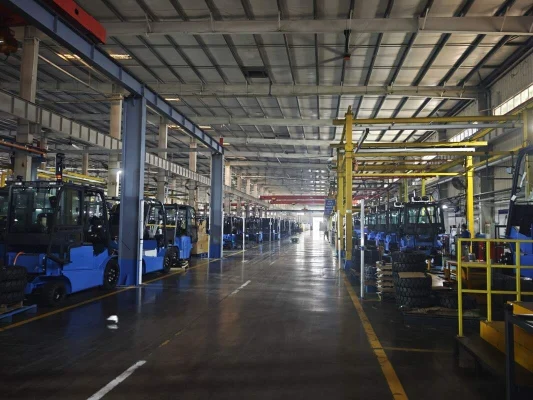
Matching the Truck to Doorways and Racking: A Measurement Procedure
Step 1: Survey every opening on the route
Measure the clear opening height and width of each doorway, not the nominal door size. Record the lowest point of any roller shutter, dock seal, or header. Include the route between the dock and the storage area: a truck that fits the main door may not fit a service corridor. Note floor transitions, because a ramp or a dock plate changes the effective clearance as the truck pitches.
Step 2: Map the racking
For each beam level, record the underside height of the beam and the top of the highest pallet position. Add the pallet and load height to the beam height to find the fork height the task requires. Then check the truck’s extended height at that lift and the free-lift available at the beam underside. If a beam sits lower than the point where the inner mast starts to rise, free-lift is essential; if not, a simpler mast may be adequate.
Step 3: Confirm the load and load centre
Rated capacity is stated at a specific load centre, usually 500 mm or 600 mm. A longer load, a non-standard pallet, or an attachment moves the centre forward and reduces the capacity that can be lifted to full height. Ask the supplier to confirm the residual capacity at your actual load centre and lift height, not just the headline rating. This is also where the truck’s own dimensions, such as overall width and turning radius, must be compared with the aisle width.
Step 4: Check the supplier’s data sheet against your numbers
Request the mast drawing and the dimension sheet that apply to the exact configuration quoted. Confirm the collapsed height with the standard carriage and fork position, the overhead guard height, the free-lift stroke, and the extended height at the maximum lift you need. Ask whether the quoted figures assume a specific tyre type or battery, because either can change the standing height.
Step 5: Verify on site before committing
Where possible, arrange a demonstration with the proposed configuration at the actual doorway and in the actual aisle. Measure the clearance with a tape at the tightest point and confirm the mast collapses fully with the forks in the travel position. A demonstration resolves questions that a data sheet cannot, such as whether an operator can see the fork tips over a high load near a low beam.
Comparison table: what to check and what to ask
| Item | Why it matters in this application | What to confirm with the supplier | Typical status |
|---|---|---|---|
| Overhead guard height | Sets the lowest doorway the truck can pass | Exact figure with the quoted tyres and battery | Fixed by truck structure |
| Collapsed mast height | Must clear the doorway header with the forks down | Dimension drawing with standard carriage and forks | Depends on mast type |
| Free-lift stroke | Allows lifting under low beams without extending the mast | Full or partial free-lift, and the stroke figure | Option; not every mast has it |
| Extended height at working lift | Must clear sprinklers and roof structure at the top beam | Height at your required lift, not only at maximum lift | Depends on mast and lift height |
| Residual capacity at load centre and height | Long loads or attachments reduce what can be lifted | Capacity chart at your actual load centre | Requires confirmation |
| Aisle width and turning radius | Determines whether the truck can manoeuvre at the rack face | Turning radius and right-angle stacking data | Requires confirmation |
The table distinguishes what is fixed, what is optional, and what must be confirmed from documentation. Do not assume a free-lift mast is standard on every truck, and do not treat a brochure figure as valid without the matching configuration details.
Common mistakes that cause a bad fit
- Using the door’s nominal height. The clear opening is smaller once the shutter box and frame are counted.
- Checking only the main entrance. The route to the storage area often includes a lower opening.
- Confusing free-lift with lift height. Free-lift changes how the mast extends, not how high the forks can ultimately reach.
- Ignoring the load. A pallet taller than expected raises the fork height needed at each beam and may change the mast choice.
- Overlooking the operator’s view. A high load close to a low beam restricts visibility; this is a working-condition issue, not just a dimension.
Where a four-wheel counterbalance truck may not be the right answer
Very narrow aisles, very low mezzanines, and doorways below the guard height can fall outside what a four-wheel counterbalance electric forklift can reasonably serve. In those cases the honest conclusion may be to modify the building, change the storage layout, or reconsider the handling method. A supplier should say so rather than promise a configuration that cannot meet the measurement.
Frequently Asked Questions
Can I lower the overhead guard to fit a doorway?
The overhead guard is a structural protective feature, and its height is set by the truck design. It is not a field-adjustable dimension to trim to a door. If the guard does not clear the opening, the practical options are to change the route, alter the doorway, or select a different truck class. Ask the supplier to confirm the guard height that applies to the exact configuration quoted.
Does free-lift reduce the maximum lift height?
Free-lift changes the sequence in which the mast sections extend, allowing the carriage to rise before the inner channel moves. It does not by itself remove the truck’s ability to reach its rated lift height. The mast specification states both the free-lift stroke and the maximum lift, and both should be checked against the racking.
What if the doorway is fine but the rack beams are low?
This is exactly the case where free-lift helps: the forks can be raised to the beam underside while the mast remains compact. Confirm the free-lift stroke covers the height difference between the collapsed position and the beam underside, and check that the load height still fits beneath the beam.
Which measurements should I send when requesting a quote?
Send the clear height and width of every doorway on the route, the underside height of each rack beam, the top pallet height, the pallet dimensions and weight, the load centre, the aisle width, and any ramps or floor transitions. These figures let the supplier match a mast and guard height to your building instead of quoting from a general specification.
Do tyre type and battery choice affect the height figures?
They can. Tyre size and type, and the battery fitted, influence the truck’s standing height, and therefore the overhead guard and collapsed mast dimensions. Confirm the figures with the exact tyre and battery specification quoted, and ask whether the data sheet assumes a different configuration.
Before you order: the data checklist
Collect the doorway clear heights and widths, the lowest overhead obstruction on the route, the rack beam underside heights, the maximum pallet and load height, the load weight and load centre, the aisle width, and the floor and ramp conditions. Then ask the supplier to confirm the overhead guard height, collapsed mast height, free-lift stroke, extended height at your working lift, residual capacity at your load centre, and turning radius, all with the quoted tyres and battery. A four-wheel counterbalance electric forklift can serve many low-clearance doorways and racking layouts, but only when these numbers are checked against the building rather than assumed.