Comparing Four-Wheel Counterbalance Electric Forklift Configurations: Load Center, Mast Type and Site Conditions Buyers Must Reconcile
News 04/11/2026
A four-wheel counterbalance electric forklift is a major purchase, and the configuration you choose determines whether it handles your loads safely and efficiently or becomes a source of downtime. This comparison focuses on three interrelated decisions: load center, mast type, and site conditions. These factors must be reconciled because a change in one affects the others. The goal is to help you ask the right questions and specify a truck that matches your actual operation.
Load Center: The Rating Basis That Changes With Attachments
Load center is the horizontal distance from the vertical face of the forks to the center of gravity of the load. Forklift capacity ratings are typically stated at a specific load center, often 24 inches (600 mm). When the actual load center is greater—because the load is deeper or an attachment moves it forward—the allowable capacity decreases. This relationship is not linear and must be obtained from the manufacturer’s load chart.
Buyers often compare capacity numbers without checking the load center at which they apply. A truck rated 5,000 lb at 24 inches may have a significantly lower capacity at 36 inches. If your loads are palletized and uniformly stacked, the load center may be close to the rating point. But if you handle long items, double-deep pallets, or attachments such as push-pull or clamp, you need a capacity rating at the actual load center.
To reconcile load center with your needs:
- Measure the depth of your deepest load and estimate its center of gravity.
- Confirm the load center at which the truck’s capacity is rated.
- If an attachment is used, obtain the attachment’s load center shift and the resulting derated capacity.
- Check that the truck’s capacity at your load center exceeds your heaviest load by a safe margin.
Without a load chart, you cannot assume that a higher capacity number means more capability. Always request the rating at your specific load center.
Mast Type and Lift Height: Matching the Mast to the Work
The mast determines lift height, visibility, and overall truck dimensions. Common mast types include simplex (two-stage), duplex (two-stage with free lift), and triplex (three-stage with free lift). Each has trade-offs.
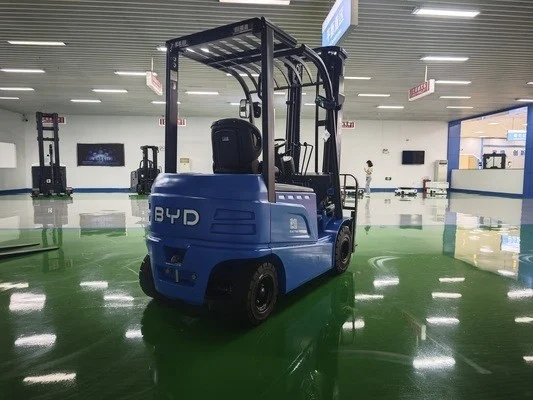
A simplex mast offers good visibility and simple construction but limited lift height and no free lift. Free lift allows the forks to rise without increasing the mast height, which matters in low-clearance areas such as trailers or containers. A duplex mast with free lift is often used when lifting to moderate heights and entering low openings. A triplex mast provides higher lift in a collapsed height similar to a duplex, but the additional stages can reduce forward visibility and add weight.
When comparing masts, consider:
- Required lift height: The highest shelf or stack you need to reach, plus clearance.
- Free lift: Needed if you work inside trailers, containers, or low-clearance areas.
- Collapsed height: Must fit through doorways and under overhead obstructions.
- Visibility: More stages can obscure the load at height; evaluate with the mast extended if possible.
- Capacity at height: Capacity decreases as lift height increases; check the load chart.
No mast type is universally best. The right choice depends on your lift height profile and the spaces you enter. A common mistake is selecting a mast that meets the maximum lift height but ignores free lift needs, leading to inefficient double-handling.
Site Conditions: Floor, Aisle, Ramp and Power
Site conditions affect stability, productivity, and power requirements. Four-wheel counterbalance electric forklifts are common in warehouses and manufacturing, but their suitability depends on specific factors.
Floor and Aisle
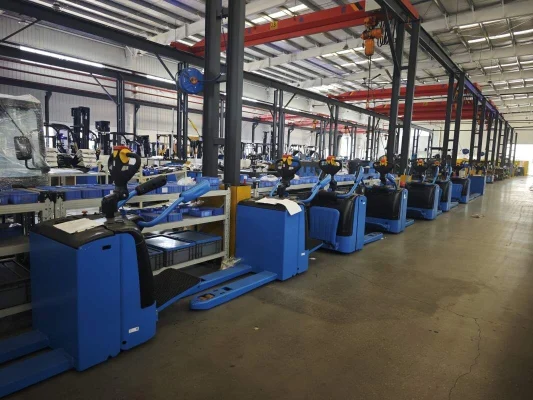
Floor condition influences tire choice and ride comfort. Smooth concrete is typical, but cracks or uneven surfaces may require different tires. Aisle width must accommodate the truck’s turning radius and the load. Four-wheel trucks generally have a larger turning radius than three-wheel models, so aisle width is critical. Measure your narrowest aisle and compare it to the truck’s right-angle stacking aisle requirement, which the manufacturer provides.
Ramps and Slopes
Electric forklifts can operate on ramps, but gradeability and stability must be checked. The manufacturer’s gradeability specification is typically for a specific load and surface. Never exceed it. On ramps, load orientation (forks pointing uphill) and speed control are important. If your site has ramps, confirm the truck’s rated gradeability with your expected load.
Power and Charging
Battery capacity and charging infrastructure affect uptime. Lithium-ion batteries allow opportunity charging, which can suit multi-shift operations, but you need to confirm the charger and site power capacity. Lead-acid batteries typically require dedicated charging rooms and longer charging times. The choice depends on your shift pattern and available space. Without site power details, you cannot determine the right battery and charger combination.
Reconciling these factors means checking that the truck’s dimensions, capacity, and power system align with your actual environment. A truck that is perfect on paper may not fit your aisle or charging area.
Frequently Asked Questions
How does load center affect capacity on a four-wheel counterbalance electric forklift?
Capacity decreases as load center increases. The manufacturer’s load chart shows the allowable capacity at various load centers. You must use the capacity at your actual load center, not the nominal rating.
What is free lift, and when do I need it?
Free lift allows the forks to raise without increasing the mast height. You need it when working in low-clearance areas such as trailers or containers, where the mast cannot extend upward.
Can I use a four-wheel counterbalance electric forklift on ramps?
Yes, but you must verify the truck’s gradeability rating with your load and surface conditions. Exceeding the rating can compromise stability and safety.
How do I choose between lithium-ion and lead-acid batteries?
Consider your shift pattern, charging infrastructure, and space. Lithium-ion allows opportunity charging and may suit multi-shift operations, while lead-acid typically requires dedicated charging areas and longer charge times. Confirm with your site power assessment.
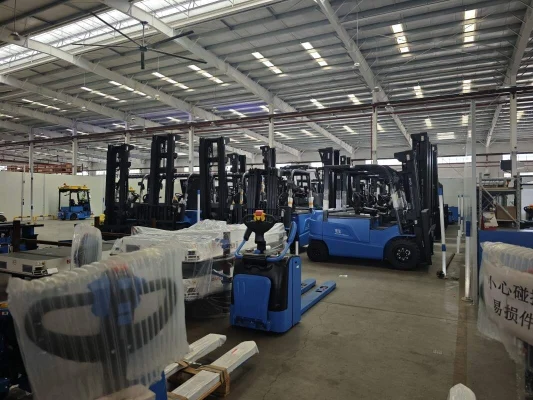
To specify a four-wheel counterbalance electric forklift that fits your operation, gather your load details, lift height requirements, aisle dimensions, ramp grades, and charging conditions. Share these with a supplier who can provide load charts and confirm configurations. This site offers BYD four-wheel counterbalance electric forklifts; contact us with your actual conditions to discuss selection and options.