How Total Cost of Ownership Projections Shape BYD Forklift Price Assessments Among Industrial Procurement And Engineering Decision Makers
News 13/10/2026
Many industrial procurement teams first focus on upfront purchase cost when evaluating material handling equipment, but BYD forklift price assessments increasingly incorporate long-term total cost of ownership (TCO) projections. BYD produces electric forklifts, which have different cost structures than traditional internal combustion (IC) models, so TCO changes how decision makers rank options against budget and operational needs. This guide breaks down core concepts and practical steps to build accurate assessments aligned with long-term operational value.
Core Factors Beyond Upfront BYD Forklift Price
Upfront purchase cost makes up only a portion of total expense across a forklift’s service life. Many teams new to electric forklift evaluations prioritize initial sticker cost, which often sits higher than comparable IC forklift options from other brands. This initial gap can lead teams to dismiss BYD options without exploring long-term cost offsets that accumulate across years of use.
The Shift From Upfront Cost Focus To Long-Term Value
Industrial procurement teams now recognize hidden costs that accumulate across years of equipment use. These costs include energy, maintenance, downtime, battery replacement, and end-of-life processing. BYD’s lithium iron phosphate (LFP) battery technology changes many of these long-term cost elements, so accurate projections require updated modeling that accounts for these differences. Decision makers who rely solely on upfront cost miss these critical value differences between electric and IC forklift options.
How TCO Projections Change BYD Forklift Price Assessments
TCO projections reframe how decision makers measure value against available budget. A higher upfront BYD forklift price often translates to lower annual operating costs when compared to equivalent IC forklifts. Over a 5 to 10 year service life, these cumulative savings can offset the initial price difference entirely, resulting in lower net cost overall.
Alignment With Organizational Sustainability Goals
Many industrial operations now tie equipment purchasing decisions to company-wide carbon reduction targets. TCO models can incorporate cost savings associated with emissions regulations compliance and green incentives, which further adjust the perceived value of a BYD forklift relative to higher-emission alternatives. Decision makers can include these indirect value elements alongside direct operating costs to get a more complete assessment of net long-term cost.
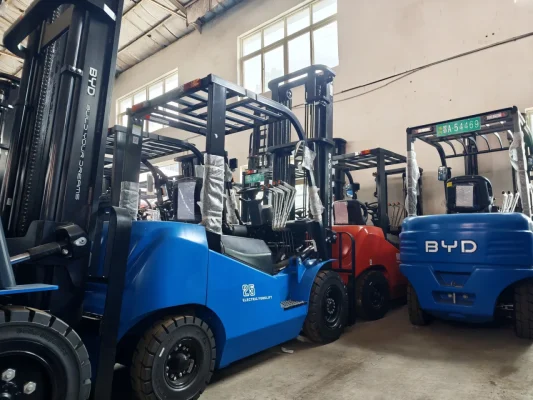
Key TCO Components Relevant To BYD Electric Forklifts
Accurate TCO projections require inclusion of all recurring and one-time costs across the equipment service life. Common components included in modern BYD forklift price assessments include:
- Energy consumption costs: Electric power costs less per hour of operation than diesel or propane in most global markets. BYD’s energy-efficient drive systems further reduce hourly energy use compared to older electric and IC models.
- Maintenance requirements: Electric forklifts have far fewer moving parts than IC models, so they require less routine maintenance. No oil changes, filter replacements for combustion systems, or regular tune-ups cut annual maintenance expenses dramatically.
- Battery service life: BYD’s LFP batteries typically deliver 10,000 to 15,000 charge cycles, which matches the full service life of most forklifts. Many competing electric models require battery replacement mid-service life, adding a large unexpected expense that BYD owners avoid.
- Downtime costs: Fewer maintenance needs and fewer breakdowns reduce unplanned downtime. Unplanned downtime cuts operational output, so reduced downtime directly translates to lower indirect costs associated with lost production.
Each of these components adjusts the net long-term BYD forklift price, making upfront cost a less relevant metric when evaluated alone. Teams that ignore these components often make purchasing decisions that increase long-term operational expenses.
Practical TCO Modeling Steps Procurement Teams Use
Teams can build accurate TCO projections following these structured steps to get a clear picture of net long-term cost:
1. Map Operational Usage Parameters
Start by documenting daily run time, load capacity requirements, work environment, and expected service life of the new forklift. These parameters directly impact energy use, wear and tear, and replacement needs. A forklift used 8 hours daily will have different cumulative cost projections than one used 24 hours across multiple shifts.
2. Input All Upfront And Recurring Costs
Include the upfront BYD forklift price, delivery and installation costs, charging infrastructure investment, annual energy costs, annual maintenance, and any applicable taxes or fees. Allocate one-time infrastructure costs across the entire fleet of electric forklifts to avoid overestimating cost for a single unit if multiple units will share charging equipment.
3. Compare Against Competing Options
Run the same TCO model for all competing forklift options, including IC and other electric brands. Use the same usage parameters and cost assumptions for all options to ensure an apples-to-apples comparison. This step will highlight any gaps between upfront price and long-term net cost across available options.
4. Adjust Risk And Uncertainty Assumptions
Energy prices and maintenance costs can change over time. Build in sensitivity analysis to test how changing cost assumptions impact total TCO. BYD forklifts often remain the lower long-term cost option even when energy prices shift, due to their higher efficiency relative to IC models.
Frequently Asked Questions
Does higher upfront BYD forklift price always translate to better long-term value?
Not always. Value depends on your operational usage. Facilities that use a forklift fewer than 10 hours weekly may not accumulate enough operating cost savings to offset the higher initial price. High-usage multi-shift operations almost always see greater net savings with a BYD electric forklift.
Where can I get accurate TCO data to assess BYD forklift price?
Authorized BYD forklift distributors can provide standardized TCO calculation tools tailored to your operational parameters. Always verify assumptions around battery life, energy use, and maintenance costs with your own operational historical data to get the most accurate projection.
Do TCO projections include end-of-life value for BYD forklifts?
Most standard TCO models can incorporate residual value at end of service life. BYD LFP batteries hold recoverable material value at end of life, which adds a small residual value that many IC forklift engines do not offer. You can add this value to your projection to get a more complete net cost calculation.
Can small operations benefit from TCO-based BYD forklift price assessments?
Yes. Even smaller operations with one or two forklifts can see long-term savings from lower operating costs. Small businesses with limited maintenance staff also benefit from reduced maintenance requirements, which cuts time spent on equipment upkeep alongside direct cost savings.