Choosing a Four-Wheel Counterbalance Electric Forklift Charger: Matching Output, Connector Type and Charge Window to Your Fleet
News 07/11/2026
A charger that suits one four-wheel counterbalance electric forklift can be a poor match for another, even when both trucks look similar on the floor. The three variables that decide whether a charger works well are output, connector type and the charge window your operation can actually offer. Get any one of them wrong and you face slow turnaround, nuisance faults, connector damage or a battery that never receives a full charge. This guide walks through each variable in turn, then shows how to combine them into a purchase decision you can defend.
Output: Voltage, Current and What the Battery Can Accept
Output is the first filter, because a charger that cannot deliver the right voltage and current will either underperform or push the battery beyond its limits. Read the battery nameplate and the truck’s technical documentation before looking at charger ratings. The nameplate normally states nominal voltage, ampere-hour capacity and the maximum charge current the battery maker permits. Treat those figures as the ceiling.
Voltage must match the battery’s nominal system voltage. A charger rated for a different nominal voltage is not a candidate, regardless of its current rating. Current is where judgement enters. A higher output current shortens charging time, but only within the limit the battery accepts and within the capacity of the charging circuit feeding the charger. The charger’s input requirements matter too: confirm the available supply voltage, phase and current capacity at the intended charging location, and check whether the building circuit and protection devices can support the charger’s input draw. These are site electrical questions, and a qualified electrician should confirm them.
Two further points deserve attention. First, charger output specifications should be read together with the charging profile the charger applies, because the profile determines how current tapers as the battery fills. Second, if the truck uses a lithium battery, confirm that the charger is intended for that battery chemistry and its battery management system; a charger configured for a different chemistry is not interchangeable. Where the manufacturer’s technical data does not state a figure you need, ask the supplier to confirm it rather than estimating.
Questions to settle before comparing charger ratings
- What nominal voltage and capacity does the battery nameplate show?
- What maximum charge current does the battery documentation permit?
- What supply voltage, phase and current capacity is available where the charger will stand?
- Does the charger’s stated profile match the battery chemistry installed on the truck?
Connector Type and the Charge Window
Connector type is a physical compatibility question with real consequences. Battery connectors vary in housing shape, contact arrangement and current rating, and a charger fitted with the wrong connector will not mate with the truck, or will mate poorly and create heat and wear at the contacts. Identify the connector on the truck’s battery cable and specify the same type on the charger. Do not assume that two connectors of similar appearance are interchangeable; check the part number and current rating against the supplier’s documentation. If the fleet contains trucks with different connectors, decide whether to standardise on adapters, order chargers with matching connectors per truck, or plan a connector changeover, and confirm with the supplier which option their product supports.

The charge window is the time your operation can give a truck to charge, and it is often the constraint that decides the output rating. Map the working pattern honestly: shift length, the number of trucks sharing each charger, the time each truck actually spends parked, and whether charging happens during breaks, between shifts or overnight. A window that looks generous on paper shrinks when trucks queue at a single charger or when a truck returns late.
Use the window to test whether a candidate charger is realistic. Take the energy a truck consumes in a shift, derived from the battery capacity and the depth of discharge you expect, and compare it with what the charger can deliver in the available window. If the arithmetic leaves little margin, either the window, the charger output or the number of chargers needs to change. This is a planning exercise based on your own figures; the supplier should confirm whether a specific charger can meet the resulting requirement.
| Decision point | What to check | Risk if overlooked |
|---|---|---|
| Voltage | Battery nominal voltage versus charger rating | Charger unsuitable; do not use |
| Current | Battery maximum charge current and site supply capacity | Overloaded circuit or battery charged beyond its limit |
| Chemistry | Charger profile versus installed battery type | Incorrect charging behaviour and possible battery damage |
| Connector | Housing, contact arrangement, current rating | No mating, arcing, heat and contact wear |
| Charge window | Shift pattern, trucks per charger, parked time | Insufficient turnaround between shifts |
Turning the Three Variables into a Purchase Decision
Work through the variables in a fixed order so that one decision does not undermine another. Start with the battery and truck documentation to fix voltage, capacity, permitted charge current and chemistry. Then survey the charging location to confirm supply capacity and the space available. Then record the connector on each truck. Only after those facts are on paper should you compare charger models, because output and connector requirements will already have narrowed the field.
Next, test the charge window against the shortlisted chargers. If a truck must be ready at the start of the next shift, calculate the energy it needs and the time the charger will have, allowing for the fact that charging slows as the battery approaches full. Keep a margin rather than planning to the last minute. Where the fleet runs several trucks, decide how many chargers the window requires, not just which single charger to buy.
Finally, confirm the details that are easy to miss in a quotation: the connector specified, the charging profile, the input requirements, the installation conditions the supplier expects, and the documentation that will be delivered with the unit. Ask the supplier to state these in writing. A charger is part of a system that includes the truck, the battery, the building electrical installation and the working schedule, so the purchase decision should show that all four have been considered together.
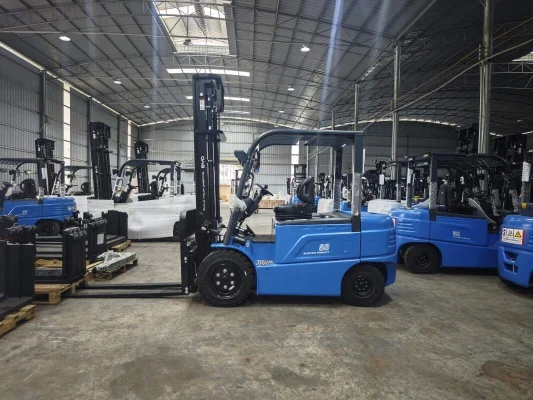
If you are buying a four-wheel counterbalance electric forklift from this site, share your actual duty cycle, load and lift height, battery details and charging location when you request a configuration. That information lets the selection discussion cover the truck and its charger as one package rather than two separate purchases.
Frequently Asked Questions
Can I use one charger across several counterbalance trucks?
Only if the charger’s voltage, current and charging profile suit every battery it will serve, and every truck has a compatible connector. Trucks with different battery chemistries or connector types usually need separate arrangements. Confirm compatibility with the charger supplier before sharing a unit.
Does a higher-output charger always shorten turnaround?
Not reliably. The battery’s permitted charge current and the charging profile limit how much current it will accept, and the site supply may cap the charger’s input. A higher rating that exceeds those limits does not help and may be unsuitable.
What should I check on the connector before ordering?
Compare the connector on the truck’s battery cable with the charger’s specified connector: housing shape, contact arrangement and current rating. Use part numbers where available rather than visual similarity, and ask the supplier to confirm the match in writing.
How do I know whether my charge window is realistic?
Estimate the energy each truck uses per shift and the time it will actually be parked at the charger, allowing for slower charging near full and for any queueing. If the result leaves little margin, adjust the window, the charger output or the number of chargers before committing.