Specifying Four-Wheel Counterbalance Electric Forklift Trucks: Matching Load Centers and Mast Height to Your Actual Lift Profiles
News 30/10/2026
Most electric forklift truck specification errors start with a single number: the rated capacity on the data plate. That figure applies only at a defined load center, usually 500 mm or 600 mm, with a standard mast and no attachment. Once your real lift profile differs—a longer load, a taller rack, a clamp, a wet or cold floor—the capacity that matters is the residual capacity at your actual load center and lift height. This article explains how to read those two variables together and how to turn them into a specification you can verify at delivery.
Why Load Center and Mast Height Must Be Read Together
Load center is the horizontal distance from the fork face to the center of gravity of the load. Mast height is the vertical distance the load must rise. Both change the load moment that the truck must resist, and both reduce usable capacity as they increase. A truck rated at a nominal capacity at a 500 mm load center will not carry the same mass at a 700 mm load center, and the derating is not a simple linear guess—it comes from the manufacturer’s capacity chart, which should be requested as a document rather than inferred.
Three practical consequences follow:
- Pallet depth matters. A load that overhangs the fork tips shifts the center of gravity outward. Measure the real load, not the pallet footprint alone.
- Lift height matters even before full height. Capacity charts usually list several heights; the residual capacity at your highest pick and place point governs the specification.
- Attachments change the geometry. A side-shifter, clamp, or rotator adds forward offset and its own weight, so the residual capacity must be recalculated with the attachment fitted.
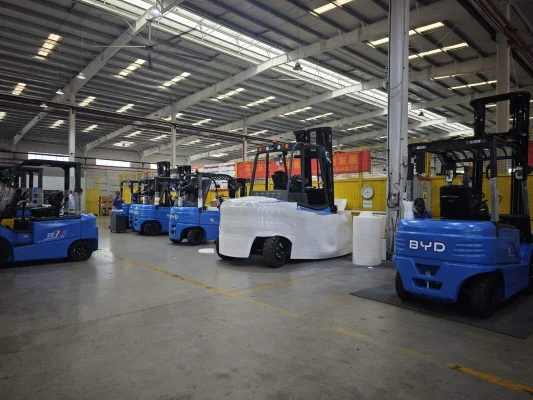
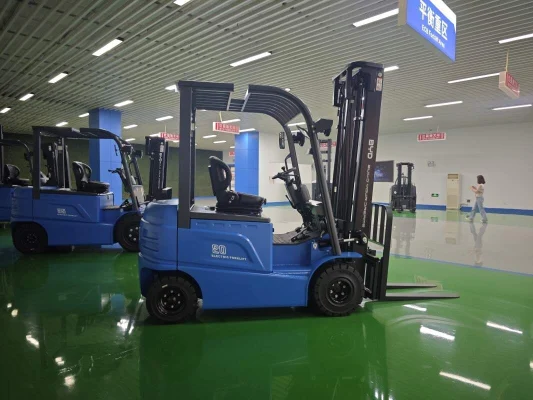
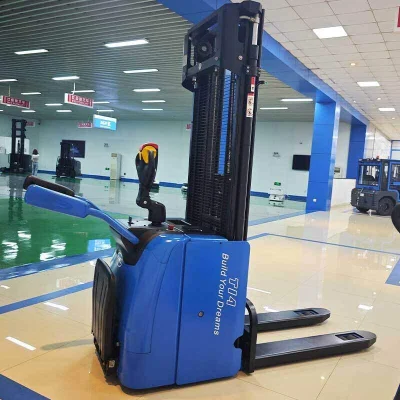
This is the core reason a four-wheel counterbalance electric forklift is specified from a lift profile rather than from a single capacity figure. The same logic applies to any electric forklift truck, but the four-wheel layout is the common general-purpose choice in factories, loading docks, and warehouse transfer work, where stability under load and outdoor-to-indoor movement are frequent requirements.
Building the Lift Profile an Electric Forklift Truck Must Satisfy
A lift profile is a short written record of what the truck actually does. It is more useful than a list of wishes because it lets a supplier check the capacity chart against real numbers. Collect the following before discussing models or configurations.
Load data
- Maximum load mass, including packaging, and the heaviest single item you expect.
- Load dimensions and the distance from the fork face to the load’s center of gravity.
- Whether loads are uniform pallets or variable, and whether attachments will be used.
Height and reach data
- Highest pick height and highest place height, measured to the fork surface or the load base, and stated consistently.
- Whether the truck must pass under low doorways or rack beams when the mast is lowered—this affects mast type and overall lowered height.
- Any need to lift while travelling, which many operations prohibit and which changes the duty cycle.
Site and duty data
- Aisle width, turning radius available, and whether racking or rack legs narrow the path.
- Floor condition, slope, dock plates, and whether the truck moves between indoor and outdoor surfaces.
- Shift length, number of lifts per shift, and charging windows, including whether opportunity charging is possible.
- Ambient conditions: temperature range, moisture, dust, washdown, or cold-store work.
An illustrative profile (hypothetical)
Consider a hypothetical distribution centre that receives palletised goods at a dock and puts them away in racking at 6 m. Loads are 1,200 mm deep, the heaviest pallet is declared at 1,000 kg, and the aisle is narrow enough that the operation wants to confirm turning clearance before choosing a model. This profile does not tell us which truck to buy. It tells us which documents to request: the capacity chart at the actual load center and at the highest lift height, the turning radius and right-angle stacking aisle requirement, and the mast lowered height. The 1,000 kg figure is a load declaration, not a truck rating.
Parameters to Verify, Configure, and Confirm with the Supplier
The table below separates what is usually a standard specification item, what is typically a configuration choice, and what must be confirmed against the manufacturer’s technical data. It is a checklist structure, not a claim that any particular model offers these options.
| Parameter or configuration | Why the operation cares | How to verify or state it | Trade-off or limit |
|---|---|---|---|
| Residual capacity at actual load center and lift height | Governs safe handling of the real load | Request the capacity chart; state load center and height in the inquiry | Capacity falls as load center and height rise; charts are model-specific |
| Mast type and lowered height | Determines doorway and rack-beam clearance | State the lowest obstruction on site; confirm lowered height on the data sheet | Taller lift usually means a taller mast; free-lift options may be needed |
| Attachment (side-shifter, clamp, rotator) | Changes offset and adds weight | Name the attachment and ask for residual capacity with it fitted | Reduces capacity and may require a different mast or carriage |
| Turning radius and aisle requirement | Confirms the truck fits the aisle | Compare against measured aisle width and rack configuration | A four-wheel counterbalance truck needs more aisle than some other designs; confirm rather than assume |
| Battery and charging arrangement | Affects shift coverage and charging space | State shift pattern and available charging time; confirm charger and battery specification | Charging infrastructure and battery type must match the duty cycle; confirm with the supplier |
| Operating temperature range | Cold stores, freezers, and outdoor docks | Ask for the stated operating, storage, and charging temperature ranges | Cold conditions affect usable battery capacity and charging; confirm derating and any cold-store configuration |
| Floor, slope, and tyre type | Affects traction, braking, and stability | Describe surfaces, gradients, and dock plates; confirm tyre and brake specification | Wet or sloped surfaces change safe working practice; no tyre choice removes the need to assess the route |
Cold-store and washdown considerations
If the truck will enter a cold store, distinguish continuous in-store work from frequent crossings between temperature zones. Ask specifically about the battery’s operating and charging temperature limits, whether the battery management system restricts charge or discharge at low temperature, and what cold-store configuration the manufacturer offers. Condensation, sealed wiring, display behaviour, hydraulic oil viscosity, and floor grip are legitimate questions, but the answers must come from the manufacturer’s documentation rather than from general assumptions. A four-wheel counterbalance electric forklift can suit many cold-store transfer tasks, but the aisle width, rack height, and load center still decide whether it fits the building.
Common specification errors
- Quoting capacity at a standard load center while the real load sits further out.
- Choosing lift height from the rack’s top beam rather than the required fork or load height.
- Ignoring the mast’s lowered height and discovering a doorway conflict after delivery.
- Adding an attachment without asking for the revised residual capacity.
- Assuming a charging window without checking the battery and charger specification.
Frequently Asked Questions
Does a higher lift height reduce capacity even when I lift a light load?
The capacity chart defines the maximum load at each height and load center. A light load may be well within the limit, but the limit itself changes with height. Use the chart at your highest working height and confirm with the supplier rather than extrapolating.
Can I specify a truck from the load weight alone?
No. Load weight, load center, lift height, attachment, and aisle dimensions together define whether a truck is suitable. A capacity figure without the load center and height attached to it is incomplete.
What should I send when requesting a quotation?
Send the heaviest load and its dimensions, the distance from the fork face to the load center, highest pick and place heights, aisle width, floor and slope conditions, shift pattern and charging windows, and any temperature or washdown exposure. Ask for the capacity chart, mast dimensions, turning radius, and battery and charging specifications in writing.
How do I check the specification at delivery?
Compare the data plate and capacity chart with the agreed documents, confirm the mast and attachment fitted, and verify that the delivered configuration matches the quotation. Record any deviation before putting the truck into service.
To move from a lift profile to a concrete proposal, share your load, height, aisle, and shift data with our team so the selection and configuration of BYD four-wheel counterbalance electric forklifts can be checked against your actual working conditions.