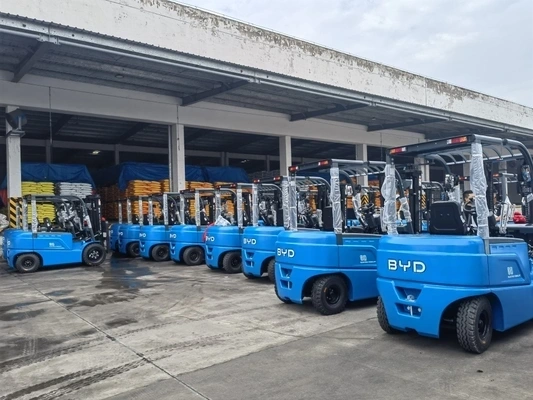
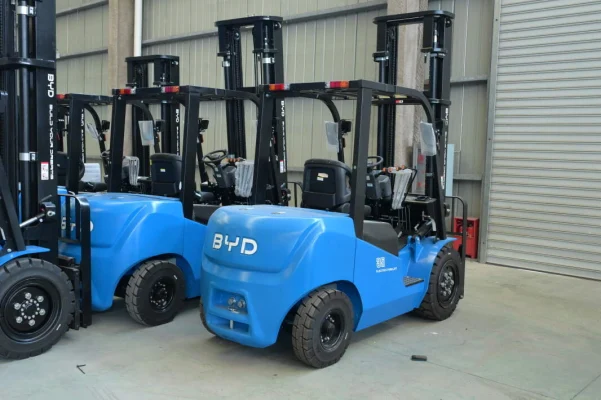
Specifying a Four-Wheel Counterbalance Electric Fork Lift Truck: Duty Cycle, Attachment Loads, and Capacity Margins That Hold Up in Production
News 01/11/2026
A four-wheel counterbalance electric forklift is often the default choice in general factory, loading, and warehouse transfer work, but the specification that survives daily production is rarely the one written from a catalogue headline. The useful starting point is a realistic duty cycle, a realistic attachment plan, and a clear understanding of how rated capacity changes once load center, lift height, and attachments move away from the test conditions. This article explains how to turn those three inputs into a specification you can check with a supplier, and where the honest limits of a counterbalance truck sit.
Start with the duty cycle, not the model number
A duty cycle describes what the truck actually does across a shift: how often it lifts, how far it travels, how high it lifts, how much time it spends loaded versus empty, and how the shift pattern interacts with charging. Two operations with the same payload can place very different demands on a truck.
Data worth collecting before you talk to a supplier
- Number of pallets or loads moved per shift, and the peak hour rather than the average.
- Typical and maximum load weight, including packaging and any attachment weight.
- Lift height used in normal work, plus the highest lift the truck will ever need.
- Travel distance per trip and the number of shifts per day.
- Floor condition, ramps or slopes, thresholds, and the narrowest aisle the truck must enter.
- Charging windows: when the truck is available, where the charger is, and whether opportunity charging is realistic.
These figures let a supplier match battery capacity, motor rating, and hydraulic performance to your real pattern instead of a generic claim. Where you cannot measure a value, say so and agree on a trial or measurement method rather than accepting an assumed number.
Why the peak hour matters more than the average
A truck sized to the average shift may perform well in quiet periods and fall short during the busiest hour, when heat, hydraulic demand, and battery draw all peak together. Ask the supplier how the proposed configuration behaves during your peak hour, and what evidence supports the answer. If no evidence is available, treat the configuration as unverified and plan a supervised trial.
Attachments and load center: where rated capacity changes
Rated capacity is normally stated at a defined load center and lift height, often with a standard carriage. Clamp attachments, push-pull units, rotators, fork positioners, and similar devices move the load forward, add their own weight, and can reduce the load the truck can safely handle at height. The same applies when a load sits further out on the forks than the rated load center.
Questions that reveal the real capacity margin
- What is the rated capacity at the load center and lift height we actually use, not only at the standard test point?
- How much does the attachment weigh, and how does it shift the load center?
- Does the supplier provide a derated capacity chart covering our attachment, lift height, and load center?
- What mast, carriage, and hydraulic configuration does the attachment require?
- Are there restrictions on lifting a rated load while the attachment is actuated?
A capacity margin is not a fixed percentage you can apply blindly. It is the difference between what the truck can handle under your actual conditions and what you intend to lift. The only defensible way to establish it is a capacity chart or written confirmation that reflects your attachment and lift geometry. If that document does not exist, the specification is incomplete.
Common specification mistakes
- Quoting capacity at ground level and then using the truck at full mast height.
- Adding an attachment after the truck is ordered, without recalculating capacity.
- Assuming a heavier truck automatically solves an attachment load problem; it may, but only if the capacity chart confirms it at your load center and height.
- Ignoring the weight of the attachment itself when estimating the load.
- Selecting a mast height that fits the building but not the highest rack beam.
Matching the four-wheel counterbalance truck to the workplace
Four-wheel counterbalance electric trucks suit many general factory and warehouse transfer tasks because they combine a stable chassis with the ability to lift loads onto racks and vehicle beds. They are not automatically the right answer everywhere. Narrow aisles, very high lifts, and tasks built around pallet movement at floor level may point to other truck types, and a counterbalance truck should not be forced into a layout it cannot serve safely.
Parameters that decide whether the truck fits
| Parameter | Why it matters in production | What to confirm with the supplier |
|---|---|---|
| Rated capacity and load center | Determines the heaviest safe load at your actual geometry | Capacity chart at your lift height, load center, and attachment |
| Lift height and mast type | Must reach the highest rack beam without exceeding free-lift or overhead clearance | Mast dimensions, overhead guard height, and collapsed height |
| Aisle width and turning radius | Decides whether the truck can work in your layout | Turning radius and right-angle stacking dimensions |
| Floor and slope conditions | Affects traction, braking, and stability | Permitted slope, floor flatness, and tyre options |
| Battery and charging | Sets how the truck fits shift patterns and charging windows | Battery capacity, charger rating, charging time, and opportunity-charging guidance |
| Operator environment | Affects comfort, visibility, and safe control | Cab or overhead guard options, lighting, and display layout |
Treat options as options. A supplier may offer different batteries, chargers, masts, and attachments, but not every combination is validated together. Ask which items are standard, which are optional, and which require factory confirmation.
An illustrative scenario, not a case study
Consider a hypothetical food-processing plant that moves palletised goods from a production line to a racking area, with one ramp between the two zones and a peak hour at shift change. The specification work would begin with peak pallet count, maximum load weight including the pallet, lift height at the racking face, ramp gradient, and the charging window between shifts. An attachment may be proposed to handle a specific load type; the next step is a capacity chart that reflects that attachment at the racking height. If the aisle at the racking face is too narrow for the truck’s turning radius, the layout or the truck type must change. None of these conclusions can be reached from a brochure alone.
Frequently asked questions
How much capacity margin should I allow?
There is no universal percentage. The correct margin comes from comparing your actual load, load center, lift height, and attachment against the manufacturer’s capacity chart. If your intended load is close to the charted limit, ask the supplier to confirm the configuration in writing or propose a higher-capacity configuration. Do not rely on a rule of thumb that ignores your geometry.
Can I add an attachment to a truck after delivery?
Sometimes, but the effect on capacity, hydraulics, and stability must be recalculated. An attachment added without an updated capacity chart leaves you without a verified safe working limit. Confirm the attachment, the required hydraulic configuration, and the revised capacity with the supplier before installation.
Is a four-wheel counterbalance truck suitable for narrow aisles?
It depends on the aisle width and turning radius. Counterbalance trucks need space to turn and stack. If your aisle is tighter than the truck’s right-angle stacking requirement, the layout or truck type needs review. Measure the aisle and confirm the turning dimensions rather than assuming a compact model will fit.
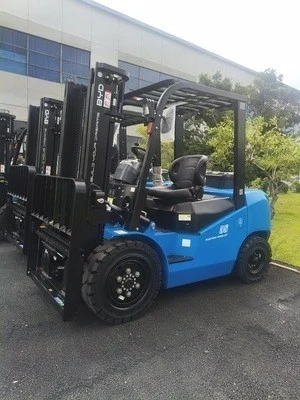
What charging information should I request?
Ask for the battery capacity offered, charger rating, expected charging time, and the supplier’s guidance on opportunity charging and battery temperature limits. Match these to your shift pattern and available charging windows. Where the supplier cannot confirm a value, treat it as an open item to resolve before purchase.
What should I have ready before requesting a quote?
Prepare peak and typical load weights, lift heights, load center, attachment details, aisle and door dimensions, floor and ramp conditions, shift pattern, and charging arrangements. These inputs let a supplier propose a configuration you can verify against a capacity chart rather than a generic recommendation.
If you are specifying a four-wheel counterbalance electric forklift and want to check a configuration against your real duty cycle, share your load, lift height, aisle, and charging details with our team so the selection and options can be discussed against the available technical information.