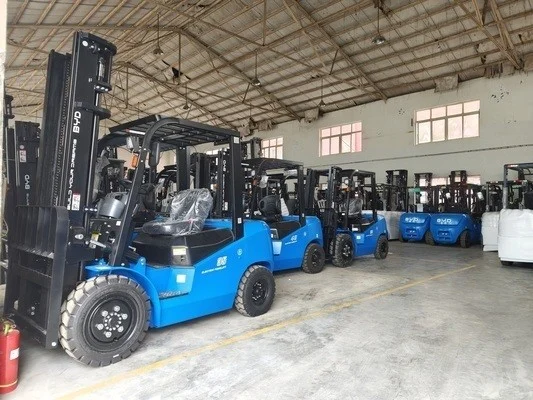
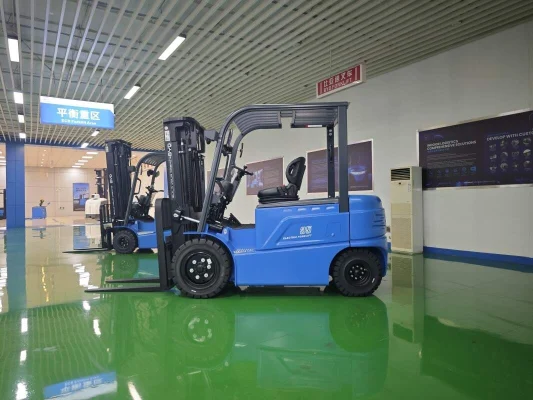
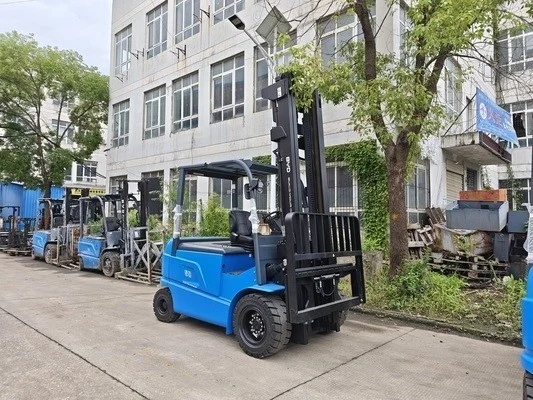
Specifying Industrial Forklift Lift Height and Mast Configuration: A Procurement Checklist
News 31/10/2026
Lift height and mast configuration are the two specification choices that most often cause rework in an industrial forklift procurement project. A buyer who fixes the maximum lift height before confirming the collapsed height, free lift, and rated capacity at height can end up with a machine that cannot enter the trailer, clear the rack beam, or handle the stated load at the top shelf. This checklist sets out the information to collect before you request a quotation, and the points to confirm in writing before you accept delivery.
The scope here is the four-wheel counterbalance electric forklift, the general-purpose configuration most commonly used in factories, loading docks, and warehouse transfer work. The principles apply to that family; other truck types have different geometry and capacity rules and should be assessed separately.
Start With the Real Lift Requirement
Lift height is not a single number. Record each of the following from the actual racking, trailer, or stacking task:
- Maximum lift height: the highest point the fork carriage must reach, measured at the fork surface.
- Required height at the load: the height needed to place or retrieve the load, which may differ from the rack beam height because of pallet and beam thickness.
- Collapsed (lowered) mast height: critical when the truck passes through doors, enters trailers, or works under mezzanines or sprinkler pipework.
- Overhead obstruction clearance: the lowest fixed obstruction along the travel route, not just at the rack face.
A common error is to specify lift height from the racking drawing alone. Walk the route with a tape measure and note every low point. If the collapsed height of the candidate mast exceeds a doorway or trailer opening, the truck may be unable to reach the work area at all, regardless of its lift capability.
Mast Configuration: What Each Option Changes
Mast stages and free lift determine how the truck behaves when lifting, and they trade off against visibility, collapsed height, and capacity retention. Ask the supplier to confirm which configuration matches your duty and to state the resulting specifications.
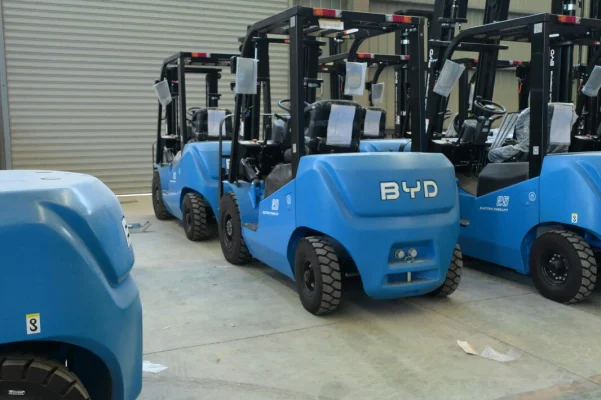
Simplex, Duplex, and Triplex Stages
A two-stage mast is generally adequate where lift heights are modest and collapsed height is not constrained. Three-stage masts reach higher while keeping the collapsed height lower, which matters in trailer loading and low-doorway sites. The trade-off is usually some loss of forward visibility through the mast and a different capacity curve; confirm both against the supplier’s data.
Free Lift and Its Practical Effect
Free lift is the amount the forks can rise before the mast itself extends. It is relevant wherever the truck lifts inside a trailer, container, or under a low ceiling, because the load must be raised to the bed height without the mast hitting the roof. Specify the free lift needed at the actual working height rather than accepting a default.
Capacity at Height and Load Centre
Rated capacity is normally quoted at a defined load centre. Capacity decreases as the load centre moves outward and, on many configurations, as lift height increases. If your loads are long, off-centre, or handled at full height, request the capacity chart and check the figure at your actual lift height and load centre. Do not assume the headline capacity applies everywhere in the lift range.
Information to Collect Before Requesting a Quotation
A complete enquiry shortens the specification cycle and reduces the risk of a mismatched machine. Gather the following and state it in the request:
- Maximum and typical load weight, plus load dimensions and load centre.
- Maximum lift height, required height at the load, and collapsed height limit.
- Lowest overhead clearance on the travel route.
- Aisle width and any turning constraints.
- Floor condition, including joints, ramps, and gradients.
- Shift pattern and available charging time or battery-change arrangements.
- Attachments required, since these affect residual capacity.
Where a figure is unknown, say so and ask the supplier which parameter needs to be measured. A quotation built on assumed heights is a quotation that may need revising.
Verification and Acceptance Points
Before signing off, compare the delivered machine against the agreed specification, not against a general brochure. Check the mast type and stage count, the collapsed height, the free lift, and the capacity chart supplied with the truck. Confirm that the data plate and the documentation match your order. Test the truck in the actual work area at the intended lift height with a representative load, and record any deviation in writing.
If the site conditions change later — new racking, a different trailer fleet, added mezzanine clearance — revisit the lift height and mast assumptions. These are not set-and-forget parameters. Buyers with measured site data can request a configuration review and a specification matched to their actual duty; the figures should come from the supplier’s technical documentation rather than from general estimates.
Frequently Asked Questions
Does a higher lift height always mean a larger mast?
Not necessarily. A three-stage mast can reach a given height with a lower collapsed profile than a two-stage design, but it may reduce visibility and alter the capacity curve. The right choice depends on your doorway and trailer clearances as well as the top shelf height.
Can I use the rated capacity at full lift height?
Only if the capacity chart confirms it at your load centre and lift height. Capacity typically falls as load centre and height increase, so check the specific figure rather than the headline rating.
What if I do not know my exact lift height yet?
Measure the racking, the trailer interior, and the lowest overhead obstruction first. If the racking is not yet installed, specify the planned height and ask the supplier to confirm the mast options that satisfy both the lift and collapsed-height limits.
Should attachments change the specification?
Yes. Attachments add weight and move the load forward, which usually reduces residual capacity. State the attachment in the enquiry so the supplier can confirm the derated capacity at your required lift height.