Industrial Forklift Turning Radius and Aisle Width: Checking Site Access Before Choosing a Four-Wheel Counterbalance Electric Truck
News 10/11/2026
An industrial forklift only works efficiently when it can enter, turn, lift, and leave within the space your building actually offers. Before you compare models, measure two things: the truck’s turning radius and the usable aisle width on your busiest route. A four-wheel counterbalance electric forklift needs enough clearance at the rear swing and at the load corners, and the aisle that matters is the narrowest one the truck must use, not the widest. This guide explains how those two numbers relate, which site measurements you need, and where a four-wheel counterbalance electric truck fits — and where it does not.
How Turning Radius and Aisle Width Work Together
Turning radius describes the arc a truck’s outer body follows during a turn. Manufacturers usually publish two values: the inner radius at the steer axle and the outer radius measured at the truck body. The outer figure is the one that governs aisle planning, because the counterweight and rear body swing outward as the truck pivots.
Aisle width is not a single fixed number. The space a truck needs depends on:
- The load length, including any overhang beyond the fork face
- Whether the truck must turn 90 degrees into a rack bay or merely travel straight
- The rack uprights, columns, door frames, and wall projections that reduce usable width
- The clearance the operator needs to align the load without striking the rack
A common planning mistake is to compare the published turning radius directly with the aisle width. The radius is measured from the center of the turn, not from the side of the truck, so the two figures are not interchangeable. The right approach is to obtain the truck’s dimension drawing and check the actual swept path against your aisle.
Site Measurements to Collect Before You Shortlist a Truck
Reliable selection starts with a site survey rather than a brochure. Walk the routes the truck will use and record the following. These measurements do not require special equipment, but they should be taken at the narrowest point, not the average.
| Measurement | Why It Matters | Where to Check |
|---|---|---|
| Narrowest aisle width | Determines whether a 90-degree turn is possible | Rack aisles, doorways, between machinery |
| Clear height | Limits lift height and overhead guard clearance | Door frames, sprinkler lines, mezzanines |
| Floor condition and slope | Affects traction, braking, and load stability | Ramps, dock plates, expansion joints |
| Load weight and center | Sets the required rated capacity at your lift height | Pallets, stillages, attachments |
| Turn points | Identifies where rear swing is most constrained | Rack ends, corners, cross-aisles |
| Charging location | Affects route length and battery strategy | Charging bay, break room, outdoor area |
Write down the load length and width as well. A truck may fit an empty aisle but fail once a long load projects beyond the fork tips. If your loads vary, plan around the largest common load, not the smallest.
Matching a Four-Wheel Counterbalance Electric Truck to the Route
A four-wheel counterbalance electric forklift is a general-purpose choice in many warehouse, dock, and production environments. Its stable four-wheel chassis and counterweight design suit straightforward travel, lifting, and truck loading. The trade-off is maneuverability: compared with a three-wheel or articulated design, a four-wheel truck generally needs more space to turn, so aisle width becomes a decisive constraint.
Use the following sequence to decide whether the route is compatible:
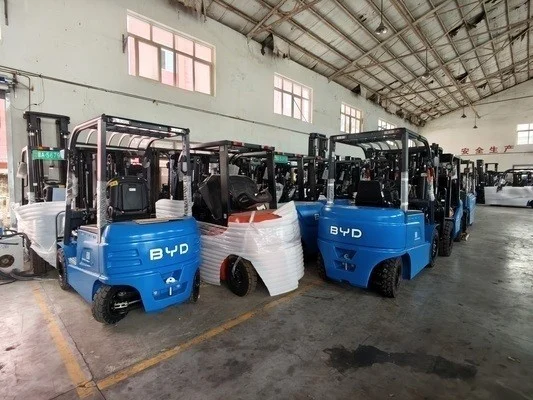
- Confirm the lift task. Check rated capacity at the load center and lift height you actually use. Capacity at the fork face is not the same as capacity at height with a long load.
- Compare the swept path. Ask the supplier for the dimension drawing and confirm the outer turning radius and rear swing against your narrowest turn point.
- Add operating clearance. Leave room to align the load and allow for operator variation. A truck that fits with no margin will slow every cycle.
- Check the floor and ramps. Slopes, dock plates, and uneven surfaces affect traction and braking. Verify these conditions with the supplier rather than assuming.
- Review the duty cycle and charging plan. Shift length and charging location shape the battery and charging configuration. Confirm these details with the supplier using your real schedule.
In a hypothetical scenario, a warehouse with a 3.0 m rack aisle and 90-degree turns into double-deep racking would need the truck’s swept path checked carefully before purchase. The same truck might be entirely suitable in a 4.5 m aisle with wide cross-aisles. The difference is the site, not the truck alone.
Where the aisle is genuinely too tight, the honest answer may be to change the rack layout, reduce load length, or reconsider the truck type. It is better to identify that before delivery than to discover it during the first shift. If your measurements suggest a four-wheel counterbalance electric truck is a candidate, share your aisle widths, load weights, lift heights, and floor conditions with our team so we can check the configuration against your site.
Frequently Asked Questions
Can I use the published turning radius as the minimum aisle width?
No. The published turning radius is measured from the center of the turn, while aisle planning needs the swept path of the truck body and load. Use the dimension drawing and check the outer radius and rear swing against your actual turn points.
Does a wider aisle always mean a larger truck is suitable?
Not automatically. Aisle width is one constraint among several. Rated capacity at your load center and lift height, floor condition, ramp slope, overhead clearance, and duty cycle all affect the choice. A truck that fits the aisle may still be the wrong capacity or configuration.
What if my aisle is too narrow a four-wheel counterbalance truck?
First confirm the measurement and the load dimensions; sometimes the constraint is a single rack end or door frame. If the route truly cannot accommodate the swept path, options include revising the layout, reducing load length, or reviewing a different truck type with the supplier. Do not assume a larger model will solve a tight-turn problem.
Which measurements should I send when requesting a selection check?
Send the narrowest aisle width, clear height at doorways and racking, load weight and dimensions, required lift height, floor and ramp conditions, and your shift and charging pattern. These details let the supplier match a configuration to your site rather than to a generic specification.