LiFePO4 Forklift Load Chart Planning: How Battery Position and Counterweight Affect Rated Capacity at Height
News 30/10/2026
A load chart tells you what a four-wheel counterbalance electric forklift can lift at a given load center and lift height. On a LiFePO4 forklift, the battery is part of that chart. Its mass acts as counterweight, and its position in the chassis changes the truck’s center of gravity. Move the battery, change the counterweight, or fit a different attachment, and the rated capacity at height may no longer match the chart you planned around. This article explains how those factors interact and what to verify before you commit to a load plan.
Why the Load Chart Is a Conditional Document
A rated capacity printed on a data plate is not a single number that applies everywhere. It is tied to defined conditions: a stated load center, a stated lift height, a specified mast, and a specified truck configuration. The plate value usually describes the most favorable of those conditions. As the load center moves forward or the carriage rises, the allowable load generally falls.
Three variables dominate planning:
- Load center: the horizontal distance from the vertical face of the forks to the load’s center of gravity. A pallet whose weight sits well forward reduces allowable capacity.
- Lift height: the higher the carriage, the less stable the combination of truck and load, so derating usually applies.
- Attachment and configuration: side shifters, clamps, and other attachments add weight and move the effective load center forward.
Battery mass and position sit underneath all three. They set the baseline stability the chart assumes. If the battery in your truck differs from the one the chart was written around, the chart’s assumptions may not hold.
How Battery Position and Counterweight Shape Rated Capacity
A counterbalance truck stays upright because the load moment at the front is balanced by the mass behind the drive axle. The battery is one of the heaviest single components in an electric truck, so its location matters. A battery mounted low and toward the rear contributes more stabilizing moment than one placed higher or further forward.
The battery as part of the counterweight
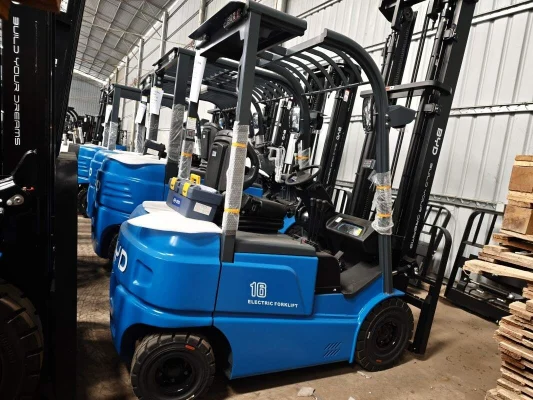
In many electric counterbalance designs, the battery compartment is positioned to use battery mass as ballast. That is why battery weight and dimensions are part of the truck’s specification, not an afterthought. Replacing a battery with a lighter unit, or one with a different footprint, can reduce the stabilizing moment the truck was designed around. The result is not necessarily an immediate failure, but the margin between the chart value and actual stability shrinks.
Why LiFePO4 packs need a configuration check
LiFePO4 (lithium iron phosphate) packs differ from conventional lead-acid batteries in energy density, mass, and physical format. A lithium pack that delivers comparable usable energy may weigh less than the lead-acid battery it replaces. That can be an advantage in charging and maintenance, but it changes the counterweight equation. Before treating a LiFePO4 forklift as a drop-in replacement, confirm with the manufacturer that the pack’s mass and mounting position match the truck’s approved configuration, and that the load chart supplied with the truck reflects that pack.
Height magnifies the effect
At low lift heights, small changes in counterweight may stay within the truck’s stability margin. At full mast height, the same change matters more because the load’s moment arm is longer and the combined center of gravity rises. This is why capacity derating at height should be read together with the battery configuration, not separately.
Building a Load Plan Step by Step
The following sequence works as a general planning method. It does not replace the manufacturer’s load chart or a site-specific stability assessment.
- Measure the real load center. Include pallet overhang, load shape, and any forward shift caused by the attachment. Do not assume the nominal pallet dimension equals the load center.
- Record the maximum lift height you actually use. Note whether the load must be raised to place it on the top rack beam or only to clear the second level.
- Identify the attachment and add its weight and forward offset to the load moment. Attachments usually reduce net capacity.
- Obtain the load chart that matches the truck’s current battery configuration. Ask whether the chart assumes a specific battery mass and position.
- Compare the required capacity at your actual height and load center against the chart. If the chart does not cover your combination, request a written derating from the manufacturer rather than estimating.
- Check the aisle and floor conditions. Turning radius, aisle width, floor flatness, and slope affect safe operation even when the load is within the chart.
Parameters worth confirming with the supplier
| Item | Why it matters | What to request |
|---|---|---|
| Battery mass and dimensions | Sets the counterweight contribution | Approved pack specification and mounting position |
| Rated capacity at load center | Baseline chart value | Chart covering the actual attachment and mast |
| Capacity at lift height | Derating at height | Derating table or written confirmation |
| Attachment weight and offset | Reduces net capacity | Attachment data and revised rating |
| Charging and operating temperature range | Affects availability and battery limits | Manufacturer’s stated range and BMS restrictions |
| Aisle and floor conditions | Affects safe operation | Site measurements and any slope data |
Treat the table as a checklist, not a specification. Values must come from the manufacturer’s documentation covering the exact truck, battery, mast, and attachment you intend to use.
Common Planning Mistakes and Their Limits
Several errors recur when teams plan loads around a LiFePO4 forklift.
- Using the data plate as an all-height rating. The plate value typically applies to a defined load center and often a lowered or standard condition. Always read the chart.
- Swapping batteries without rechecking the chart. A lighter lithium pack may change the stabilizing moment. Confirm the approved configuration.
- Ignoring attachment offset. A side shifter moves the load forward, which reduces capacity more than its own weight alone suggests.
- Assuming a higher-capacity truck solves every height problem. It may help, but the chart at your actual height and load center still governs.
- Overlooking floor and aisle constraints. A load within the chart can still be unsafe on a slope or in a narrow aisle.
None of these points imply that a particular truck will fail. They describe where the chart’s assumptions can drift away from real operations, and where a written confirmation from the manufacturer is the honest answer.
An illustrative planning scenario
Consider a hypothetical warehouse that stores palletized goods on racking and uses a four-wheel counterbalance electric forklift with a LiFePO4 pack. The team wants to place loads on the third beam. Their plan should record the load center including pallet overhang, the exact lift height, the attachment fitted, and the battery configuration the chart assumes. If any of those differ from the chart, the team should request a derating rather than extrapolate. This is a planning example, not a tested case.
FAQ: Battery, Counterweight, and Load Chart Questions
Does a LiFePO4 battery change the rated capacity?
It can, if the pack’s mass or mounting position differs from the configuration the load chart assumes. The chart is tied to a specific truck setup. Ask the manufacturer whether the chart covers your pack.
Can I use the data plate value at full lift height?
Usually not without checking. Plate values are tied to defined conditions, and capacity generally derates as load center and lift height increase. Use the chart that matches your mast and attachment.
How do I confirm the load center of my pallet?
Measure from the vertical face of the forks to the load’s center of gravity, including overhang and any forward shift from the attachment. If the result exceeds the chart’s stated load center, request a revised rating.
What should I send a supplier when asking about capacity?
Provide the load weight and dimensions, maximum lift height, attachment type, aisle width, floor and slope conditions, shift pattern, and charging arrangements. Ask which battery configuration the chart assumes and whether it matches the truck offered.
If you are evaluating a four-wheel counterbalance electric forklift with a LiFePO4 pack, share your actual load, lift height, and site conditions so the selection and configuration can be checked against the manufacturer’s documentation rather than assumed.