Specifying a Lithium Ion Forklift: Load Center, Lift Height, and Mast Configuration Checks Before Purchase
News 01/11/2026
A lithium ion forklift purchase usually starts with a capacity number, but capacity alone tells you very little. The load center, lift height, and mast configuration you specify determine whether that capacity is usable at the height and reach your operation actually needs. Before you request a quote, confirm where the load sits, how high it must travel, and which mast geometry fits the building. This guide covers the checks that prevent a specification mismatch on a four-wheel counterbalance electric forklift.
Load Center: The Number Behind the Capacity Rating
Rated capacity is stated at a specific load center, which is the horizontal distance from the vertical face of the forks to the center of gravity of the load. A load that sits farther out reduces the capacity the truck can safely handle at that reach. When you compare quotes, confirm that the rated capacity and the load center are quoted together; a capacity figure without its load center is incomplete.
Measure your actual loads rather than assuming pallet dimensions. Check the pallet depth, how far the goods overhang, and whether loads are uniform. A load that is deep or front-heavy shifts the center of gravity forward. If your loads vary, specify the worst realistic case and note it in the inquiry.
What to send with your inquiry
- Maximum load weight and the load center at which it occurs
- Pallet or container dimensions, including overhang
- Whether attachments will be fitted, since they change the effective load center and capacity
- Any loads that are off-center or irregularly shaped
Attachments deserve particular attention. A side shifter, clamp, or other device moves the load forward and adds weight, so the capacity shown on the data plate no longer applies unchanged. Ask the supplier to confirm derated capacity with the attachment installed, and treat any figure you cannot trace to the manufacturer’s technical data as unconfirmed.
Lift Height and Mast Configuration: Matching the Truck to the Building
Lift height is not just the top shelf you need to reach. It includes the height at which the forks must clear the rack beam, the free lift required to enter a trailer or low doorway, and the collapsed height that must fit under obstructions. On a four-wheel counterbalance electric forklift, the mast choice follows from these constraints.
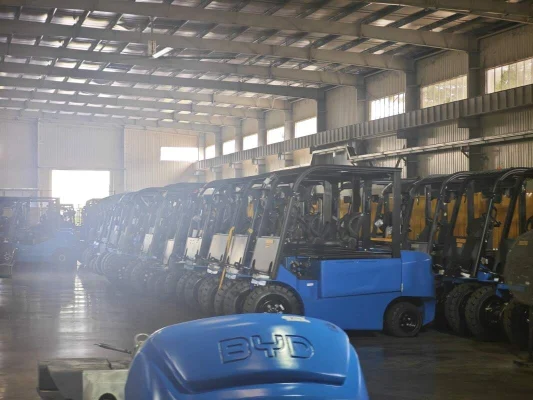
Mast configurations differ in how many stages they use and whether they offer free lift. A simplex mast is simple and compact but limited in lift. Duplex and triplex masts add stages to reach higher while keeping the collapsed height lower. Full free lift lets the forks rise within the mast before the mast itself extends, which matters when entering trailers, containers, or buildings with low overhead clearance.
Checks to run before specifying a mast
- Highest shelf or rack beam height, plus clearance to lift a load off and on
- Lowest overhead obstruction along the travel path, including doorways and trailer roofs
- Required free lift, if the truck must enter enclosed spaces
- Whether the truck will work at full height regularly or only occasionally
- Overhead guard height and any site-specific height limits
Capacity also changes with lift height on many masts, because the mast and carriage add load as they extend. Ask the supplier to state residual capacity at your maximum lift height and load center, not only at ground level. If that information is unavailable, request it before committing; do not assume the ground-level rating carries upward.
Building and aisle constraints
Mast geometry interacts with the aisle. Confirm available aisle width, right-angle stacking clearance, floor condition, and any ramps or slopes on the route. Gradeability, ground clearance, and travel speed should be checked against the actual route rather than a generic assumption. Where the route includes ramps, tell the supplier the slope and load so the specification can be assessed.
Documents and Acceptance Points to Confirm Before Ordering
A clear specification package reduces the risk of a truck arriving with the wrong mast or an overstated capacity. Ask for the manufacturer’s technical data sheet showing rated capacity, load center, mast type, lift height, free lift, and residual capacity at height. Confirm battery voltage and capacity, charger type, and charging time, plus the space and power supply available at your site.
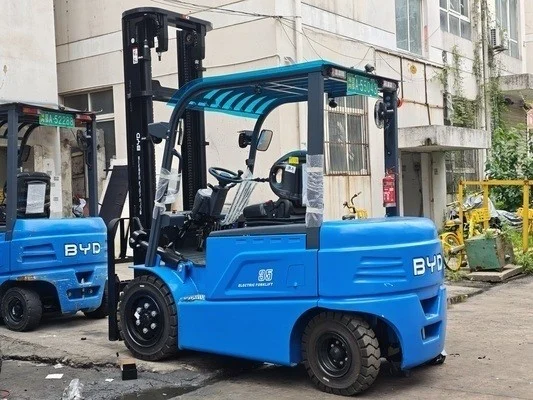
Agree on acceptance checks before delivery: verify the data plate matches the ordered configuration, confirm the mast and attachment fitted, check lift height against the building, and test the truck with representative loads at working height. Keep a written record of the agreed configuration. Where a supplier cannot provide a verified figure, record it as an open item rather than filling the gap with an estimate.
If you are evaluating a four-wheel counterbalance electric forklift, share your load weights, load centers, lift height, aisle dimensions, floor and ramp conditions, and shift pattern. Those details let the supplier propose a configuration against your operating conditions instead of a generic capacity number.
Frequently Asked Questions
Does a higher lift height reduce capacity?
It can. As the mast extends, the moving components add load, and the capacity available at height may be lower than the ground-level rating. Ask the supplier to state residual capacity at your maximum lift height and load center.
Why does load center matter more than the capacity number?
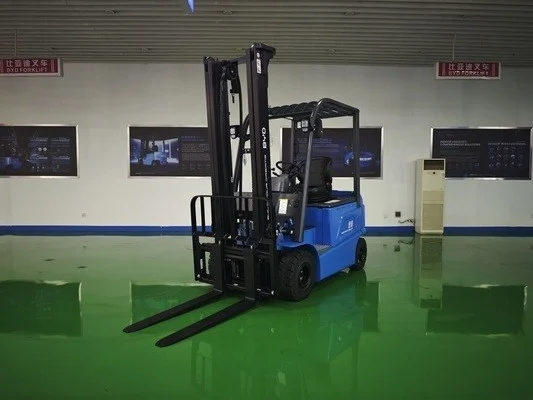
Capacity is rated at a defined load center. A load whose center of gravity sits farther from the fork face reduces the weight the truck can safely handle. Quoting capacity without its load center leaves the rating incomplete.
When do I need full free lift?
Full free lift helps when the truck must raise forks inside a trailer, container, or low-clearance building before the mast extends. Confirm the overhead clearance and the required entry height with the supplier.
Do attachments change the specification?
Yes. Attachments add weight and move the load forward, which changes the effective load center and reduces capacity. Request the derated capacity with the attachment fitted and confirm it against the manufacturer’s data.