Lithium Ion Forklift Battery Cycle Life: Duty Cycle and Depth-of-Discharge Questions Buyers Should Confirm
News 09/11/2026
When evaluating a lithium ion forklift, cycle life claims often appear as a single number, but that figure depends heavily on how the battery is used. Before you request a quote, clarify the duty cycle and depth of discharge (DoD) assumptions behind any cycle-life statement. This article outlines the key questions to ask, the parameters to verify, and how to align them with your actual operation—especially if you are considering a four-wheel counterbalance electric forklift.
Why Cycle Life Is Not a Fixed Number
Battery cycle life is typically defined as the number of full charge-discharge cycles a battery can deliver before its capacity falls to a specified percentage of its original value—often 80%. However, that definition varies by manufacturer and test conditions. A cycle count obtained under controlled laboratory conditions may not reflect real-world performance in a warehouse or loading dock. Factors such as depth of discharge, charge rate, temperature, and rest periods all influence how long a battery lasts. Therefore, any cycle-life figure should be treated as a reference point, not a guarantee, unless the test conditions match your application.
Key Questions About Duty Cycle and Depth of Discharge
What is the expected depth of discharge per cycle?
Depth of discharge refers to the percentage of battery capacity used before recharging. Shallow discharges (e.g., 30–50% DoD) generally allow more cycles than deep discharges (e.g., 80–100% DoD). Ask the supplier what DoD the cycle-life claim assumes. If your operation routinely runs batteries down to 80% or more, the expected cycle life may be lower than a figure based on 50% DoD. Clarify whether the battery management system (BMS) limits discharge depth and how that affects usable capacity.
How many shifts per day, and what is the available charging window?
Duty cycle includes the number of hours the forklift operates per shift, the intensity of use (e.g., continuous travel vs. intermittent lifting), and the time available for charging. A single-shift operation with opportunity charging may keep the battery in a partial state of charge, which can influence cycle life. Multi-shift operations may require either larger batteries or rapid charging, both of which affect battery stress. Confirm with the supplier whether the proposed battery and charger combination is suitable for your shift pattern and charging infrastructure.
What are the environmental conditions?
Temperature extremes accelerate battery aging. Ask how the cycle-life figure was derived—was it at a controlled 25°C, or does it account for typical warehouse temperatures? If your facility experiences high heat or freezing conditions, discuss mitigation options such as battery thermal management or operating guidelines.

What is the charging strategy?
Charge rate and charging profile matter. Fast charging can increase throughput but may reduce cycle life if not managed properly. Ask whether the battery is designed for frequent opportunity charging and what charging voltages and currents are recommended. Also, confirm if the BMS balances cells and how that affects long-term capacity retention.
What maintenance and warranty terms apply?
Cycle life is often tied to warranty coverage. Clarify what the warranty states about capacity degradation over time and what constitutes normal wear. Ask about maintenance requirements—such as periodic capacity tests or software updates—that could affect battery health.
How to Verify Supplier Claims
Request documentation that describes the test conditions behind any cycle-life claim. Look for details on:
- Depth of discharge used in the test
- Charge and discharge rates
- Ambient temperature
- End-of-life capacity threshold (e.g., 80% of initial capacity)
- Whether the test follows a recognized standard or internal protocol
If the supplier cannot provide this information, treat the cycle-life figure as indicative only. Also, ask for references from similar applications—but be aware that references are not a substitute for your own validation. During acceptance testing, you can plan to monitor battery capacity over the first few months to compare with expected trends.
Frequently Asked Questions
Does a higher cycle life rating always mean a better battery?
Not necessarily. A high cycle-life rating based on shallow discharges may not translate to your operation if you routinely deep-discharge. Consider the full picture: usable capacity, charging infrastructure, warranty, and total cost of ownership.
Can I use the same battery across multiple shifts?
It depends on the battery capacity relative to your energy consumption per shift and the available charging time. Some operations use opportunity charging during breaks, while others require battery swapping. Discuss your shift schedule with the supplier to determine the right configuration.
What is the typical depth of discharge for a lithium ion forklift battery?
There is no universal value. Many lithium-ion batteries allow deeper discharges than lead-acid without damage, but the optimal DoD depends on the battery design and BMS settings. Your supplier should specify the recommended operating range.
How does temperature affect cycle life?
High temperatures generally accelerate capacity fade, while very low temperatures can reduce available capacity and charging efficiency. If your facility is not climate-controlled, ask about the battery’s operating temperature limits and any thermal management features.
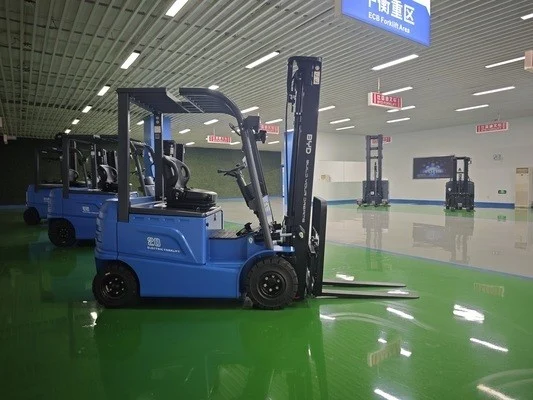
To move from general questions to a specific recommendation, gather your duty cycle data—shifts per day, hours of operation, average load weight, lift heights, and charging windows—and share it with a supplier who can match a four-wheel counterbalance electric forklift and battery configuration to your needs. This site offers比亚迪 four-wheel counterbalance electric forklifts; provide your actual operating conditions to discuss suitable models and battery options.