1.5 ton electric forklift: Tire Type, Wheelbase, and Turning Radius Checks That Suit Your Aisle Width
News 07/11/2026
A 1.5 ton electric forklift only fits a narrow aisle when three dimensions agree: the tire profile, the wheelbase, and the turning radius. Buyers often compare load capacity first and treat aisle fit as an afterthought. In practice, a truck rated at 1,500 kg can still be the wrong machine if its outside turning radius exceeds the free space between racking and load, or if its tire type adds width where the aisle is tightest. This guide explains how each dimension affects real clearance and gives you a practical check sequence you can run before requesting a quote. The scope here is four-wheel counterbalance electric forklifts, including lithium-battery models, because that is the configuration most general warehouse and loading work assumes.
Start With the Real Free Aisle, Not the Rack Spacing
Aisle width in a drawing is rarely the width your truck can use. The number that matters is the free channel left after subtracting obstructions: column guards, protruding pallets, door frames, floor drains, and any racking that extends past the uprights. Measure the narrowest point along the whole travel path, not just the straight run between two rack rows.
Two widths are usually relevant:
- Travel aisle: the clear channel needed to drive straight with a load. This is normally wider than the truck itself plus a safety margin you define internally.
- Working aisle: the clear space needed to turn 90 degrees into a rack bay and place or retrieve a pallet. This is where turning radius and wheelbase dominate.
Measure both at floor level and at the height of the lowest obstruction. A low guard rail or a pallet overhanging the aisle can reduce the usable width even when the rack layout looks generous. Record the values in millimeters or inches and keep them with your inquiry, because tire and chassis choices are judged against these figures.
How Tire Type Changes Width and Floor Behavior
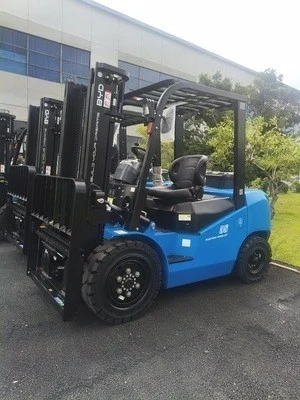
Four-wheel counterbalance electric forklifts commonly run on pneumatic, solid pneumatic-style, or press-on cushion tires. The choice affects more than traction. Tire section width and outer diameter influence the truck’s overall stance and the height of the chassis above the floor, and the tread pattern affects how the machine behaves on smooth concrete versus uneven yards.
Pneumatic and pneumatic-shaped tires
These tires have a larger outer diameter and a more compliant ride. They suit mixed surfaces, outdoor aprons, and routes with small bumps or debris. The trade-off is a taller, often wider stance that can consume aisle clearance. If your route leaves sealed concrete, this category is usually worth discussing with the supplier.
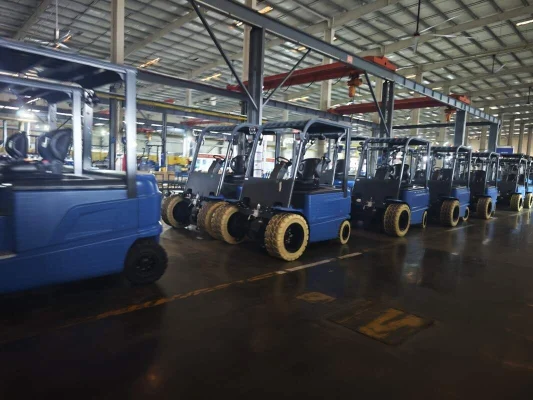
Cushion and press-on tires
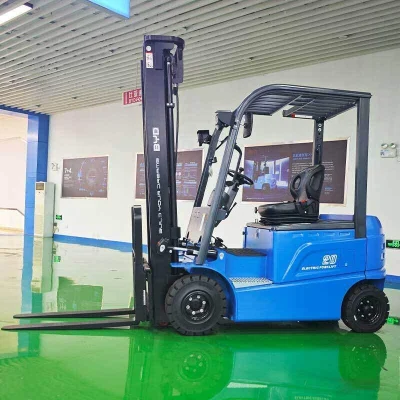
Cushion tires have a smaller outer diameter and a firmer footprint. They are common indoors on smooth floors and can help keep the truck compact. They are less forgiving on rough ground, gravel, or sharp transitions, where the harder ride and lower ground clearance become practical limits.
Tire choice is not a free upgrade in either direction. Confirm the actual tire size, overall truck width, and ground clearance in the manufacturer’s technical data. If a supplier cannot provide those figures, treat the aisle fit as unconfirmed rather than assuming the truck will squeeze in.
Wheelbase, Turning Radius, and the Space a Turn Really Needs
Wheelbase is the horizontal distance between the front and rear axle centers. A longer wheelbase generally supports stability with a raised load, while a shorter one helps a truck rotate inside a tighter working aisle. Turning radius describes the arc the truck’s outermost point traces during a full turn. Manufacturers usually publish an outside turning radius, and that figure, not the wheelbase alone, tells you how much floor space a 90-degree turn demands.
Use this sequence to test a candidate truck against your measured aisle:
- Take the published outside turning radius and add the clearance from the truck’s outer edge to the rack or wall.
- Compare that combined figure with your working aisle width, measured at the tightest point.
- Account for the load. A pallet that overhangs the fork tips or sides increases the swept path during the turn.
- Add the space needed to align the forks before entering the bay; operators rarely turn and insert in one continuous motion.
- Repeat the check at every turn on the route, including doorway approaches and blind corners.
These checks are planning estimates, not a substitute for an on-site assessment. Floor slope, surface friction, and operator technique all affect how much margin is realistic. A layout that works on paper with zero clearance will not work in daily operation.
A Practical Comparison Table and Common Mistakes
The table below summarizes how each factor pushes the decision. It describes general tendencies, not specific product performance; confirm exact values against the technical data your supplier provides.
| Factor | What it affects | Practical implication |
|---|---|---|
| Tire type and size | Overall width, ground clearance, ride | Larger tires may suit outdoor routes but can reduce aisle margin indoors |
| Wheelbase | Stability with raised loads, maneuverability | Longer wheelbase favors stability; shorter favors tight turns |
| Outside turning radius | Floor space a turn consumes | Compare against the working aisle at its narrowest point |
| Load dimensions | Swept path during turns | Overhanging loads need extra clearance beyond the truck’s own arc |
| Floor and slope | Traction and safe control | Ramps and polished floors change realistic margins |
Common mistakes tend to repeat:
- Using rack-to-rack distance instead of the clear free channel.
- Comparing turning radius figures without checking whether they are inside or outside radius.
- Choosing a tire type by appearance rather than by surface and clearance needs.
- Ignoring how a raised load or a long pallet changes the swept path.
- Assuming a 1.5 ton rating means every 1.5 ton load fits the same aisle.
Load capacity also depends on load center and lift height. A truck rated at 1,500 kg at a stated load center may have a lower capacity once the load center moves outward or the mast is raised. Ask for the capacity chart rather than relying on the headline rating.
FAQ: Matching a 1.5 Ton Electric Forklift to Your Aisle
Can a 1.5 ton electric forklift work in a very narrow aisle?
It depends on the measured free channel and the truck’s outside turning radius, not on the capacity rating. Four-wheel counterbalance trucks need enough working aisle to turn into the rack bay. If the aisle is extremely tight, a different truck category may be the correct discussion, but that is a separate decision from choosing a counterbalance model. Provide your aisle measurements and load dimensions so the fit can be checked against actual data.
Does tire type really change whether the truck fits?
Yes, because tire size contributes to overall width, outer diameter, and ground clearance. A larger tire can add width and height that reduce margin in a tight aisle. Confirm the tire specification and overall dimensions in the manufacturer’s technical data rather than estimating from photos.
Is a shorter wheelbase always better in tight spaces?
Not always. A shorter wheelbase can improve maneuverability, but stability with a raised load and operator comfort also matter. The outside turning radius and the load’s swept path are the more direct figures to compare against your aisle width.
What should I send with a selection inquiry?
Send the narrowest free aisle width, the working aisle width at each turn, load weight and dimensions, required lift height, floor surface and slope, shift pattern, and charging conditions. Those details let a supplier check a four-wheel counterbalance electric forklift configuration against your real route instead of a generic recommendation.
Before you commit, verify the tire size, overall width, wheelbase, outside turning radius, and capacity chart in writing. If any figure is missing, mark the aisle fit as unresolved and request the data. A truck that meets the capacity requirement but not the clearance requirement creates daily friction that no load rating can fix.