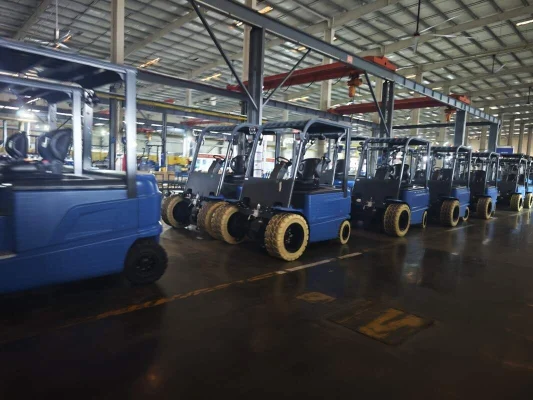
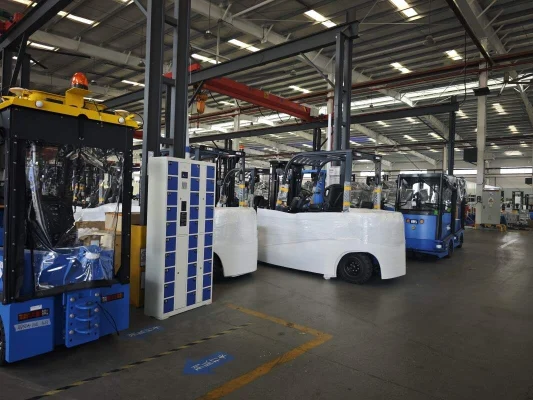
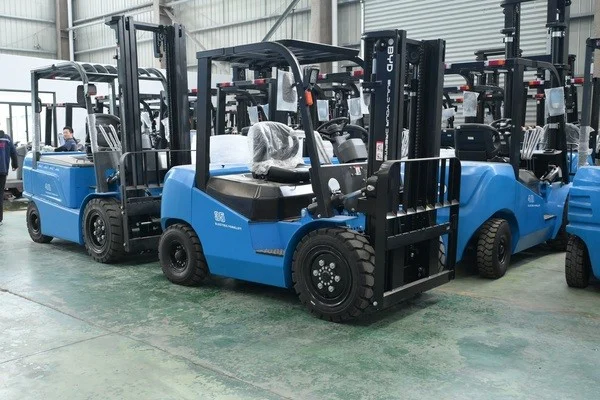
1.5 ton electric forklift: How to Match Battery Capacity and Opportunity Charging Windows to Your Shift Pattern
News 04/11/2026
A 1.5 ton electric forklift can complete a full shift on one battery only when its usable energy matches the work profile and the charging schedule fits the breaks. The practical approach is to calculate energy demand from duty cycle, verify the battery’s usable capacity, and then confirm that opportunity charging windows—short breaks and shift changes—can restore enough energy without exceeding the battery’s acceptance limits. This article explains how to align those three factors, with the understanding that the discussion centers on four-wheel counterbalance electric forklifts, the type this site supplies.
Start with the duty cycle, not the battery label
Battery capacity is often quoted as a nominal figure, but what matters is the energy the forklift actually consumes during a shift. That consumption depends on load weight, lift height, travel distance, number of starts and stops, floor conditions, and operator behavior. A 1.5 ton rating refers to the rated load, not to energy use. Two operations with the same load can have very different energy demands.
To estimate demand, break the shift into activities: loaded travel, unloaded travel, lifting, lowering, idling, and any ramps or dock work. For each activity, note the duration and the intensity. Without measured data, use conservative assumptions and treat the result as a planning estimate, not a guaranteed runtime. The goal is to identify the worst-case shift, not the average.
Key variables that change energy use
- Load weight: Heavier loads increase hydraulic and traction energy, especially during lifting.
- Lift height: Higher lifts require more energy per cycle; frequent high lifts can dominate consumption.
- Travel distance and speed: Longer runs and frequent acceleration add to traction energy.
- Floor and ramp conditions: Rough floors, inclines, and dock ramps increase resistance.
- Temperature: Extreme cold or heat can reduce usable battery capacity and affect charging.
- Operator technique: Aggressive acceleration and simultaneous functions raise energy use.
Because these variables interact, the same 1.5 ton electric forklift may run eight hours in one warehouse and four hours in another. The next step is to translate the duty cycle into an energy figure, typically in kilowatt-hours (kWh), using the forklift manufacturer’s consumption data or a duty-cycle calculator if available. If such data is not available, ask the supplier to help estimate based on your operation.
Translate battery capacity into usable energy
Battery capacity is usually stated in amp-hours (Ah) at a nominal voltage, and sometimes directly in kWh. Usable energy is lower than nominal because batteries should not be discharged to zero. Depth of discharge (DoD) limits vary by battery type and manufacturer; for planning, use the manufacturer’s recommended maximum DoD. For example, if a battery has a nominal capacity of 10 kWh and a recommended DoD of 80%, usable energy is about 8 kWh. This is the figure to compare against shift demand.
Also consider that capacity declines with age and temperature. A new battery may deliver close to its rated capacity, but a battery near the end of its service life will deliver less. For critical operations, plan a margin—often 20–30% above estimated demand—to account for degradation, cold storage, and unexpected heavier use. The exact margin should be based on your risk tolerance and the supplier’s guidance.
Checking the match
If a shift requires 6 kWh and the battery’s usable energy is 8 kWh, one battery can cover the shift with a 2 kWh buffer. But if the shift requires 9 kWh, the battery will not last, and you need either a larger battery, a second battery, or opportunity charging during the shift. The calculation is straightforward, but the inputs must be realistic.
| Shift energy demand (kWh) | Usable battery energy (kWh) | Result |
|---|---|---|
| 5 | 8 | One battery covers shift with margin |
| 7.5 | 8 | Marginal; opportunity charging advisable |
| 9 | 8 | Insufficient; need larger battery or charging |
These figures are illustrative. Actual values must come from your duty-cycle estimate and the battery specification.
Fit opportunity charging into real break windows
Opportunity charging means adding energy during short breaks, lunch, or shift changes without fully recharging. It can extend runtime and reduce the need for battery swaps, but it depends on having accessible charging points and enough time. The charging rate must also be compatible with the battery and charger; fast charging may require specific battery designs and infrastructure.
Map your actual breaks: morning break, lunch, afternoon break, and shift handover. For each, note the duration and whether the forklift is available. Then estimate how much energy can be restored. A simple approximation: energy added (kWh) ≈ charger power (kW) × time (h) × charging efficiency. Efficiency is typically below 100%, and the battery’s acceptance rate may taper as it fills, so use conservative assumptions. For example, a 10 kW charger might add roughly 6–8 kWh in an hour, but the actual figure depends on the battery’s state of charge and temperature.
Example: aligning a two-shift pattern
Consider a hypothetical operation running two 8-hour shifts with a 30-minute lunch break and two 15-minute breaks per shift. The 1.5 ton electric forklift consumes an estimated 6 kWh per shift. The battery provides 8 kWh usable. Without charging, one battery covers one shift but not two. With opportunity charging during the 30-minute lunch and one 15-minute break, assuming a 6 kW charger and 85% efficiency, energy added per shift ≈ 6 kW × 0.75 h × 0.85 ≈ 3.8 kWh. That may be enough to cover the second shift if the total daily demand is 12 kWh and the battery starts full. However, the battery must accept charge at that rate, and the breaks must be reliably available. This example is illustrative and not a guarantee; actual results require verification with the charger and battery specifications.
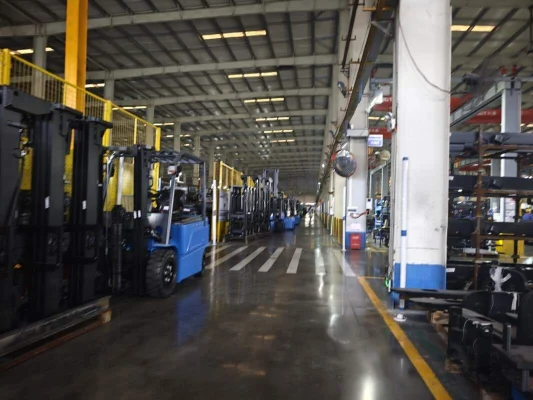
If breaks are too short or the charger is undersized, opportunity charging may not close the gap. In that case, consider a larger battery, a second battery for swap, or a different shift pattern. The choice depends on cost, space, and operational flexibility.
Verify assumptions and avoid common pitfalls
Before committing to a configuration, verify the inputs with real data where possible. Use a data logger or the forklift’s telemetry if available to measure energy consumption over a representative week. Check the battery manufacturer’s charging recommendations, including maximum charge rates and temperature limits. Confirm that the charger is compatible with the battery and that the electrical supply can support it.
Common mistakes include:
- Using nominal battery capacity instead of usable capacity.
- Assuming opportunity charging adds energy at the charger’s full rated power without accounting for efficiency and tapering.
- Ignoring battery aging and temperature effects.
- Planning charging during breaks that are often skipped or too short.
- Overlooking the need for additional charging infrastructure or training.
Also, remember that opportunity charging can affect battery life if done improperly. Follow the battery supplier’s guidance on partial charging and equalization. For four-wheel counterbalance electric forklifts, the battery and charger are integral to the vehicle’s performance, so involve the supplier early.
If you are evaluating a 1.5 ton electric forklift, gather your shift pattern, load data, lift heights, and break schedule, and share them with the supplier. They can help you size the battery and charging plan accurately. This site offers比亚迪 four-wheel counterbalance electric forklifts; we can discuss your requirements and provide configuration options based on available specifications.
Frequently asked questions
Can I use opportunity charging with any battery?
Not necessarily. Opportunity charging is more suitable for certain battery types and requires a charger that matches the battery’s acceptance profile. Always check the battery manufacturer’s recommendations before adopting this approach.
How do I estimate energy consumption without historical data?
Start with a detailed duty-cycle breakdown and use the forklift manufacturer’s consumption figures or a trusted calculator. If those are unavailable, consult the supplier with your operational details. Treat the result as an estimate and add a safety margin.
What if my breaks are too short for meaningful charging?
If total break time is limited, opportunity charging may not provide enough energy. Consider a larger battery, a battery swap system, or adjusting the shift pattern. The right choice depends on your operational constraints and cost considerations.
Does battery capacity decrease over time?
Yes, all batteries lose capacity with age and use. The rate depends on battery chemistry, depth of discharge, temperature, and charging habits. Plan for a margin to maintain performance as the battery ages.