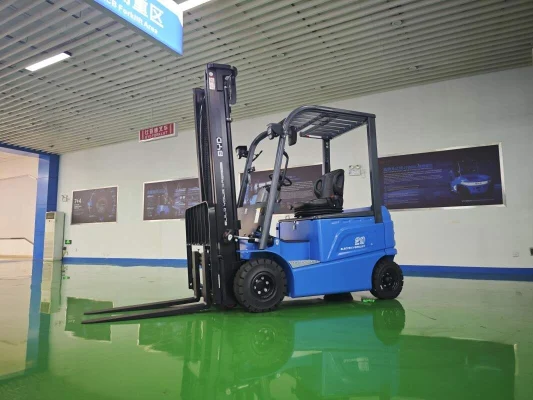
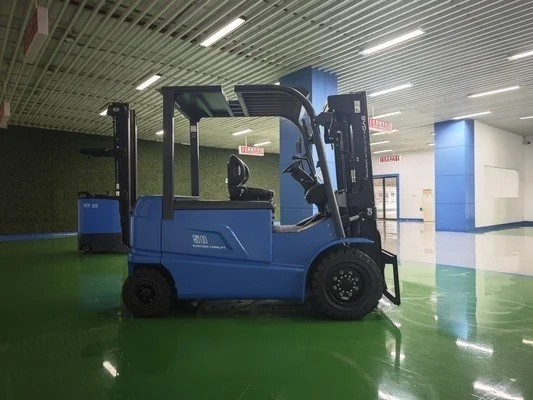
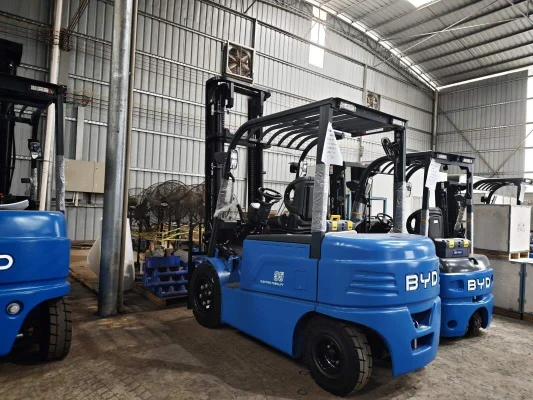
1.5 ton electric forklift: How to Specify Fork Length, Spread, and Thickness to Match Your Pallet Openings on a Four-Wheel Counterbalance Truck
News 10/11/2026
A 1.5 ton electric forklift only handles your pallets well when its fork dimensions agree with the pallet openings and the load sitting on them. On a four-wheel counterbalance electric forklift, three fork measurements drive that fit: length, spread, and thickness. Length decides whether the tips reach the far stringer and whether the load stays inside the wheelbase; spread must line up with the pallet entry openings; thickness sets the gap under the load and the clearance over the floor. Get any one wrong and you face damaged pallets, poor load stability, or a truck that cannot enter the rack cleanly. This guide explains how to translate pallet and load data into a fork specification, what to confirm with a supplier, and where the limits of a counterbalance layout appear.
Start with the Pallet and the Load, Not the Truck
Fork specification begins on the floor. Measure a sample of the pallets you actually receive, not the nominal size on a purchase order. Pallet dimensions vary by material, moisture content, and manufacturer, and those variations change the entry geometry.
Measurements to collect
- Overall pallet width and depth, measured across several pallets.
- Entry opening width and height on both the front and side faces, since stringer spacing and board thickness vary.
- Distance between the outer stringers, which sets the maximum usable spread.
- Bottom board thickness and floor clearance, which limit fork thickness.
- Loaded weight and load centre, measured from the fork face to the centre of gravity.
- Load height and stacking pattern, including whether loads are double-stacked or handled at height.
A hypothetical example shows the logic. Suppose a warehouse receives 1200 mm × 1000 mm wooden pallets with four-way entry, loaded to roughly 900 kg with a load centre near 600 mm. The pallet openings accept a spread of about 550–600 mm, the bottom boards leave roughly 100 mm of clearance, and the loads are stored two high in selective racking. Those numbers, not a catalogue page, become the starting point.
Fork Length, Spread, and Thickness: What Each One Controls
Fork dimensions interact with load centre and rated capacity. A 1.5 ton rating applies at a stated load centre, usually 500 mm or 600 mm, and capacity falls as the load centre moves outward. Longer or heavier forks change that relationship, so treat fork choice and capacity rating as one decision.
Fork length
Fork length should be long enough that the load sits fully on the blades, with the load centre comfortably inside the rated load centre. Forks that are too short leave the rear of the load unsupported and shift the effective load centre forward. Forks that are too long project beyond the pallet, can strike racking or adjacent loads, and add unnecessary weight ahead of the carriage. As a working rule, fork length should cover most of the pallet depth while keeping the load centre within the truck’s rating; confirm the exact figure against the manufacturer’s load chart rather than assuming a standard length.
Fork spread
Spread is the distance between the fork blades. It must fit inside the pallet entry openings and still support the load symmetrically. Too narrow a spread concentrates load on the middle of the pallet, increasing board stress and tipping risk. Too wide a spread can foul the stringers or fail to enter the opening. On many counterbalance trucks, fork spread is adjusted by repositioning the forks on the carriage or by a side-shift or fork-positioning attachment; the available adjustment range is a specification item to confirm, not an assumption.
Fork thickness and width
Thickness determines whether the blades slide into the pallet opening and how much ground clearance remains. Thicker forks are stronger but reduce entry clearance and add weight. Fork width affects surface pressure on the pallet and the load, and narrower blades suit tighter openings. The right combination depends on the pallet’s bottom board thickness, the entry height, and the load weight. Where openings are tight, a thinner or narrower fork section may be needed, and the resulting capacity effect must be checked on the load chart.
Matching the Specification to a Four-Wheel Counterbalance Truck
The four-wheel counterbalance layout brings a rear counterweight and a fixed wheelbase, which gives stable lifting and a familiar driving feel but also sets clear limits. The truck’s turning radius, overall width, and mast height must suit your aisle and door dimensions, and the fork dimensions must work with the carriage and any attachment fitted.
Checks that belong in the specification
- Rated capacity at the actual load centre, taken from the manufacturer’s load chart with the chosen fork length and any attachment.
- Fork carriage class and fork mounting, so the selected forks fit the carriage without adapters that change capacity.
- Fork spread adjustment range, including whether side-shift or fork positioning is needed to handle mixed pallet sizes.
- Free lift and mast height, compared with rack beam heights and doorway clearances.
- Aisle width and turning radius, compared with the actual travel and stacking aisles.
- Floor and ramp conditions, since slopes and uneven surfaces affect stability and load handling.
- Battery and charging arrangement, matched to shift length and available charging time.
If your racking, aisle, or lift height demands a very narrow truck or a different load-handling principle, a four-wheel counterbalance machine may not be the right fit. Say so early rather than forcing the application. Where the layout suits a counterbalance truck, the fork specification should be written into the order alongside capacity, lift height, and attachment details.
Comparison table: specification points, risks, and what to confirm
| Specification point | Why it matters in this application | What to confirm with the supplier | Standard or optional |
|---|---|---|---|
| Fork length | Load support and effective load centre | Recommended length against pallet depth and load centre; capacity at that length | Model-dependent; confirm |
| Fork spread | Entry into pallet openings and load symmetry | Adjustment range; whether side-shift or fork positioning is available | Often optional; confirm |
| Fork thickness and width | Entry clearance and surface pressure | Available sections and their effect on rated capacity | Model-dependent; confirm |
| Rated capacity at load centre | Safety margin under real loads | Load chart with the exact fork and attachment combination | Published data; request copy |
| Mast and free lift | Rack and doorway clearance | Lift height options and collapsed height | Model-dependent; confirm |
| Aisle and turning radius | Manoeuvring in storage aisles | Dimensions with the chosen forks and attachment | Published data; request copy |
Treat every “confirm” entry as a question, not a promise. Standard equipment varies between models and markets, and attachments change capacity and dimensions. Ask for the load chart and dimension drawing that apply to the exact configuration you are considering.
Common Mistakes and How to Avoid Them
Most fork problems trace back to assumptions made before the order. A few patterns recur:
- Specifying forks from the pallet’s nominal size. Measure real pallets, including damaged and replacement stock.
- Ignoring the load centre. A load that sits far forward reduces usable capacity, even on a 1.5 ton truck.
- Choosing the widest possible spread. Spread must fit the openings, not the pallet’s outer edges.
- Overlooking attachments. Side-shift and fork positioners add weight and shift the load centre; the load chart must reflect them.
- Forgetting the aisle. A truck that fits the pallet may still not fit the rack aisle or doorway.
- Mixing pallet types without a plan. If several pallet sizes arrive, decide whether adjustable spread or a second truck is the practical answer.
Write the agreed fork length, spread, thickness, and the capacity at your load centre into the purchase documentation. That record protects both the specification and the people operating the truck.
Frequently Asked Questions
Can I use standard forks on a 1.5 ton electric forklift with non-standard pallets?
Possibly, but only after checking the pallet entry openings, the load centre, and the load chart. Standard forks may be too long, too wide, or too thick for the pallet, or they may reduce capacity at your actual load centre. Measure the pallets and ask the supplier to confirm the capacity with the proposed forks.
Does a wider fork spread always improve stability?
No. Wider spread can improve support only if the forks still enter the pallet openings and the load remains centred. A spread that is too wide may foul the stringers, and a spread that is too narrow concentrates load. The correct spread matches the pallet geometry and keeps the load balanced.
How do I know whether a four-wheel counterbalance truck suits my aisle?
Compare the truck’s turning radius, overall width, and mast dimensions with your measured aisle and doorway widths. Include the forks and any attachment in those dimensions. If the aisle is very narrow relative to the load size, the counterbalance layout may not be the practical choice, and that should be discussed before ordering.
What information should I send when requesting a configuration?
Send pallet dimensions and entry measurements, typical and maximum load weights, load centre, required lift height, rack beam heights, aisle widths, floor and ramp conditions, shift pattern, and charging arrangements. With those details, a supplier can propose fork dimensions and a configuration and state the capacity that applies.
To move from general guidance to a concrete specification, gather your pallet measurements and load data, then ask about a BYD four-wheel counterbalance electric forklift configured to your lift height, capacity, and fork requirements. The more precise your site data, the more useful the answer.