What to Confirm About Rated Capacity and Derating When Specifying a 2.5 Ton Electric Forklift
News 03/11/2026
A 2.5 ton electric forklift is normally rated at 2,500 kg at a defined load center, usually 500 mm, with the mast vertical and a standard fork carriage. That number is a reference point, not a promise that the truck will lift 2,500 kg in every configuration. Rated capacity falls when the load center moves forward, when the mast is raised, when an attachment is fitted, or when the truck works on a slope. Before you approve a specification, confirm the rating basis, the derating curve, and the exact configuration the quotation describes.
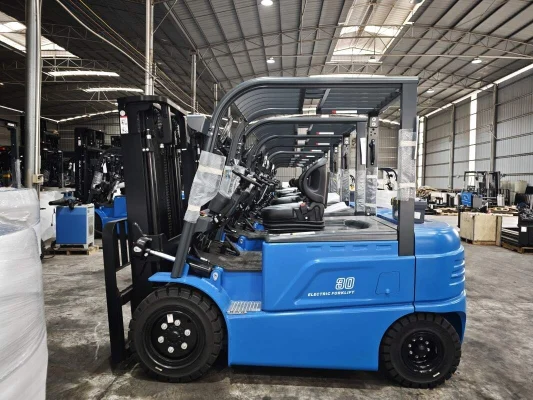
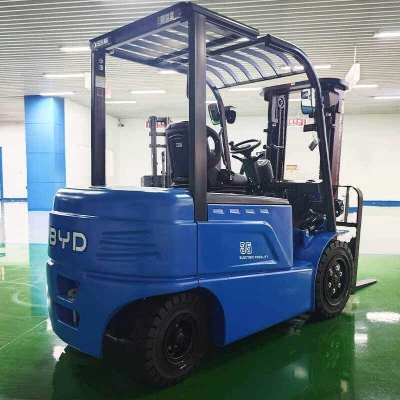
This article covers four-wheel counterbalance electric forklifts, the type most often used in general factory and warehouse work. It explains what to ask, which documents to request, and where the real limits usually appear.
Start With the Rating Basis, Not the Headline Number
Every capacity figure depends on assumptions. Ask the supplier to state them in writing. The usual items are load center, lift height, mast type, carriage and forks, attachment, tyre type, and whether the rating applies with the mast vertical or tilted.
Load center and load shape
Load center is the horizontal distance from the vertical face of the forks to the center of gravity of the load. A pallet whose weight is evenly distributed and sits tight against the carriage behaves differently from a load that overhangs the fork tips. Long timber, wide crates, and drums on a fork-mounted handler all shift the center of gravity forward. When the actual load center is greater than the rated one, capacity must be reduced according to the manufacturer’s curve. Do not estimate this reduction yourself; request the curve.
Lift height and mast configuration
Many trucks hold full rated capacity only to a stated height. Above that height, capacity may be reduced. The reduction depends on mast type, number of stages, and whether the truck has a free-lift section. If your racking requires placing loads at 4.5 m or higher, confirm the capacity at that height, not only at floor level. A two-stage mast and a three-stage mast can carry different ratings even on the same chassis.
Attachments change the rating
Side shifters, fork positioners, rotators, clamp arms, and extendable forks add weight and move the load forward. Each attachment usually has its own capacity label and its own derating effect. The truck’s residual capacity with the attachment fitted should come from the manufacturer, in writing, and should match the attachment you actually intend to use.
Derating Factors You Should Verify in the Quotation
Derating is the reduction of rated capacity under conditions other than the standard test configuration. The common factors are listed below, with the questions that expose them.
| Factor | Why it matters | What to request |
|---|---|---|
| Load center greater than rated | Forward center of gravity increases overturning moment | Capacity curve or table showing capacity at each load center |
| Lift height above the rated point | Mast and hydraulic behaviour change; stability margin narrows | Capacity at your maximum lift height, with the specified mast |
| Attachment fitted | Attachment weight and forward offset reduce residual capacity | Residual capacity with that attachment, plus attachment weight |
| Slope or ramp work | Gradient affects stability and braking | Manufacturer guidance on maximum gradient and travel direction |
| Tyre and floor conditions | Pneumatic, solid, or non-marking tyres behave differently; wet or uneven floors reduce grip | Recommended tyre type and any restrictions on floor condition |
| Battery and counterweight configuration | Battery mass is part of the counterweight on many electric trucks | Confirmed battery mass and whether the rating assumes that battery |
Treat the table as a checklist, not a specification. The values belong in the supplier’s documentation, not in a general article.
Battery mass is part of the stability calculation
On many electric counterbalance trucks, the battery contributes to counterweight. If you later change battery type, capacity, or housing, the rating may no longer apply. Confirm the battery mass assumed in the rating and keep it unchanged, or ask the manufacturer to re-rate the truck. This is easy to overlook when a second battery is purchased or when a different chemistry is considered.
Slopes, ramps, and dock edges
Rated capacity is normally stated on level ground. Travel on gradients, loading ramps, and dock levellers introduces additional limits. Ask about the maximum gradient the manufacturer permits, the recommended travel direction with a load, and any reduction in capacity on a slope. Do not assume that a truck rated at 2,500 kg can carry that load up a ramp at full height.
Matching the Rating to Your Actual Duty Cycle
Capacity is only one part of the specification. A truck that meets the load rating may still be a poor fit if the duty cycle, aisle width, or floor conditions are wrong. The following checks help you avoid a mismatch.
Loads and handling equipment
List the heaviest loads, the lightest loads, and the load shapes you handle. Note pallet sizes, overhang, and whether loads are stable. If you handle two pallets at once with a double fork, the effective load center moves forward and the rating changes. Confirm the capacity with the exact handling equipment you plan to use.
Aisle width and turning
A four-wheel counterbalance truck needs more aisle width than some other designs. Measure the narrowest aisle, the door openings, and the turning space at rack ends. Ask the supplier for the truck’s dimensions, including overall width and turning radius, and compare them with your measured values. If the aisle is too narrow, a different truck type may be required, and the capacity discussion becomes secondary.
Floor, tyres, and environment
Floor condition affects tyre choice and braking. Confirm whether the floor is smooth concrete, expansion-jointed, or uneven, and whether it is wet or oily. For food, pharmaceutical, or cold-store work, ask about washdown, condensation, and low-temperature operation. These requirements may change the specification and may affect the rated capacity.
Shift pattern and charging
Capacity does not describe how long the truck can work. Confirm the battery capacity, charging method, and whether battery exchange is needed. For multi-shift operation, ask how the charging schedule fits your breaks and whether opportunity charging is supported. These details belong in the same conversation as the load rating.
Questions to Ask and Documents to Collect
Before you approve a 2.5 ton electric forklift specification, collect the following from the supplier. Each item should be specific to the truck and configuration you are buying.
- Rated capacity, load center, and lift height at which the rating applies.
- Capacity curve or table covering your actual load center and maximum lift height.
- Residual capacity with the attachment you intend to use, if any.
- Battery mass assumed in the rating, plus battery type and capacity.
- Overall dimensions, turning radius, and aisle width guidance.
- Tyre type and any floor or gradient restrictions.
- Operating temperature range, charging temperature range, and any cold-store or washdown configuration.
- Documentation showing the configuration quoted matches the rating stated.
If the supplier cannot provide a capacity curve or a written statement of the rating basis, treat the headline figure as unconfirmed. Ask instead which parameters you should verify, and request the manufacturer’s technical data sheet. Our team can review your load list, lift heights, and aisle measurements and discuss configuration options within our four-wheel counterbalance electric range.
Frequently Asked Questions
Does a 2.5 ton rating mean the truck can lift 2,500 kg at any height?
No. The rating applies at a stated load center and lift height, usually with the mast vertical and a standard carriage. Capacity may be lower at greater heights or with a forward load center. Ask the supplier for the capacity at your actual lift height and load center.
How much capacity do I lose when I add a side shifter?
The reduction depends on the attachment’s weight and forward offset, and on the truck’s mast and carriage. There is no universal percentage. Request the residual capacity with that specific attachment from the manufacturer, and check the attachment’s own capacity label.
Can I use the truck on a ramp at full load?
Rated capacity is normally stated on level ground. Slope work introduces additional stability and braking limits. Confirm the manufacturer’s maximum gradient, the recommended travel direction with a load, and any capacity reduction on slopes before planning ramp routes.
What should I check if I plan to change the battery later?
On many electric trucks the battery mass forms part of the counterweight. Confirm the mass assumed in the rating and whether a different battery would require re-rating. Ask the manufacturer to confirm in writing before you change battery type or capacity.
Is a four-wheel counterbalance truck suitable for very narrow aisles?
Not always. Four-wheel counterbalance trucks need adequate aisle width and turning space. Measure your narrowest aisle and compare it with the truck’s dimensions and turning radius. If the aisle is too narrow, a different truck type may be more appropriate, and you should discuss that boundary with the supplier.