Specifying a 2 Ton Electric Forklift: Counterweight, Chassis Width, and Site Access Constraints Buyers Should Check
News 02/11/2026
A 2 ton electric forklift is often specified by rated capacity alone, and that is where many procurement problems begin. Rated capacity is a laboratory condition tied to a defined load center and lift height; the counterweight, chassis width, and site access constraints determine whether the truck can actually do the work. This guide covers what to confirm before you request a quotation, how to read a data sheet critically, and which site measurements to collect. It focuses on four-wheel counterbalance electric forklifts, the type this site supplies, including lithium-battery models.
What the “2 Ton” Rating Really Tells You
Rated capacity is the load the manufacturer states the truck can handle under specified conditions. Those conditions usually include a load center (commonly 500 mm or 600 mm, but confirm this on the data sheet) and a lift height. Move the load center outward, raise the load, or fit a non-standard attachment, and the safe capacity falls. A 2 ton electric forklift is therefore a starting point, not a guarantee that every 2,000 kg load can be lifted to every height.
Ask suppliers to state the rated capacity, load center, and lift height together, plus a derating curve if one is available. If the load is a long crate, a double-deep pallet, or a drum handled with a clamp, the effective load center is larger than the nominal figure. The honest answer may be that a higher-capacity model is needed, or that the load must be handled differently.
Counterweight, Chassis Width, and Load Center
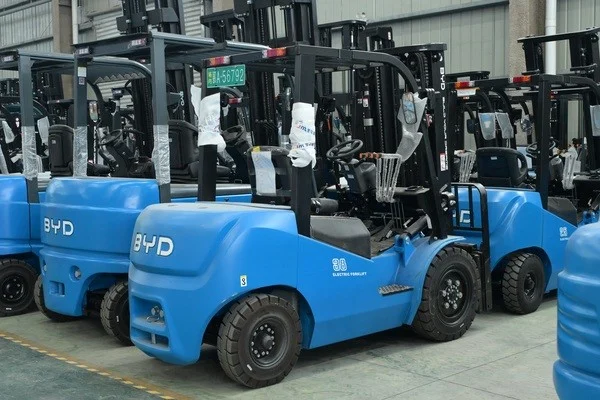
The counterweight balances the load on the steer axle. A heavier counterweight supports a higher rated capacity at a given load center, but it also adds dead weight that the floor, ramps, and trailer ramps must carry. Chassis width affects stability and aisle requirements in opposite directions: a wider chassis generally improves lateral stability but needs more room to maneuver.
These are not independent choices. A truck configured with a long wheelbase and heavy counterweight may be stable but too wide or too long for a narrow aisle or a tight loading dock. A compact chassis may fit the aisle but carry a lower capacity at the load center you actually use. The data sheet should list the following, and each item should be confirmed rather than assumed:
- Rated capacity, load center, and lift height as a set
- Service weight and axle load distribution
- Overall width, overall length, and turning radius
- Mast type, collapsed height, and extended height
- Battery type and voltage, plus charging time and method
For lithium-battery models, confirm the charger type, charging window, and whether opportunity charging suits your shift pattern. Do not assume a charging strategy from a general article; the supplier’s technical documentation should state what the battery and charger allow.
Site Access Checks Before You Request a Quotation
Most access problems show up as a truck that fits the load but not the building. Measure the actual route the forklift will take, not just the widest aisle. A practical checklist includes the narrowest aisle, door and gate clearances, floor loading limits, ramp gradients, floor surface and joints, overhead obstructions, and the space available at rack faces and loading docks.
Turning radius and aisle width should be checked together. A truck may turn within the radius stated on paper but still need extra clearance when the mast or load extends beyond the chassis. Door height matters when the mast is raised, and overhead clearance matters where sprinklers, pipes, or mezzanine edges intrude. On ramps, confirm the permitted gradient and the load being carried; capacity and stability on a slope differ from level-floor figures, so ask the supplier to confirm suitability rather than assuming it.
| Check | What to measure or confirm | Why it matters |
|---|---|---|
| Narrowest aisle | Clear width between rack uprights and walls | Determines whether the truck can maneuver with a load |
| Door and gate openings | Width and height, including the mast in travel position | Prevents blocked routes and impact damage |
| Floor loading | Permitted point loads and surface condition | Heavy counterweight and loaded tires concentrate load |
| Ramps and slopes | Gradient, length, and surface | Affects stability and safe operation |
| Charging area | Space, ventilation, and power supply | Determines charging method and shift planning |
A common error is measuring only the storage aisle and ignoring the route from the dock. Another is ordering from a capacity figure without checking the load center of the actual pallet. A third is treating a lithium-battery option as a drop-in change without confirming charger capacity and the available charging window.
Frequently Asked Questions
Is a 2 ton electric forklift always able to lift 2,000 kg?
Only under the rated conditions stated on the data sheet, typically a specified load center and lift height. With a larger load center, a raised load, or an attachment, the safe capacity is lower. Confirm the derating with the supplier using your actual load dimensions.
Does a wider chassis always mean better stability?
Width generally helps lateral stability, but stability also depends on counterweight, wheelbase, mast, load center, and travel speed. A wider truck may not fit a narrow aisle. Treat chassis width as one variable in a set, not a standalone quality.
Which site measurements should I send with an inquiry?
Send the narrowest aisle, door and gate dimensions, floor loading limits, ramp gradients, the load’s weight and dimensions, required lift height, and shift and charging patterns. These let a supplier propose a configuration instead of guessing from capacity alone.
Can a four-wheel counterbalance truck work in a very narrow aisle?
It depends on the aisle width, the load size, and the truck’s turning radius. Four-wheel counterbalance trucks are a common general-purpose choice, but a very narrow aisle may require a different handling approach. Measure first and confirm with the supplier rather than assuming a fit.
Before you compare quotations, confirm the rated capacity, load center, and lift height as a set; check chassis width and turning radius against measured aisles and doors; and confirm floor loading, ramps, and charging arrangements. Share your actual load, lift height, aisle dimensions, and shift pattern with this site’s team so a four-wheel counterbalance electric forklift configuration, including lithium-battery options, can be checked against your site conditions.