What to Confirm About Mast Stages and Free Lift Before Buying a 3.5 ton electric forklift
News 11/11/2026
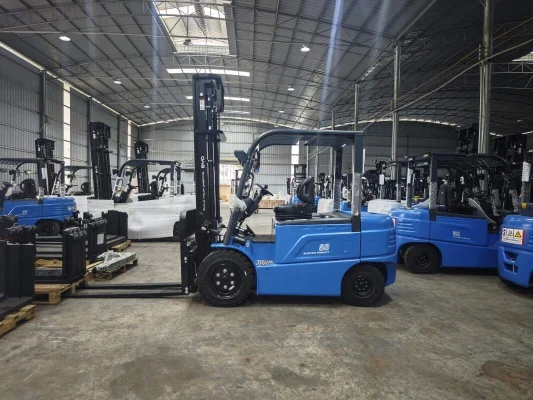
A 3.5 ton electric forklift is a substantial purchase, and the mast is the most consequential part of the specification to get right. Mast stages and free lift determine how high the truck can reach, how much residual capacity remains at that height, and whether it can work inside a trailer or a low-clearance building without raising the inner rails. Before you request a quotation, confirm the lifting height you actually need, the free lift your doorways and trailers impose, the derated capacity at your load center, and the dimensional data the supplier must put in writing. The sections below set out what to verify, what to ask, and where buyers commonly get caught.
Establish the Lift Height and Free Lift Your Operation Actually Needs
Two different numbers drive mast selection, and mixing them up is a frequent source of rework.
- Maximum fork height is the highest point the forks reach. It should come from your tallest storage level plus the clearance needed to enter and withdraw a pallet, not from a general impression of the warehouse.
- Free lift is the amount the inner mast and carriage rise before the outer mast starts to extend. It is the number that decides whether the truck can enter a trailer, a container, or a building with a low header.
Measure the clear opening of every doorway, trailer rear, and mezzanine edge the truck will pass. If the truck must lift a pallet inside a trailer, the free lift must exceed the height of the pallet stack plus the carriage and fork thickness, otherwise the mast collides with the trailer roof. Record the lowest obstruction on each route, not the average.
Also confirm the lowered mast height and the overall height with the mast fully extended. A high-lift mast can be tall enough to conflict with sprinkler heads, lighting, or roof trusses even when the forks are empty. These are dimensional checks, and the supplier should provide them as drawings rather than verbal assurances.
Match Mast Stages to the Load and the Building
The number of mast stages is a trade between reach and visibility, weight, and collapsed height. The table below describes the general characteristics of each configuration; it is a guide to the questions to ask, not a substitute for the manufacturer’s data sheet.
| Configuration | General behaviour | Typical check points |
|---|---|---|
| Two-stage (duplex), no free lift | Simple, low collapsed height, limited free lift | Suitable only where lifting inside a trailer or low doorway is not required |
| Two-stage with free lift | Adds free lift while keeping a relatively low collapsed height | Confirm free lift value against trailer and door clearances |
| Three-stage (triplex) with free lift | Higher reach with free lift, but more mast sections in the view | Check visibility through the mast and residual capacity at height |
For a four-wheel counterbalance electric forklift, the mast, carriage, and fork assembly is carried ahead of the front axle, so every additional stage adds weight and shifts the load centre. That is why the same nominal 3.5 ton rating does not mean 3.5 tons at every height. Ask the supplier to show the capacity chart at your planned load centre and maximum height, and compare it with the heaviest pallet you will lift at that height, not the heaviest pallet in the building.
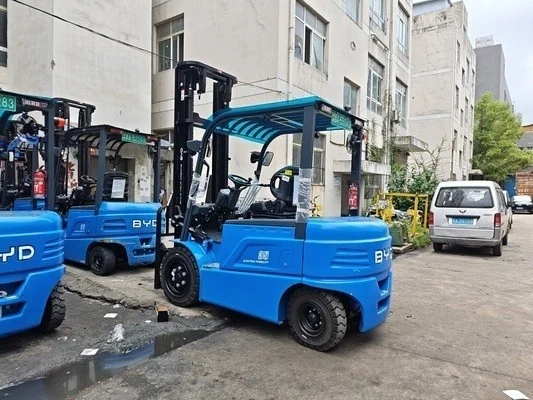
Visibility deserves equal attention. A triplex mast with free lift places more rails in the operator’s line of sight. If your application involves precise placement at height or frequent work near pedestrians, ask whether the supplier offers a mast configuration with improved visibility, and check it during a demonstration if one is available.
Confirm the Data and Documents Before You Request a Quotation
A quotation is only comparable if every supplier quotes against the same requirement. Prepare a short specification sheet and ask each supplier to respond to it line by line.
- Required maximum fork height and the storage levels it serves.
- Required free lift, with the trailer or doorway clearance that drives it.
- Load centre distance and the heaviest load lifted at full height.
- Collapsed mast height and overall extended height.
- Mast stages and whether free lift is included.
- Capacity chart at the stated load centre and height.
- Fork length, width, and thickness, and whether the carriage accepts the attachments you need.
- Battery voltage and capacity, charger type, and the charging window available between shifts.
- Aisle width and the truck’s right-angle stacking dimension, measured against your narrowest aisle.
- Floor condition and any ramps or slopes on the route.
Ask for the capacity chart, the mast drawing, and the dimensional drawing as attachments. If a supplier cannot provide these, treat the offer as incomplete rather than assume the figures. Where the site has not been surveyed, state that a site visit or a measured drawing is required before the mast is finalised.
This is also the point to raise the operating environment: dust, moisture, cold-store temperatures, and floor joints all affect which mast and carriage specification is appropriate. Describe the conditions honestly so the supplier can advise on the correct configuration rather than the cheapest one.
Acceptance Checks and Common Buying Mistakes
When the truck arrives, verify the delivered specification against the approved drawing before it enters service. Check the mast stages, the free lift value, the collapsed and extended heights, and the capacity plate against the ordered figures. Raise the mast through its full travel with a representative load and confirm there is no interference with racking, door headers, or overhead services. Confirm the forks and carriage match the order, and that the capacity chart supplied with the truck matches the one quoted.
Common mistakes include ordering a mast on maximum lift height alone and discovering there is no free lift to enter a trailer; assuming the rated capacity applies at full height; measuring a doorway at its centre rather than at its lowest point; and accepting a verbal capacity figure instead of a chart. Each of these is avoidable with a written specification and a dimensional drawing.
If your operation involves trailer loading, high racking, or tight aisles, send us the load weight, the required lift height, the free lift constraint, and the aisle and floor details. We can then discuss the appropriate four-wheel counterbalance electric forklift configuration and the documentation you should expect with the quotation.
Frequently Asked Questions
Does a higher maximum lift height always mean less capacity?
Capacity generally decreases as load centre and lift height increase, but the exact relationship is defined by the manufacturer’s capacity chart. Ask for the chart at your specific load centre and height rather than relying on a general rule.
How much free lift do I need to work inside a trailer?
It depends on the trailer’s internal height and the height of the load plus the carriage and forks. Measure the clear opening and the stack height, then confirm the free lift figure on the supplier’s drawing exceeds that total.
Can I add free lift to a mast after delivery?
Mast configuration is fixed at build, so free lift should be decided before ordering. Changing it later usually means replacing the mast assembly rather than adjusting it.
What documents should accompany a mast quotation?
Ask for the capacity chart, a mast drawing showing stages, free lift, collapsed and extended heights, and the truck’s dimensional drawing. These let you compare offers on equal terms and verify the delivered machine.
Is a three-stage mast always better than a two-stage mast?
No. A three-stage mast offers greater reach, but it adds weight and can reduce visibility. The right choice depends on your required height, free lift, and the clearance available in your building.