How to Verify Rated Capacity and Load Center Data Before Ordering a 3.5 ton electric forklift
News 03/11/2026
Rated capacity and load center are two of the most misread figures on a forklift data plate, and they matter most when you are specifying a 3.5 ton electric forklift. A nominal 3,500 kg rating is not a promise that the truck will lift 3,500 kg at every height or with every load shape. The rating is tied to a stated load center and usually to a specific lift height and attachment configuration. Before you place an order, confirm that the plate, the quotation and the intended duty all describe the same conditions.
This guide covers what to check on the data plate, how load center changes usable capacity, which documents to request from the supplier, and where buyers commonly get caught out. It applies to four-wheel counterbalance electric forklifts, the type this site supplies in lithium-battery configurations.
What the Data Plate Actually Tells You
A capacity plate on a counterbalance truck normally lists the rated load, the load center distance, the lift height to which the rating applies, and sometimes a second lower rating at a greater height or with a side-shifting attachment. Read every line, not just the headline number.
- Rated capacity: the maximum mass the truck is rated to handle under the stated conditions, not an unconditional limit.
- Load center: the horizontal distance from the vertical face of the forks to the centre of gravity of the load. A 500 mm or 600 mm figure is common, but confirm the actual value on the plate rather than assuming.
- Lift height: many plates show a derated capacity at higher lift, because stability and mast strength change with height.
- Attachment: integrated side shifters, positioners or special forks usually reduce capacity and move the effective load center forward.
If the quotation says only “3.5 ton” without a load center, lift height and attachment condition, you do not yet have enough information to compare offers.
How Load Center Changes Usable Capacity
Capacity falls as the load centre moves further from the fork face, because the turning moment on the truck increases. The exact derating curve is a manufacturer calculation and must come from the supplier’s technical data; do not estimate it from a rule of thumb.
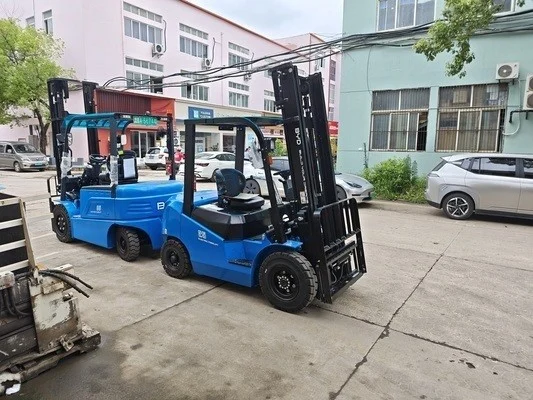
What you can do is measure the real load. Take the actual pallet or stillage, note where its centre of gravity sits relative to the fork face, and compare that with the rated load center. Common causes of a load centre larger than expected include:
- Loads overhanging the pallet edge, so the mass sits further forward.
- Long or irregular goods, such as timber, pipe or bundled profiles, where the centre of gravity is not at the pallet midpoint.
- Attachments that add thickness between the carriage and the load.
- Non-standard pallets with an offset weight distribution.
Assume, as an illustrative scenario, a buyer moving 1,200 kg pallets of bagged material on 1,200 mm pallets. If the goods sit flush and the pallet is loaded evenly, the load centre may fall within the plate rating. If the same goods overhang by 150 mm, the centre of gravity moves forward and the effective capacity at that load center may no longer cover the load. Only the supplier’s derating data can confirm the outcome.
Documents and Questions to Settle Before Ordering
Ask the supplier to confirm the following in writing. These points turn a vague capacity claim into something you can check against your duty.
- Plate image or specification sheet showing rated capacity, load center, lift height and attachment condition.
- Derating information if you intend to lift above the rated height or use an attachment.
- Mast and fork specification, including fork length and spacing, since these affect where the load sits.
- Battery and counterweight configuration, because the truck’s stability depends on the specified battery mass and position.
- Ground and aisle conditions, including floor flatness, slope and aisle width, which affect safe operation even when the load is within the rating.
- Verification method at delivery, such as checking the plate against the order documents and confirming the attachment fitted matches the quoted configuration.
A simple comparison table helps keep offers aligned:
| Item to confirm | Why it matters | Where to find it |
|---|---|---|
| Rated capacity | Sets the maximum load under stated conditions | Data plate and spec sheet |
| Load center | Determines how capacity changes with load shape | Data plate |
| Rated lift height | Capacity may be lower above this height | Data plate or derating chart |
| Attachment type | Attachments usually reduce capacity | Quotation and plate |
| Battery mass | Affects counterbalance and stability | Specification sheet |
If any cell is blank in the supplier’s response, treat it as unresolved rather than assuming a favourable value.
Where Buyers Commonly Go Wrong
The most frequent errors are comparing trucks on the headline tonnage alone, ignoring the load center printed on the plate, and ordering an attachment after the capacity has been agreed. Another common mistake is measuring the load on a level floor with an evenly loaded pallet, then using the same truck with overhanging or off-centre loads in the aisle. Finally, buyers sometimes accept a capacity figure quoted at a lower lift height than the racking they actually use.
Frequently Asked Questions
Does a 3.5 ton rating mean the truck lifts 3,500 kg at any height?
No. The rating applies under the conditions stated on the data plate, typically a specified load center and lift height. Capacity may be lower at greater heights or with attachments. Confirm the derating data with the supplier.
How do I measure the load center of my actual loads?
Identify the centre of gravity of the loaded pallet or stillage and measure the horizontal distance from the vertical face of the forks to that point. For irregular or overhanging loads, this is often further forward than the pallet midpoint.
Can an attachment be added without changing the rated capacity?
Usually not. Attachments such as side shifters or positioners add distance between the carriage and the load and normally reduce the rated capacity. Ask the supplier to confirm the capacity with the exact attachment you intend to use.
What should I check when the forklift is delivered?
Compare the data plate against the order documents: rated capacity, load center, lift height and attachment. Confirm the fitted battery matches the specified mass and configuration, and that the mast and forks match the quotation.
Before ordering, gather your real load weights, load dimensions, lift heights and aisle measurements, then ask the supplier to confirm each figure against the data plate. If you are evaluating a four-wheel counterbalance electric forklift from this site, share your duty details and the team can confirm which configuration and capacity rating fit your operation.