Selecting a 3 Ton Electric Forklift: Matching Battery Capacity and Charging Regime to Your Shift Pattern
News 05/11/2026
A 3 ton electric forklift is often specified around a single headline number: rated load. That number tells you what the truck can lift under stated test conditions, but it does not tell you whether the battery will still be delivering useful work at hour six of a busy shift. Battery capacity and charging regime are the two variables that decide whether a nominally suitable truck keeps up with your schedule, and they must be matched to the shift pattern rather than chosen independently. This guide explains the conditions that drive the decision, the trade-offs between battery options and charging approaches, and the data you should gather before requesting a configuration.
Why shift pattern drives battery and charging decisions
A shift pattern is not just the number of hours the truck is switched on. It combines operating hours, the intensity of work within those hours, breaks, idle periods, and the time available between shifts. Two operations running the same four-wheel counterbalance electric forklift eight hours a day can place very different demands on the battery: one may spend much of the day waiting at a loading dock, while another may run continuous pallet movement with frequent lifting and travel.
The practical consequence is that battery capacity should be sized against energy consumed per shift, not against clock hours alone. Where duty is light and intermittent, a smaller battery may complete the shift with reserve remaining. Where duty is heavy and continuous, the same battery may be depleted before the shift ends, forcing either a larger pack, an opportunity-charging routine, or a battery exchange.
Three shift characteristics matter most:
- Operating hours per shift: the window during which the truck must remain available, including short pauses.
- Duty intensity: how much of that window involves travel, lifting, and hydraulic work, and how much is idle.
- Turnaround between shifts: whether the truck can charge during breaks and between shifts, or must be ready immediately.
These characteristics should be recorded as observed ranges rather than single estimates. A truck that occasionally works a peak day needs headroom that an average day would not reveal.
Reading battery capacity in the context of a 3 ton electric forklift
Battery capacity is usually quoted in kilowatt-hours or as a voltage and amp-hour combination. Both describe stored energy, and both must be read alongside the truck’s nominal voltage and the manufacturer’s approved battery specification. A capacity figure that does not match the truck’s voltage and compartment dimensions is not a usable option, regardless of its nominal energy content.
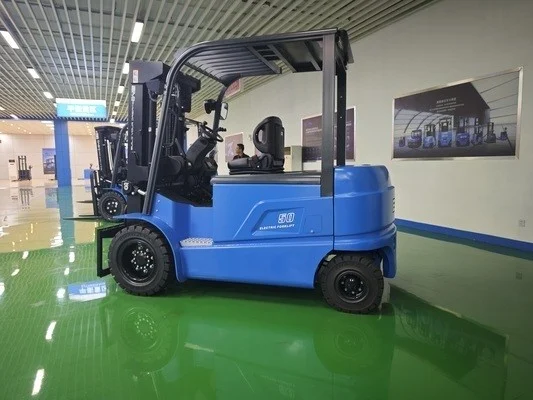
Capacity also interacts with counterweight and stability. A four-wheel counterbalance electric forklift relies on the battery as part of its counterweight, so the approved battery mass and position are part of the truck’s stability envelope. Substituting a lighter or differently shaped pack without manufacturer confirmation is not a capacity upgrade; it is a change to the machine’s configuration.
When comparing options, separate the questions:
| Question | What it determines |
|---|---|
| Does the pack meet the truck’s approved voltage, mass, and compartment specification? | Whether the configuration is permissible at all |
| How much energy does a typical shift consume? | Whether one charge covers the shift with reserve |
| How much energy does a peak shift consume? | Whether the plan survives the busiest days |
| What charging power and time are available? | Whether the pack can be replenished within the schedule |
Energy consumption per shift is best estimated from the actual work profile: travel distance, number of lifts, lift height, load weight distribution, and floor and ramp conditions. Where such data is unavailable, the honest approach is to state the assumptions and treat the resulting figure as provisional until measured on site. Published runtime claims should be read with their test conditions, which rarely match a specific operation.
Charging regimes and how they fit different schedules
Charging regime means when, how often, and at what power the battery is replenished. The main patterns are straightforward, and each suits a different schedule shape.
Single overnight charge
The truck works one shift, then charges during a long off-shift period. This is the simplest regime and suits operations with a clear daily cycle and a charging point at the parking position. Its limitation is that any shift extension or unexpected second shift must be covered by reserve capacity, because there is no opportunity to recharge mid-duty.
Opportunity charging during breaks
The truck is connected during scheduled breaks, shift changes, and idle windows. This spreads replenishment across the day and can allow a smaller pack to complete a longer working period. It requires charging equipment at locations the truck naturally visits, and it requires discipline: connectors must be rated and handled correctly, and charging must not interfere with safety or traffic routes. Opportunity charging is a schedule design decision, not a plug-in afterthought.
Multi-shift operation with exchange or dedicated charging windows
Where the truck must run across two or three shifts, the plan usually involves either a battery exchange or carefully placed charging windows that do not reduce availability below the required level. Both approaches depend on battery handling arrangements, charger capacity, and the time actually available between shifts. These should be confirmed with the supplier rather than assumed.
Across all regimes, the charger must match the battery’s approved charging profile. Fast charging is not a universal setting; it is a capability that depends on the battery, the charger, and the manufacturer’s instructions. Treat any claim about charging speed as conditional on those three elements.
Matching capacity and charging to your operation: a practical sequence
The following sequence keeps the decision grounded in observed conditions rather than catalogue figures. It applies to a four-wheel counterbalance electric forklift and should be repeated whenever the duty cycle changes materially.
- Describe the shift pattern in hours and intensity. Record operating hours, typical and peak duty, break windows, and the gap between shifts.
- Estimate energy demand per shift. Use travel distance, lift count, lift height, load weights, and floor or ramp conditions. Mark the estimate as provisional if it is based on assumptions.
- Check permissible battery configurations. Confirm approved voltage, mass, and compartment dimensions with the supplier before comparing capacities.
- Select a charging regime that fits the schedule. Decide whether overnight charging, opportunity charging, exchange, or a combination is realistic given charger locations and available time.
- Test the plan against peak conditions. Confirm that the chosen capacity and regime still work on the busiest expected day, not only the average day.
- Define what will be measured. Agree which parameters will be checked during commissioning, such as energy used per shift or state of charge at shift end, so the plan can be adjusted with evidence.
A hypothetical application shows how the sequence works. Suppose a warehouse runs a single eight-hour shift with moderate pallet movement and a 30-minute lunch break, and the truck parks near a charger. An overnight charge may be sufficient if the estimated energy demand leaves reserve. If the same site adds a busy dispatch period at the end of each day, the estimate should be recalculated against that peak, and opportunity charging during the lunch break may be worth evaluating. The conclusion is site-specific; the sequence is what makes it defensible.
Common errors include sizing on average duty and ignoring peaks, assuming a larger battery always solves a schedule problem without checking charging time, and treating opportunity charging as free time when it actually competes with truck availability. Each error is corrected by returning to observed shift data.
Frequently asked questions
Can one battery last a full shift on a 3 ton electric forklift?
It can, but only when the battery capacity matches the energy consumed during that shift with reserve remaining. Light, intermittent duty is more likely to be covered by a single charge than heavy, continuous duty. The reliable way to decide is to estimate energy demand from the actual work profile and confirm the permissible battery configuration with the supplier.
Is opportunity charging always better than overnight charging?
No. Opportunity charging can help longer or more intense schedules, but it requires accessible charging points, suitable equipment, and time windows that do not reduce truck availability. Overnight charging is simpler and often adequate where a single shift leaves a long off-shift period. The right choice depends on the schedule shape.
Does a bigger battery remove the need to plan charging?
Not entirely. A larger approved pack may extend runtime, but it still must be recharged within the available window, and it must meet the truck’s approved mass and compartment specification. Charging time, charger capability, and shift turnaround remain part of the plan.
Which details should I provide when requesting a configuration?
Provide operating hours and duty intensity, typical and peak loads, lift heights, load centre, aisle widths, floor and ramp conditions, break and shift-change windows, charger locations, and available charging time. These details let the supplier propose a battery capacity and charging regime that fit the schedule rather than a generic specification. If you are evaluating a four-wheel counterbalance electric forklift, share these operating conditions and the required load and lift height so the selection and configuration can be checked against your actual work.