Battery Charging Strategy and Runtime Planning for a 5.0t Electric Counterbalance Forklift
News 06/11/2026
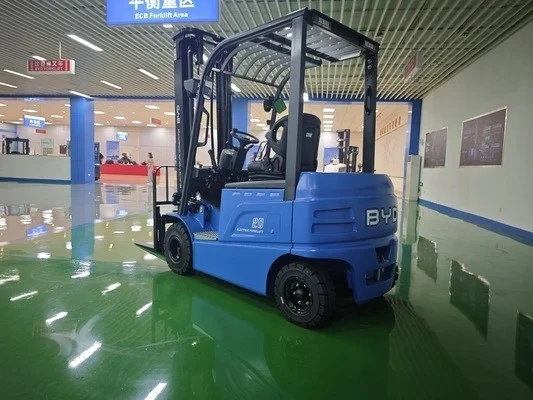
A 5.0t electric counterbalance forklift is a high-draw machine, and its working day is shaped less by the nominal battery capacity than by how that energy is scheduled. The practical answer is to plan around usable ampere-hours per shift, match charging windows to break patterns, and confirm the battery, charger, and BMS limits with the supplier before committing to a one-battery or two-battery setup. This article explains how to build that plan around a four-wheel counterbalance electric forklift, what data to collect, and where the honest limits sit.
How a 5.0t Electric Counterbalance Shift Consumes Energy
Energy use on a heavy counterbalance truck is not constant. Lifting a full load, travelling with it, and frequent hydraulic movements at the mast all raise current draw, while idle time and empty travel lower it. A 5.0t electric counterbalance working a busy loading bay and a similar truck working light internal transfers can therefore finish the same shift with very different state-of-charge readings.
Rather than assume a fixed runtime, treat runtime as an output of four variables: load weight and how often it approaches rated capacity, lift height and lift frequency, travel distance and surface, and the share of the shift spent moving versus waiting. The battery’s usable capacity, the discharge limits set in the battery management system, and ambient temperature then determine how much of that demand the pack can actually deliver.
Because published runtime figures depend on test conditions, the only reliable number is the one measured on your own operation. A simple method is to log state-of-charge at the start and end of several representative shifts, note the loads and lift heights involved, and use that pattern to estimate daily energy demand. If the truck is new to the site, ask the supplier which test profile any quoted runtime refers to and whether it matches your duty.
Charging Strategy Options and When Each Fits
Charging decisions usually come down to three patterns: one battery charged overnight, opportunity charging during breaks, or two batteries rotated between truck and charger. Each has conditions under which it works well and conditions under which it does not.
Overnight charging with a single battery
This is the simplest pattern and suits operations where one shift’s energy demand stays comfortably within the usable capacity the supplier confirms. It requires a dedicated charging position, a charger matched to the battery’s voltage and chemistry, and enough time between shifts to complete a full charge. The risk is a busy day that exceeds the estimate; without a second pack or a mid-shift top-up, the truck may need to stop.
Opportunity charging during breaks
Short charging sessions during lunch and shift changes can extend a single battery’s working day, but only if the battery, charger, and BMS are specified to accept partial charging without harm. This is a configuration question, not a universal capability. Ask the supplier whether the proposed lithium battery and charger support opportunity charging, what charge-current limits apply, and whether any minimum cool-down or state-of-charge window should be observed.
Two-battery rotation
Where duty is heavy or the operation runs multiple shifts, rotating two batteries keeps a truck available while one pack charges. This raises cost and requires safe handling and storage space, plus a charging area with appropriate ventilation and electrical capacity. It is often the more robust answer when energy demand is uncertain, but it should be justified by measured or supplier-confirmed demand rather than by habit.
| Parameter or decision | Why it matters on a 5.0t truck | What to confirm with the supplier | Typical status |
|---|---|---|---|
| Battery nominal voltage and capacity | Sets the energy available per charge | Datasheet values and the test conditions behind any runtime claim | Standard specification |
| Usable capacity and BMS discharge limits | Determines how much of the pack can be used before derating | State-of-charge window and any power reduction near low charge | Confirm per configuration |
| Charger rating and charge profile | Controls charging time and battery life | Matched charger model and supported charge currents | Standard or optional depending on package |
| Opportunity charging support | Affects whether break-time top-ups are viable | Written confirmation of partial-charge capability and limits | Confirm; not universal |
| Operating and charging temperature range | Cold or hot environments change available capacity | Battery and charger temperature limits and any heating option | Confirm with manufacturer data |
| Battery handling and storage | Needed if packs are rotated or swapped | Recommended handling method and storage conditions | Depends on chosen strategy |
Data to Collect and Questions to Settle Before Purchase
Good runtime planning starts with the operation, not the brochure. Before selecting a battery and charger package, gather the facts that drive energy demand and check them against what the supplier can document.
- Shift pattern: hours per shift, shifts per day, and how many days per week the truck works.
- Load profile: typical load weight, how often loads approach rated capacity, and whether attachments change the effective capacity.
- Lift profile: usual lift height, maximum lift height, and lift frequency per hour.
- Travel profile: route length, floor condition, ramps, and door or aisle constraints.
- Charging environment: available electrical supply, charger location, ventilation, and ambient temperature.
- Availability target: how much downtime the operation can tolerate if a battery needs charging mid-shift.
Put these facts to the supplier as questions rather than assumptions. Which battery capacity and charger are being proposed, and on what duty profile is that recommendation based? What are the confirmed operating and charging temperature limits? Does the BMS reduce power at low state of charge, and at what point? Is opportunity charging supported in writing? What maintenance and inspection routine does the battery require? These answers let you compare offers on the same basis and avoid buying a package that only works on paper.
Two common errors deserve mention. The first is planning runtime from a nominal capacity figure without accounting for usable capacity and duty. The second is adding opportunity charging to a package that was not specified to accept it. Both are avoidable with a short written confirmation from the supplier covering the proposed battery, charger, and intended charging pattern.
Where the answers show that a single battery cannot cover the shift, the choice is between a second pack and a revised charging schedule, not a workaround that pushes the battery beyond its stated limits. If your loads, lift heights, or aisle dimensions point toward a different truck type entirely, say so early; a four-wheel counterbalance electric forklift is a strong general-purpose choice, but it is not the right answer to every handling problem.
To move from general guidance to a concrete plan, share your shift pattern, typical and maximum load, lift height, and charging conditions with our team. We can then discuss the configuration and options available on BYD four-wheel counterbalance electric forklifts and identify which parameters still need confirmation from the manufacturer’s technical data.
Frequently Asked Questions
How long will one battery last on a 5.0t electric counterbalance?
There is no single figure. Runtime depends on load weight, lift height and frequency, travel distance, floor conditions, ambient temperature, and the usable capacity the BMS allows. Ask the supplier to state the duty profile behind any estimate and measure state-of-charge across several real shifts before fixing a charging schedule.
Can we top up the battery during lunch breaks?
Only if the battery, charger, and BMS are specified to accept opportunity charging. This is a configuration-specific capability, so request written confirmation covering the proposed equipment and any charge-current or state-of-charge limits that apply.
Is a second battery worth the extra cost?
It is justified when measured or supplier-confirmed energy demand exceeds what one pack can deliver within the available charging windows, or when multi-shift operation leaves no time to recharge. Otherwise, a single battery with a well-matched charger may be sufficient. The decision should rest on your duty data, not on a general rule.
What should we verify about cold or hot storage conditions?
Confirm the manufacturer’s stated operating and charging temperature ranges for both the truck and the battery, and ask how available capacity and charging behaviour change at the temperature extremes your site actually reaches. Do not assume a standard package covers extreme conditions without documented limits.