How to Specify a 5.0t Electric Counterbalance Forklift: Load Center, Lift Height, and Battery Choices
News 30/10/2026
Specifying a 5.0t electric counterbalance involves three decisions that interact: the load center at which the rated capacity is declared, the lift height and mast type you actually need, and the battery configuration that keeps the truck working across your shift pattern. Get the order wrong and you either over-buy capacity or discover the truck cannot hold its rated load at height. This guide walks through the sequence a buyer should follow when scoping a four-wheel counterbalance electric forklift, and it flags the data you must collect before requesting a quotation.
Start With the Load, Not the Capacity Number
A nominal 5.0t rating is meaningless until you know the load center it assumes. Forklift capacity ratings are tied to a stated load center — commonly 500 mm or 600 mm, but you must confirm the figure on the manufacturer’s data plate rather than assume it. The load center is the horizontal distance from the vertical face of the forks to the center of gravity of the load.
If your real load sits farther out, the truck’s allowable capacity falls. The relationship is a moment balance: capacity multiplied by load center must stay within the truck’s rated moment. A load whose center of gravity is beyond the rated load center therefore reduces the safe capacity, and the manufacturer’s load chart governs the exact figure. Do not extrapolate the reduction yourself; ask the supplier to confirm allowable capacity at your actual load center.
Practical steps to pin down the load
- Measure or obtain the weight of the heaviest load, not the average load.
- Identify the load’s center of gravity, including any overhang from pallet or attachment geometry.
- Note whether an attachment (clamp, rotator, fork extension) will be fitted — attachments typically reduce rated capacity and shift the effective load center.
- Confirm the load center stated on the data plate of the model you are considering.
A common specification error is sizing the truck to the pallet weight alone while ignoring that the load center moves outward once fork extensions or non-standard pallets are used. If the load center is uncertain, treat it as a variable to be confirmed with the supplier before signing.
Lift Height, Mast Choice, and Residual Capacity
Lift height affects more than the mast you order. As lift height increases, many trucks experience a reduction in residual capacity, and the load chart will show this. The height you specify should be the height needed to place the load, measured to the fork surface or to the load’s underside depending on how the supplier defines it — clarify the convention.
Mast type follows from the height and the building:
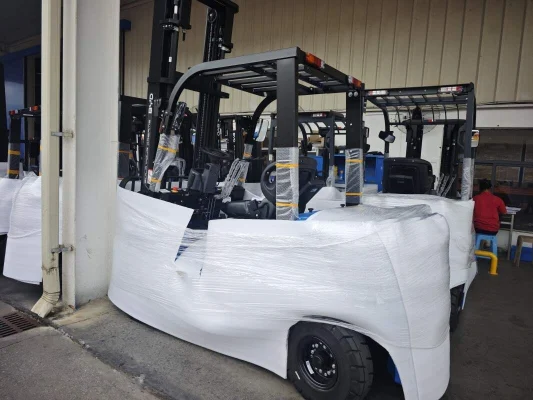
- Duplex (two-stage) masts suit moderate heights and free-lift is limited; check free lift if you work inside containers or low doorways.
- Triplex (three-stage) masts reach higher while keeping collapsed height lower, which matters where overhead clearance is tight.
- Free-lift requirements should be stated explicitly if the truck must enter trailers or low-clearance areas with the forks raised.
Record the following before requesting a quote: maximum lift height, collapsed mast height, overhead guard height, and the door or rack beam clearance the truck must pass under. Also state the racking beam levels and whether loads are double-stacked. A truck that fits the aisle but not the doorway is a costly discovery.
Height data worth confirming
| Parameter | Why it matters |
|---|---|
| Rated load center | Sets the capacity baseline |
| Maximum lift height | Determines mast selection |
| Residual capacity at height | Confirms the truck can lift the load at the top beam |
| Collapsed height and free lift | Governs entry into trailers and low-clearance zones |
| Overhead guard height | Must clear doorways and sprinkler lines |
Battery and Charging Configuration
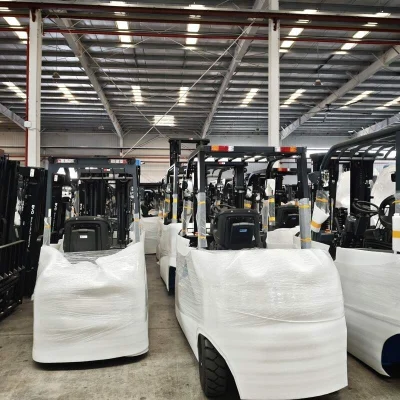
Battery choice is a shift-pattern decision. A lithium-ion battery in a four-wheel counterbalance electric forklift is typically opportunity-charged during breaks, which can suit multi-shift operations where a single battery must cover more than one shift. Whether that works depends on the truck’s energy consumption in your duty cycle, the charger rating, and the charging windows available. These are not universal figures — they must come from the manufacturer’s data and your own duty-cycle estimate.
Questions to settle with the supplier:
- Battery voltage and capacity offered with the 5.0t model, and whether the configuration is fixed or selectable.
- Charger type and rating, and whether opportunity charging is supported.
- Charging area requirements, including ventilation and electrical supply.
- Expected battery service life under your shift pattern — ask for the basis of any figure, and treat it as an estimate, not a guarantee.
Do not assume that a larger battery automatically solves a multi-shift problem. If the duty cycle is heavy and charging windows are short, the real constraint may be charger capacity or the number of batteries, not the truck’s rated capacity. State your shift length, number of shifts, and available charging time in the enquiry.
Frequently Asked Questions
Does a 5.0t rating mean the truck lifts 5 tonnes at any height?
No. The rating applies at a stated load center and often at a stated height. Residual capacity can fall as lift height and load center increase. Always check the load chart and data plate.
What if my load center is greater than the rated figure?
The allowable capacity is reduced. Ask the supplier to confirm the permitted capacity at your actual load center rather than applying the nominal rating.
Can one lithium-ion battery cover two shifts?
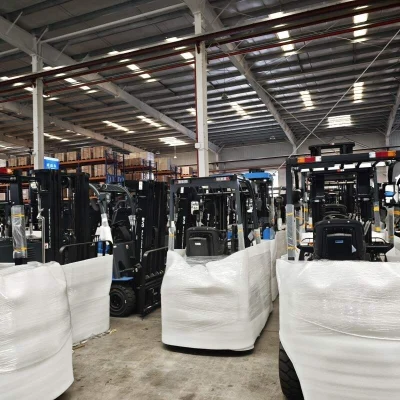
It depends on energy consumption, charger rating, and the charging windows in your schedule. Confirm with the manufacturer using your duty-cycle data; do not rely on a general rule.
What should I include in a specification enquiry?
Heaviest load weight, load center, required lift height, aisle and doorway clearances, shift pattern, charging time available, and any attachments. These let the supplier propose a configuration that fits your operation.
Before finalizing, verify every figure on the manufacturer’s data sheet against your own measurements, and confirm which parameters are fixed and which are options. Where a value is not stated, ask rather than estimate.