5 Ton Four-Wheel Counterbalance Electric Forklift: Matching Battery Voltage and Charger Infrastructure to Shift Patterns
News 04/11/2026
A 5 ton forklift asks more of its battery and charger than a lighter truck doing the same number of hours. The battery pack is larger, the current draw during lifting and travel is higher, and a charger sized around a smaller truck may not restore the pack between shifts. The practical question is not simply which voltage to choose, but whether the battery, charger, and shift schedule fit together without forcing long idle periods or deep discharges.
This article explains how operating voltage, charger output, and shift patterns interact on a four-wheel counterbalance electric forklift, and which details to confirm with a supplier before ordering. Exact figures depend on the specific model and its manufacturer datasheet, so treat the ranges here as planning guidance rather than published specifications.
Why Battery Voltage Is a System Decision, Not a Single Number
Electric forklifts commonly operate at nominal voltages such as 48 V, 80 V, and higher, and the voltage class affects the whole energy chain: the battery pack, the charger, the cables and connectors, and the motor and controller design. On a 5 ton four-wheel counterbalance electric forklift, a higher voltage class generally allows lower current at the same power level, which can reduce resistive losses and cable heating. That does not automatically make a higher voltage better, because the charger, connectors, and available battery capacity must match the truck’s design.
Voltage is set by the forklift’s electrical architecture, not chosen independently by the buyer. The useful buyer question is whether the battery capacity supplied with the truck, measured in ampere-hours, is adequate for the duty cycle, and whether the charger can deliver enough energy within the available charging window. Two batteries of the same nominal voltage can differ substantially in capacity and in how much usable energy remains at the end of a shift.
Three linked variables decide whether a configuration works:
- Energy consumed per shift: driven by load weight, lift height, travel distance, ramp use, and how many hours the truck is actually moving or lifting.
- Usable battery capacity: the portion of rated capacity that can be used without excessive depth of discharge, which the battery supplier should state.
- Charging window: the real time available between shifts, including breaks, meal periods, and any opportunity charging.
Reading Shift Patterns Against Charging Windows
Shift patterns matter more than the calendar because they determine how much uninterrupted charging time exists. A single-shift operation with an eight-hour break may allow a full recharge. A two- or three-shift operation with short handovers may require either a larger battery, opportunity charging during breaks, or a battery exchange arrangement.
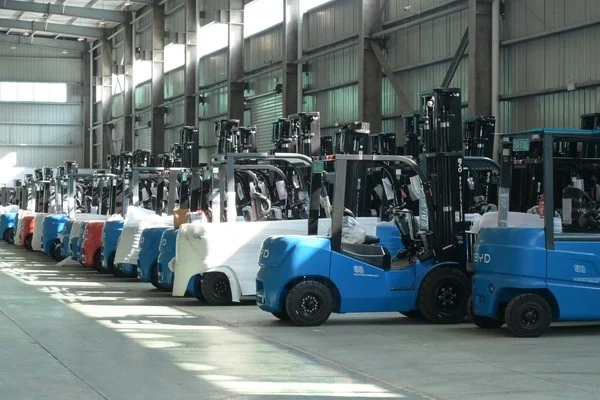
The following table describes common patterns in general terms. It is planning guidance, not a specification, and actual suitability depends on measured energy use and the charger’s published charge curve.
| Shift pattern | Charging window | Typical planning implication |
|---|---|---|
| Single shift, moderate use | Long overnight window | A single battery and a correctly sized charger may be sufficient; confirm capacity against measured energy use. |
| Two shifts, short handover | Limited between shifts | Opportunity charging during breaks or a larger battery may be needed; charger output becomes decisive. |
| Three shifts or near-continuous use | Very short windows | Battery exchange or multiple packs are often considered; confirm with the supplier whether the truck supports the chosen approach. |
| Seasonal peaks | Variable | Peak weeks may need temporary charging capacity or stricter monitoring of depth of discharge. |
One common mistake is counting the whole break as charging time. Connector handling, parking, and the charger’s tapering behavior near full charge reduce the useful window. Another is assuming that a faster charger solves every gap; charger output must be compatible with the battery’s accepted charge rate, and pushing beyond the battery supplier’s limits can shorten pack life or create safety issues.
Charger Infrastructure Checks Before You Commit
Charger infrastructure is often the constraint that appears late in a project. Before ordering a 5 ton forklift, confirm the following with the supplier and the site electrical team:
- Input power available: the charger’s supply voltage, phase, and current draw must match what the facility can provide at the charging location.
- Charger output and compatibility: output voltage range and charge profile must suit the battery chemistry and capacity supplied with the truck.
- Connector and cable standards: battery connectors, cable length, and strain relief should be specified so the truck can reach the charger safely.
- Ventilation and environment: charging areas need appropriate ventilation and protection from moisture, dust, and traffic, as required by the battery and charger documentation.
- Layout and access: space to park, plug in, and move away without blocking aisles or emergency routes.
Ask the supplier to state, in writing, the recommended charger type and the battery capacity that suits your duty cycle. If the site cannot supply the required input power at the intended charging point, the layout or the electrical service may need review before delivery, not after.
Load, Height, and Site Factors That Change Energy Demand
Battery and charger sizing cannot be separated from what the truck actually does. A 5 ton forklift rated at a nominal capacity may have a reduced capacity at a specified load center and lift height, and the manufacturer’s load chart governs. Heavier loads, higher lifts, long travel distances, ramps, and frequent hydraulic attachment use all increase energy consumption.
Site conditions also affect the choice. Narrow aisles, uneven floors, and outdoor transitions influence how much time the truck spends maneuvering rather than traveling efficiently. Ambient temperature affects battery behavior, so a cold storage or unheated warehouse application deserves a specific conversation with the battery and truck supplier rather than a generic assumption.
In a hypothetical example, a yard operation moving dense loads over long distances with frequent lifting would likely need more energy per shift than an indoor operation doing short cycles at low height. The difference should be estimated from cycle data, not guessed from truck capacity alone. Where cycle data is unavailable, describe the operation honestly to the supplier and ask what information they need to size the battery and charger.
FAQ
Can I use an existing charger with a new 5 ton electric forklift?
Only if the charger’s output profile, voltage range, connector, and charge rate are compatible with the new battery. Confirm this against the battery and charger documentation; an incompatible charger can damage the pack or create safety risks.
Is a higher voltage always better on a large counterbalance truck?
No. Voltage class is part of the truck’s design. Higher voltage can reduce current at a given power level, but the battery capacity, charger, and components must all match. The right choice depends on the model and duty cycle, not on voltage alone.
How do I know whether one battery is enough?
Compare the energy the truck uses per shift with the usable capacity the battery supplier states, allowing a margin. If the charging window is too short to restore that energy, consider opportunity charging, a larger pack, or battery exchange, subject to what the truck supports.
What information should I give a supplier when requesting a configuration?
Provide load weight and load center, lift height, travel distances, ramp use, shift length and breaks, charging location and available input power, and any temperature extremes. These details let the supplier propose a battery and charger combination that fits the actual operation.
To move from general guidance to a specific proposal, share your duty cycle and site conditions with our team and ask about configuration options on our BYD four-wheel counterbalance electric forklifts, including the battery and charger arrangements suited to your shift pattern.