Planning Charging Area Layout and Ventilation When Installing a BYD Counterbalance Forklift Fleet
News 09/11/2026
Charging area planning starts with the fleet itself, not the room. Before you draw cable routes or specify fans, confirm the number of four-wheel counterbalance electric forklifts, the battery capacity each truck carries, the charger output you intend to use, and the shift pattern that determines when trucks return to charge. A BYD counterbalance forklift fleet using lithium batteries changes several assumptions: opportunity charging is practical, so trucks may visit the charger between tasks rather than only at shift end, and the charging area may need to serve more, shorter visits instead of a single overnight queue. The layout and ventilation plan should reflect that pattern.
This guide covers the decisions you can make before installation and the parameters you must obtain from the supplier. It does not supply charger specifications or airflow figures, because those depend on the exact models and the manufacturer’s technical documentation.
Start with the charging profile, not the floor plan
A charging area layout is only as good as the operating data behind it. Collect the following before sizing anything:
- Truck count and battery capacity. Note the battery voltage and rated capacity of each truck in the fleet, taken from the supplier’s data sheet.
- Charger type and output. Confirm whether chargers are onboard or external, their input supply requirements, and their rated output. These numbers come from the charger documentation, not from estimates.
- Charging opportunity. Record when trucks are likely to be parked: breaks, shift changes, loading gaps, and overnight. Lithium batteries generally tolerate opportunity charging, but the charger and battery supplier should confirm what is acceptable.
- Peak simultaneous demand. Decide how many trucks may charge at once. This single number drives circuit capacity, charger count, and the physical bay count.
A common planning error is to size the area around the total fleet rather than the peak number of trucks charging simultaneously. If ten trucks exist but only three charge at any one time, a ten-bay layout wastes floor space and ventilation capacity.
Space allocation and traffic flow around the chargers
A four-wheel counterbalance electric forklift needs room to approach, align, and leave a charging position, and the operator needs room to connect and disconnect safely. The required clearances depend on the truck’s dimensions and turning radius, which the supplier provides. Use those figures rather than rules of thumb.
Bay arrangement
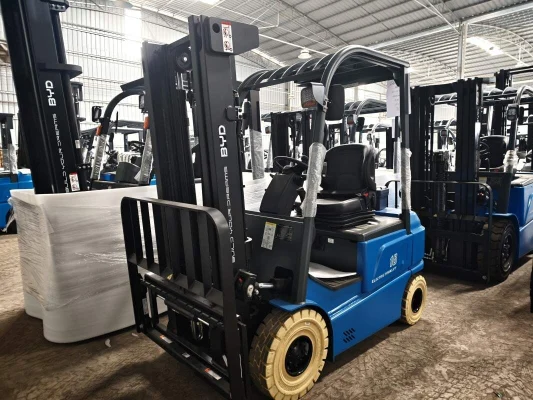
Two basic arrangements are common. Parallel bays let trucks drive in and out with a forward approach, which suits tighter rooms. Perpendicular or angled bays may reduce the length of the charging wall but demand more aisle width. Whichever you choose, keep the following in mind:
- Leave a marked pedestrian route that does not cross the charging bays.
- Keep chargers and cable connections out of the truck’s path, ideally on a wall or pedestal behind a protective barrier.
- Provide a dedicated position for the battery connector or charging plug so cables are not left on the floor.
- Allow space to park a truck that is waiting to charge, so the aisle does not become a queue.
Floor and environment
Check the floor’s flatness and load capacity where trucks will stand, and confirm the charger mounting method with the supplier. Keep the area free of standing water and away from wash-down zones unless the equipment is rated for that environment. The charger documentation should state the acceptable ambient temperature and humidity range; plan ventilation and heating around those limits.
Electrical supply, protection, and fire precautions
Electrical design belongs to a qualified electrical engineer working from the charger manufacturer’s installation instructions. Your planning role is to gather the inputs and confirm the interfaces:
- The supply voltage, phase, and current each charger requires, and whether the site supply can deliver the peak simultaneous load.
- Whether chargers need individual circuits or can share distribution, as specified by the charger documentation.
- Protective devices, isolation points, and emergency stop locations required by the manufacturer and local electrical codes.
- Cable routing that keeps leads off the floor and clear of truck traffic.
Fire precautions should follow the battery and charger documentation and applicable local regulations. Do not assume that a lithium battery fleet needs the same fire provisions as a lead-acid charging room, or the reverse; ask the supplier what they specify, and confirm the final arrangement with the authority having jurisdiction. Keep the charging area clear of combustible storage regardless of battery chemistry.
Ventilation: what to confirm and what to avoid guessing
Ventilation planning often goes wrong in two directions: assuming no ventilation is needed, or copying airflow figures from an unrelated project. Neither is safe. The correct approach is to establish what the equipment emits and what the space requires.
Questions to put to the supplier
- Does the charging process release gases, vapors, or heat that require mechanical ventilation, and under what fault conditions?
- What airflow or air-change rate does the manufacturer recommend, and at what room volume and temperature?
- Are there specific requirements during equalization, balancing, or any maintenance charging mode?
- What monitoring or alarm provisions does the charger include?
Record the answers in the project file. If the supplier states that ventilation is not required under normal operation, ask about abnormal conditions and about heat buildup in a small room. Where mechanical ventilation is specified, the design should keep the room under slight negative pressure relative to adjacent occupied areas if the supplier or regulations call for containment, and the exhaust should discharge to a safe location.

Practical layout points
Place supply air so it does not blow directly onto chargers or connectors, and keep exhaust intakes positioned according to the ventilation design rather than convenience. Avoid dead corners behind parked trucks. Confirm that ventilation runs whenever charging is possible, not only when a truck is connected, if the design requires continuous operation. Interlock arrangements and airflow monitoring should be agreed with the designer and the equipment supplier.
Commissioning checks and questions buyers should ask
Before the area goes into service, walk through a short verification list with the installer and the forklift supplier:
- Each charger is installed to the manufacturer’s instructions, with the specified clearances and protection.
- Markings show bay positions, pedestrian routes, and cable management points.
- Ventilation, if required, is operational and its controls are understood by site staff.
- Operators have been briefed on connecting and disconnecting, emergency stops, and who to contact when a charger faults.
- The supplier’s recommended charging routine has been written into the shift plan.
When requesting a quotation or layout review, give the supplier the truck models, battery capacity, expected peak simultaneous charging count, room dimensions, and available electrical supply. Those details let them confirm charger selection and the installation requirements that your ventilation and electrical designers need. If any figure is unknown, list it as an open item rather than filling it with an assumption.
Frequently asked questions
Does a BYD lithium battery fleet need a ventilated charging room?
That depends on the charger and battery documentation and on local regulations. Ask the supplier whether normal charging, balancing, or fault conditions produce gases, vapors, or significant heat, and what ventilation they specify. Do not assume that lithium batteries eliminate ventilation requirements, and do not copy airflow figures from another site.
How many charging bays should we plan?
Base the count on the peak number of trucks expected to charge at the same time, not on total fleet size. Consider break patterns, shift changes, and whether opportunity charging will spread visits across the day. Confirm charger output and charging time with the supplier before fixing the bay count.
Can trucks charge during short breaks?
Opportunity charging is often practical with lithium batteries, but the acceptable pattern depends on the battery and charger specifications. Ask the supplier what charging routine they recommend and whether partial charging between shifts affects any warranty or maintenance condition.
What clearances should the charging area have?
Clearances depend on the truck’s dimensions and turning radius and on the charger’s installation instructions. Obtain both sets of figures, then design the approach, exit, and pedestrian routes around them. Keep cables and connectors out of the truck path and behind protection where possible.
Who should design the electrical and ventilation systems?
Use qualified electrical and mechanical designers working from the charger manufacturer’s documentation and applicable local codes. Your role is to supply accurate fleet and operating data and to confirm that the installed systems match the supplier’s requirements before commissioning.