BYD ECB Forklift Site Assessment: Floor Loading, Door Clearances, and Aisle Widths to Verify Before Delivery
News 02/11/2026
A BYD ECB forklift can be a good fit on paper and still fail to reach its work area on delivery day. Before you confirm an order, verify three physical conditions at the site: whether the floor can carry the truck and its load, whether the machine can pass through every door and opening along the route, and whether the aisles leave enough room to turn and stack. These checks use dimensions and load figures you already have or can measure, so they cost little now and prevent expensive surprises later. The steps below apply to four-wheel counterbalance electric forklifts; confirm the exact values against the technical data sheet your supplier provides, because model-specific figures vary.
Floor Loading: What the Truck and Its Load Actually Impose
Floor capacity is rarely a single uniform number. A counterbalance truck concentrates much of its weight on the front wheels, and the load sits ahead of the wheelbase. That means the pressure under the drive wheels is higher than the average of truck weight plus load divided by four. Treat any simple average calculation as a starting point only.
Information to collect before asking an engineer
- Truck weight and wheelbase from the technical data sheet, including battery type and any attachment.
- Rated capacity and load centre the truck is rated at, plus the actual load weight and its centre of gravity.
- Floor construction at every point on the route: slab-on-grade, suspended slab, mezzanine, ramp, dock leveller, or trench cover.
- Any weight limits already documented by the building owner or structural engineer, especially on upper floors and ramps.
The relevant check is point load and local pressure under each wheel, not just total tonnage. A structural engineer can compare these figures with the floor design. Do not approve a route based on a visual inspection of the concrete alone, and do not assume that a floor which carries a loaded delivery truck will automatically suit a forklift, because the contact area and load path differ.
Common mistakes
Owners often check only the static parked weight and ignore the dynamic effect of braking, turning, and lifting. They also forget that a heavier battery option or an attachment changes the truck weight and the load centre. If the site includes ramps, expansion joints, drainage covers, or dock levellers, list them as separate checkpoints. Where the floor or structure is uncertain, pause the order and obtain a written assessment.
Door Clearances and the Route to the Work Area
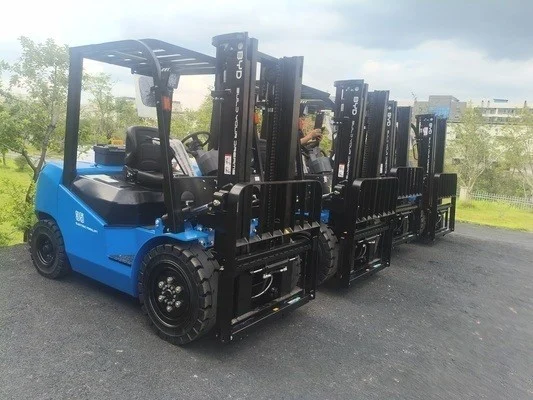
Door width and height are the most frequent reasons a new truck cannot enter a building. Measure the clear opening, not the frame size, and repeat the measurement at every door, gate, and fire shutter on the delivery route. Include the path from the delivery vehicle to the final parking or charging position.
Dimensions to verify
- Clear width and height of each opening, measured at the narrowest point.
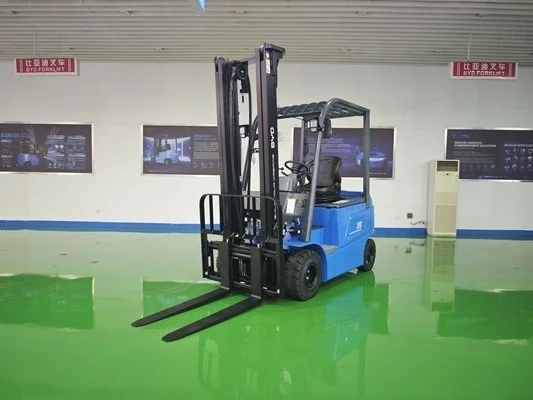
- Truck dimensions with the mast lowered and with the forks in the travel position, plus overhead guard height.
- Overhead obstructions: door tracks, roller shutters, pipes, cable trays, lighting, and sprinkler heads.
- Thresholds and ramps at each opening, including any lip or step that could catch a wheel.
- Turning space immediately inside and outside each door, since a counterbalance truck needs room to swing its rear end.
Allow a working margin rather than designing to the millimetre. A truck that clears a door by a few centimetres leaves no room for driver error, floor settlement, or a slightly misaligned load. If the mast must be lowered to pass, confirm that this is acceptable on the route and that the operator has clear sight lines.
Charging position and emergency exits
The route does not end at the production floor. Check access to the charging area, the space needed to change or connect a battery if applicable, and whether the truck blocks an emergency exit or fire equipment when parked. Confirm these points with the site safety responsible person before delivery.
Aisle Widths, Turning, and the Limits of a Counterbalance Truck
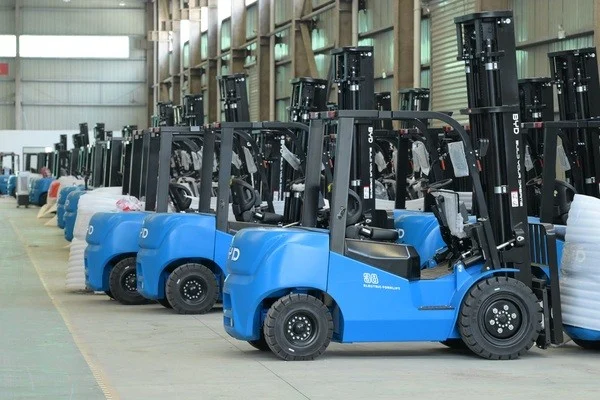
Aisle width decisions depend on how the truck will work, not only on its external dimensions. A four-wheel counterbalance electric forklift turns within a swept path that includes the rear counterweight, so the space needed to rotate 90 degrees into a rack or stack is larger than the truck width alone.
Measure these aisle conditions
- Available aisle width between rack uprights, walls, or stored goods at the tightest point.
- Right-angle stacking aisle where the truck must turn into a rack bay.
- Load length and width, including any overhang beyond the fork tips.
- Rack beam heights and clearances, plus the lift height required to place and retrieve loads.
- Pedestrian and traffic flow, since mixed traffic reduces usable space.
Ask your supplier to confirm the truck’s turning radius and the aisle width it needs under the intended load and lift height. Do not assume that a truck rated for a given capacity at one load centre will handle the same load at a greater height or a longer load centre; capacity typically decreases as load centre and lift height increase, and the data sheet states the conditions.
When the aisle is genuinely too narrow
If the measured aisle cannot accommodate a counterbalance truck safely, the honest answer may be to change the rack layout, reduce load size, or reconsider the handling method. A narrower truck is not automatically the solution, and a different truck type may suit very narrow aisles better. In that situation, discuss the layout with your supplier rather than forcing a counterbalance machine into a space it cannot work in safely.
A practical pre-delivery checklist
| Check | What to record | Who confirms |
|---|---|---|
| Floor loading | Wheel loads, floor type, documented limits | Structural engineer or building owner |
| Door clearances | Clear width and height at each opening | Site manager |
| Aisle and turning | Aisle widths, stacking aisle, rack heights | Warehouse planner and supplier |
| Charging and parking | Access route, charging position, exit clearance | Safety responsible person |
Share the completed record with your supplier so the selected BYD ECB forklift configuration matches the real site. If any measurement is missing or uncertain, resolve it before delivery rather than after the truck arrives.
Frequently Asked Questions
Can I estimate floor loading by dividing total weight by four wheels?
No. A counterbalance truck places more load on the front wheels, and the load centre affects the distribution. Use the truck’s technical data and ask a structural engineer to check the actual wheel loads against the floor design.
How much clearance should I leave at a doorway?
There is no universal figure. Measure the clear opening and compare it with the truck dimensions in its travel position, then agree a working margin with your supplier and site safety team. Designing to the exact millimetre leaves no tolerance.
Does a four-wheel counterbalance electric forklift suit every warehouse aisle?
No. It is a common general-purpose choice, but narrow aisles may require a different layout or handling method. Measure the aisle and stacking space, then confirm the truck’s turning requirements with the supplier before ordering.
What changes if I add an attachment or a heavier battery?
Both can change truck weight, dimensions, and capacity ratings. Provide the intended configuration to your supplier and recheck floor loading, door clearance, and aisle space against the updated data sheet.