What Overhead Clearance and Mast Collapsed Height Mean When Sizing a 2 Ton Electric Forklift
News 04/11/2026
Overhead clearance and mast collapsed height decide whether a 2 ton electric forklift can enter a building, pass under a rack beam, or work beneath a mezzanine without striking anything. Overhead clearance is the vertical free space along the travel path; mast collapsed height is the vertical dimension of the mast when fully lowered. The machine fits only when its collapsed height, plus a working margin, stays below the lowest obstruction on the route. A capacity rating alone tells you nothing about this fit, so both numbers belong in the selection checklist alongside load weight.
This guide treats the four-wheel counterbalance electric forklift as the default machine, including lithium-battery models. Where a specific figure matters, confirm it against the manufacturer’s technical data sheet rather than assuming a value.
Why the Lowest Obstruction Governs the Decision
Most sizing mistakes happen on the route, not at the load. A forklift may lift a 2 ton load easily and still be unable to reach the storage position because a door header, pipe, sprinkler line, cable tray, or rack beam sits too low.
Walk the full travel path and record the lowest point above the floor. Typical candidates include:
- Door and gate headers, including roll-up door frames and their raised hardware
- Sprinkler heads, piping, and ductwork
- Rack beams and the underside of mezzanine floors
- Lighting fixtures and overhead conveyors
- Trailer or container roofs during loading and unloading
The controlling obstruction is the lowest one anywhere on the route, not the average ceiling height. A single low door frame can block a machine that clears everything else.
Reading Mast Collapsed Height Correctly
Mast collapsed height is measured with the forks at their lowest position and the mast fully retracted. It is a machine dimension, not a load dimension, and it changes with mast type and lift height.
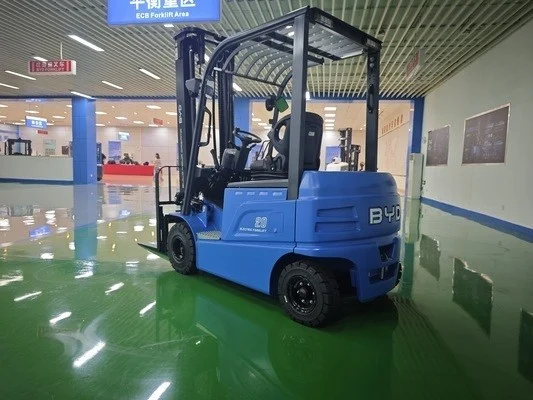
Mast types and their vertical footprint
Standard duplex masts usually have a lower collapsed height than triplex or quad masts, because the extra stages needed to reach greater lift heights add nested rail sections. A machine specified to lift to a high rack level will generally stand taller when lowered than the same capacity machine with a shorter mast. The trade-off is direct: more lift height usually means more collapsed height.
What the data sheet should state
Ask for the collapsed height of the exact mast and fork configuration quoted, not a generic model figure. Confirm whether the value includes the overhead guard, any optional lights or beacons, and the fork carriage position used in the measurement. Small additions such as work lights or a strobe can reduce effective clearance even when the mast itself is unchanged.
Add a working margin
Comparing collapsed height to obstruction height as equal numbers leaves no room for floor unevenness, tire wear, suspension movement, load deflection, or operator error. A practical approach is to keep a clear margin between the collapsed height and the lowest obstruction, then confirm the margin with the supplier against your actual floor conditions. No universal margin suits every site, so state your floor condition and route when requesting a recommendation.
Matching Rated Capacity to Height and Load Center
A nominal 2 ton rating applies under stated test conditions, usually a defined load center and a defined lift height. As lift height increases and the load center moves outward, the capacity the machine can safely handle typically decreases. The data sheet’s capacity chart shows this relationship, and it should be read together with the mast height figures.
Three inputs drive the check:
- Actual load weight: the heaviest load, not the average, including pallet and attachment weight
- Load center: the horizontal distance from the fork face to the load’s center of gravity, which grows with deep or irregular loads
- Required lift height: the height at which the load must be handled, not just the rack beam height
If the load is heavy, deep, or must be raised high, a 2 ton machine may be adequate at floor level and inadequate at the top rack level. Check the capacity chart at the required height and load center before committing. If the chart does not cover your combination, ask the supplier to confirm rather than extrapolating.
A hypothetical example: a warehouse with a low door header and high racking may find that a short mast clears the door but cannot reach the top beam, while a taller mast reaches the beam but not the door. In that situation the route and the storage layout must be reconciled before machine selection, perhaps by changing the door, relocating the storage position, or choosing a different handling method.
Practical Checks Before You Specify
Use the following sequence to turn site measurements into a specification request. It applies to four-wheel counterbalance electric forklifts, including lithium-battery versions, and helps avoid the common error of quoting a capacity without vertical dimensions.
- Measure the route. Record the lowest overhead obstruction along every path the truck will travel, including empty-return routes and loading areas.
- Measure the storage interface. Note rack beam heights, clear entry heights, and the underside of any mezzanine or conveyor.
- Confirm the load. Record maximum weight, load center, and the height at which the load is handled.
- Request exact dimensions. Ask the supplier for the collapsed height and overhead guard height of the quoted mast, with options included.
- Check the capacity chart. Verify that the rated capacity at your load center and lift height covers the actual load.
- Review the floor and charging area. Floor condition, ramps, and the space available at the charging point also affect whether the machine suits the site.
Common mistakes include using a brochure’s headline collapsed height while ignoring added lights, comparing dimensions without a margin, and assuming a 2 ton rating holds at every lift height. Each of these can lead to a machine that is technically the right capacity but operationally unsuitable.
When you contact a supplier, provide the route measurements, load weight and center, required lift height, floor conditions, and shift pattern. Those details let the supplier recommend a mast and configuration from the available range and state which figures still need verification. Do not accept a quoted capacity or height without the corresponding data sheet.
Frequently Asked Questions
Does a higher lift height always increase collapsed height?
Usually yes, because greater lift heights generally require more mast stages, which add nested sections when lowered. The exact difference depends on the mast design, so compare the collapsed height of the specific mast quoted rather than assuming a fixed relationship.
Can I use the overhead guard height instead of the collapsed height?
No. The overhead guard sits above the operator and is not the lowest point of the machine. The collapsed height of the mast and carriage is normally the dimension that governs passage under low obstructions, although added accessories can change the effective clearance.
Is a 2 ton rating valid at full lift height?
Not automatically. Rated capacity is tied to a stated load center and lift height. Read the capacity chart and confirm the figure at your actual load center and handling height, especially with deep or off-center loads.
What if my route clearance and rack height conflict?
This is a layout problem as much as a machine problem. Options include changing the route, modifying the obstruction, relocating the storage position, or reconsidering the handling method. Discuss the measurements with the supplier before selecting a mast, since no single configuration may satisfy both limits.