BYD ECB Forklift Turning Radius and Aisle Planning: Confirming Clearances Before Choosing a Four-Wheel Counterbalance Electric Truck
News 12/11/2026
Aisle planning decides whether a four-wheel counterbalance electric forklift can work in your building before any specification sheet matters. The turning radius of a BYD ECB forklift is only one input in that decision. The number that governs safe, repeatable travel is the operating aisle width: the space the truck needs when its rear body swings during a turn, plus clearance to racking, walls, and pedestrian routes. Buyers who compare only the catalog turning radius often order a truck that fits on paper and blocks the aisle in practice. This guide explains how to confirm clearances step by step, which site measurements to collect, and where the limits of a four-wheel counterbalance design become visible.
What the Turning Radius Figure Does and Does Not Tell You
Forklift data sheets usually quote a turning radius measured to the outside of the truck body, with the steer wheels at full lock and no load. That figure describes the truck alone. It does not include the load, the pallet overhang, the rear counterweight swing, or the clearance a driver needs to line up on a rack opening without repeated shunting.
Three separate dimensions matter in aisle planning:
- Turning radius: the arc traced by the outermost point of the truck during a full-lock turn. Confirm how the manufacturer measures it, since measuring points differ between data sheets.
- Right-angle stacking aisle: the aisle needed to turn 90 degrees into a rack bay from a perpendicular travel aisle. This is the figure that usually constrains warehouse layout.
- Working clearance: the gap left between the truck or load and fixed objects, including rack uprights, door frames, and pedestrian walkways. Your site rules and risk assessment set this value, not the data sheet.
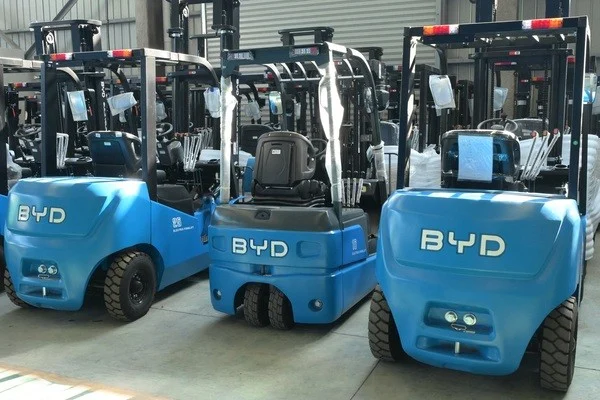
A four-wheel counterbalance truck steers with its rear wheels, so the back end swings outward through a turn. That swing is why a truck can appear to fit a narrow aisle on a layout drawing yet still need extra space when the operator actually enters a rack bay. Treat any single radius number as a starting point, then verify the full turning envelope with the load in place.
Site Measurements to Collect Before You Compare Models
Reliable aisle planning starts with the building, not the brochure. Gather the following information before requesting a configuration. Where a value is unknown, mark it as unconfirmed rather than estimating it.
Load and rack geometry
- Pallet or load length, width, and height, including any overhang beyond the pallet face.
- Load weight and its center of gravity; confirm the load center distance you intend to use.
- Rack beam heights and the lift height needed to place and retrieve loads safely.
- Distance from the rack face to the first obstruction behind the operator position.
Travel path conditions
- Measured aisle width at the narrowest point, not the nominal design width. Columns, pipes, and cable trays often reduce it.
- Door openings, thresholds, and any point where the truck must turn while partly inside a doorway.
- Floor condition and slope at ramps, dock levelers, and transitions. Slopes change both traction and stopping behavior.
- Traffic pattern: one-way loops, two-way aisles, and shared pedestrian zones.
Operating pattern
- Shift length and the number of lifts per shift, which influence battery and charging planning.
- Whether the truck works mainly in a single aisle or moves between buildings.
- Attachment requirements, such as side shift or fork positioner, since attachments change the effective load center and dimensions.
Record each measurement at the point where the truck will actually maneuver. A width taken in an empty aisle rarely reflects the aisle once racking is loaded and pallets sit slightly proud of the beam face.
Translating Measurements into a Clearance Check
Once the site data is in hand, compare it against the manufacturer’s published dimensions and the configuration you intend to order. The sequence below keeps the check honest.
- Confirm the measurement basis. Ask which point the turning radius refers to and whether it is quoted with or without a load. If the data sheet is ambiguous, request clarification before relying on the number.
- Add the load envelope. A load longer than the fork carriage extends the swing. Check that the combined truck-and-load envelope still clears rack uprights and door frames.
- Check the right-angle turn at the tightest bay. The critical point is usually the first and last bay in a run, where the operator has the least room to straighten out.
- Apply your site clearance rule. Add the margin your risk assessment requires, then compare the total to the measured aisle width.
- Confirm the lift height and load center together. A truck rated to a given capacity at one load center may carry less at a longer load center. Verify the rating at the load center and height you actually use.
A simple comparison table helps keep the discussion concrete. The example below is a template, not a set of specifications; fill it with verified figures from your site survey and the manufacturer’s technical documentation.
| Check | Site value | Truck or load value | Result |
|---|---|---|---|
| Narrowest travel aisle | Measured width | Required operating aisle | Margin remaining |
| Tightest right-angle bay | Available depth and width | Stacking aisle requirement | Pass or re-plan |
| Load center | Measured load center | Rated capacity at that load center | Within rating |
| Lift height | Required beam height | Rated height at load center | Within rating |
If any row fails, the answer is not to accept a marginal fit. Options include re-laying the rack run, restricting the truck to certain aisles, changing the load format, or reconsidering the truck type. A four-wheel counterbalance electric forklift suits many general warehouse and loading tasks, but it is not the right answer where aisle space is genuinely constrained.
Where Four-Wheel Counterbalance Trucks Fit, and Where They Do Not
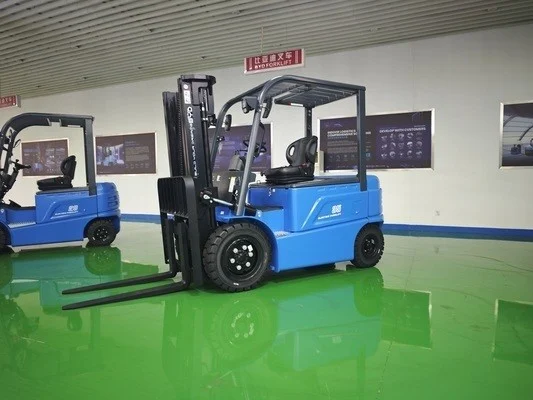
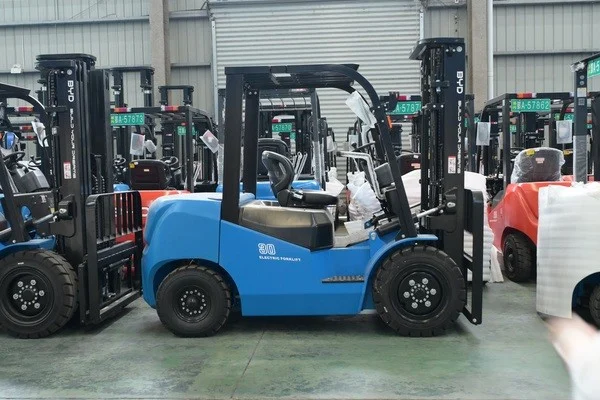
Four-wheel counterbalance electric trucks are a common general-purpose choice in factories, loading areas, and warehouse transfer work because they handle a wide range of loads and can travel between zones. Their rear-wheel steering and counterweight layout give stability with heavy loads, and lithium battery options can support opportunity charging where the electrical supply and charging area allow it. Those are general design characteristics, not guarantees about a specific model’s performance.
The same layout has limits worth stating plainly:
- Aisle width: the turning envelope is larger than that of trucks designed around narrow-aisle work. Where aisles are tight, a different truck category may be the better fit, and it should be evaluated on its own terms rather than assumed equivalent.
- Load center: long or offset loads reduce usable capacity. Always check the rating at the load center you will use.
- Floor and slope: ramps, dock levelers, and uneven surfaces affect traction and braking. Confirm the site conditions against the manufacturer’s stated limits.
- Charging: lithium battery operation depends on charger availability, supply capacity, and a suitable charging location. These are site decisions, not truck-only decisions.
An illustrative scenario: a distribution site with 3.2 m travel aisles and standard pallets may find that a four-wheel counterbalance truck works well in receiving and dock areas but needs a reserved turning zone at the end of each rack run. That conclusion comes from a site survey, not from a catalog number, and it should be confirmed with the actual truck and load before the layout is fixed.
Questions Buyers Ask About Aisle Clearance
Can I use the published turning radius as the aisle width?
No. The turning radius describes the truck’s own arc. The aisle must also accommodate the load envelope, the rear swing, the approach angle into the rack bay, and the clearance your site rules require. Use the stacking aisle requirement and your measured site data together.
Does a lithium battery change the aisle requirement?
Battery chemistry affects charging and energy planning, not the physical turning envelope. Aisle clearance depends on truck dimensions, load size, and layout. Confirm both aspects separately when specifying a BYD ECB forklift.
What should I send when requesting a configuration?
Provide measured aisle widths at the narrowest points, rack beam heights, load dimensions and weights, load center, floor and slope conditions, shift pattern, and charging arrangements. With those details, the selection discussion can focus on verified specifications rather than assumptions.
What if my aisle is slightly narrower than the requirement?
Do not assume a small shortfall is acceptable. Re-check the measurement basis, the load envelope, and the turning path at the tightest bay. Then consider layout changes, load format changes, or a different truck category. A marginal fit that depends on perfect operator positioning is a recurring risk, not a solved problem.