BYD Forklift for Sale: Specifying Four-Wheel Counterbalance Electric Trucks Around Your Heaviest Duty Cycle
News 02/11/2026
When buyers search “BYD forklift for sale,” the real decision is rarely about the badge on the hood. It is about whether a four-wheel counterbalance electric forklift can handle the heaviest shift in your operation without overheating, overloading, or running out of charge. That heaviest duty cycle — not the average one — should drive the specification. This article explains how to identify that cycle, translate it into truck requirements, and ask the right questions before committing to a configuration.
Start With the Heaviest Cycle, Not the Average One
Most buyers describe a typical day: a few pallets in, a few out. The truck that fails is usually the one sized against that average. Peak demand is what exposes a specification gap, because it combines the worst load, the highest lift, the longest route, and the tightest timing into one repeated pattern.
In a four-wheel counterbalance electric truck, the heaviest cycle shows up in three places:
- Hydraulic and drive heat: repeated lifting and long travel with a load build heat in the motors and controllers. A duty cycle that is fine once an hour can become a problem when repeated every few minutes.
- Battery draw: a lithium battery holds voltage well under load, but total energy consumed per shift still depends on distance, lift height, and load weight. A cycle that exceeds the usable capacity will shorten the working window.
- Stability and tire loading: a heavy load raised high shifts the center of gravity. The truck must be rated to lift that load at that height with an adequate margin.
Write the heaviest cycle down as a sequence: load weight, attachment, lift height, travel distance, number of moves per hour, floor condition, and ramp gradient. That list becomes the basis for every later question.
Translate the Cycle Into Truck Requirements
Once the heaviest cycle is documented, compare it against published manufacturer data rather than intuition. The table below shows the parameters that matter most and why each one changes the answer.
| Parameter | What to Record | Why It Changes the Specification |
|---|---|---|
| Load weight and center | Actual load weight and load center distance | Rated capacity falls as load center moves outward; the rating must match the real load, not the nominal maximum. |
| Lift height | Maximum height used in the heaviest cycle | Many trucks have a reduced capacity at full height; confirm the capacity at the height you actually use. |
| Aisle and door width | Narrowest aisle and door opening | Determines the required turning radius and whether a four-wheel truck fits comfortably. |
| Floor and ramps | Surface type, gradients, dock plates | Affects traction, tire choice, and the energy consumed per trip. |
| Shift pattern | Hours per shift, moves per hour, breaks | Sets the energy demand and the charging window available between shifts. |
| Charging conditions | Available power, charger location, opportunity charging | Determines whether one battery can cover the shift or whether charging must be planned into the schedule. |
Two common errors appear here. The first is specifying to the maximum load in the catalog rather than the maximum load at the height and load center actually used. The second is ignoring the aisle: a truck that meets the weight requirement but cannot turn in the aisle is not a solution. Both are resolved by matching published data to the documented cycle, and by asking the supplier to confirm the capacity at your specific lift height and load center.
Configuration Questions to Settle Before You Buy
With the cycle documented, the remaining decisions concern configuration and site readiness. These are the points worth confirming in writing with the supplier, since they affect both the truck and the building.
Battery and charging plan
Ask how the proposed lithium battery capacity relates to the energy demand of the heaviest shift, and what charging window is assumed. Confirm the charger rating, the electrical supply available at the charging point, and whether opportunity charging during breaks is part of the plan. Where the supplier publishes charge and run-time data, use those figures; where they do not, ask what test conditions the figures refer to.
Attachments and capacity derating
If the heaviest cycle uses a clamp, push-pull, or other attachment, the attachment adds weight and moves the load center. The rated capacity of the base truck no longer applies directly. Ask the supplier to confirm the capacity with the attachment fitted, rather than assuming the base rating carries over.
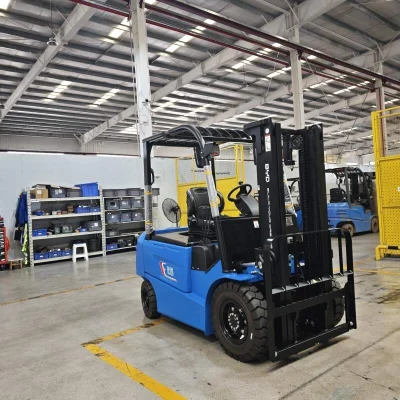
Site and operator readiness
Check the floor loading, aisle markings, door heights, and dock plates against the truck dimensions. Plan operator familiarization on the specific controls and on the stability limits of a loaded four-wheel counterbalance truck. These steps are not optional extras; they are part of making the specification work in practice.
What to send a supplier
A short, factual brief gets a more useful answer than a general inquiry. Include the heaviest load and its center, the lift height, the narrowest aisle, the ramp gradient, the number of moves per shift, the shift length, and the available charging power. Ask the supplier to confirm the model, capacity at your lift height and load center, battery capacity, charger, and delivery scope. This site supplies BYD four-wheel counterbalance electric forklifts, including lithium-battery models; share your operating conditions and the team can discuss suitable configurations against the published technical data.
Frequently Asked Questions
Can a four-wheel counterbalance electric truck handle a heavy duty cycle all shift?
It can when the battery capacity, motor thermal limits, and rated capacity at the working lift height all match the documented cycle. The honest answer depends on the numbers: load weight, moves per hour, lift height, and travel distance. Ask the supplier to confirm these against published data rather than relying on a general claim.
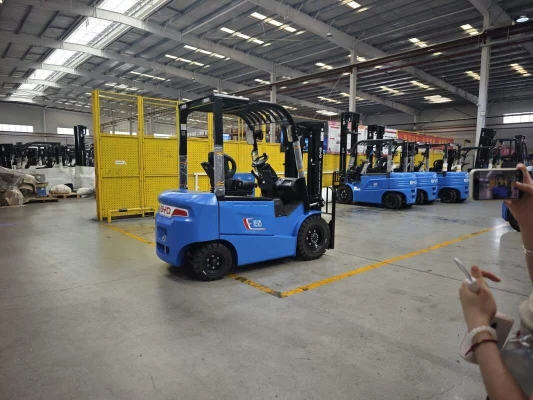
Does a lithium battery remove the need to plan charging?
No. Lithium batteries generally hold voltage well under load and can accept opportunity charging, but the energy consumed per shift still depends on the work performed. A charging plan is still needed, and the available electrical supply at the charging point should be confirmed before delivery.
Why does rated capacity change with lift height and load center?
Raising a load or moving its center outward increases the overturning moment on the truck. Manufacturers publish reduced capacity at greater heights and load centers to keep the truck stable. Always use the capacity figure that matches your actual working height and load center.
What information speeds up a quotation?
The heaviest load and load center, maximum lift height, narrowest aisle, floor and ramp conditions, moves per shift, shift length, and charging power available. With those details, a supplier can propose a configuration and state the assumptions behind it.