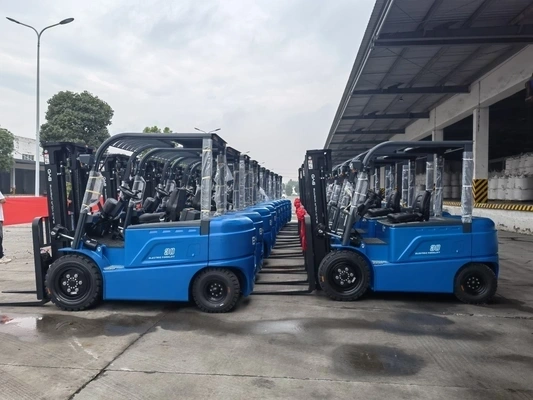
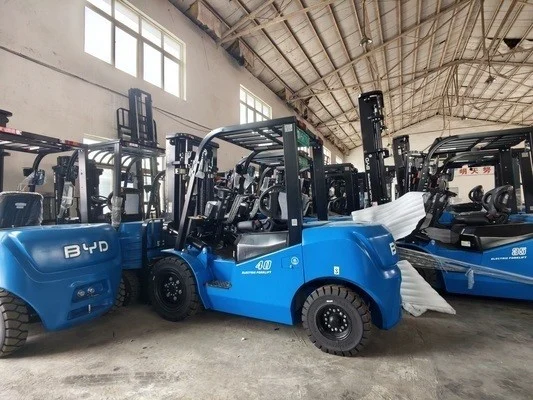
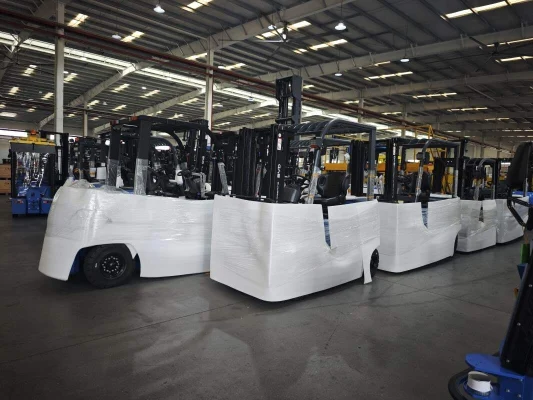
BYD Lithium Forklift: How to Verify Residual Capacity and Battery Health Before Accepting a Four-Wheel Counterbalance Electric Forklift Delivery
News 05/11/2026
A delivery inspection of a BYD lithium forklift should answer one question before you sign: does the battery state of health match what the purchase documents state? Residual capacity — the usable energy remaining relative to the pack’s rated capacity — cannot be judged by lifting a load once or reading a dashboard percentage. You need the pack’s state of charge (SOC), state of health (SOH), cell balance data and a documented load test, all compared against the specification sheet supplied with the four-wheel counterbalance electric forklift.
This guide sets out a practical acceptance sequence. It assumes the truck is a four-wheel counterbalance electric model with a lithium iron phosphate (LFP) pack, which is the common configuration in this class. Exact thresholds, test loads and instrument requirements must come from the manufacturer’s technical documentation; where this article does not state a number, treat it as a parameter you must confirm rather than assume.
Documents and Data You Should Request Before the Inspection
Verification starts with paperwork. Ask the dealer or supplier to provide these items before the truck arrives, so the physical inspection has a baseline:
- Battery specification sheet: nominal voltage, rated capacity in Ah and kWh, cell chemistry, permitted depth of discharge, operating temperature window and charging voltage limits.
- Battery management system (BMS) data report: a dated export showing SOH, SOC at delivery, maximum and minimum cell voltages, temperature readings and any stored fault codes.
- Charge and cycle history: cumulative charge energy, cycle count and any records of over-temperature or over-voltage events, if the BMS logs them.
- Forklift specification and test record: rated load, load centre, lift height, and the factory or pre-delivery test results the supplier is prepared to stand behind.
- Warranty terms covering the pack: what capacity retention or SOH level triggers a claim, and how it is measured.
If any of these are missing, note it in writing before acceptance. A verbal assurance that the battery is “new” is not a substitute for a BMS export.
Reading Residual Capacity and State of Health Correctly
Why SOC and SOH Are Not the Same Number
SOC tells you how much energy is in the pack right now. SOH describes how much capacity the pack can still hold compared with its rated value when new. A truck delivered at 60% SOC may be perfectly healthy; a truck delivered at 100% SOC may still have a degraded pack. Always record both, and record them after the pack has rested rather than immediately after charging, when voltage readings can be unsettled.
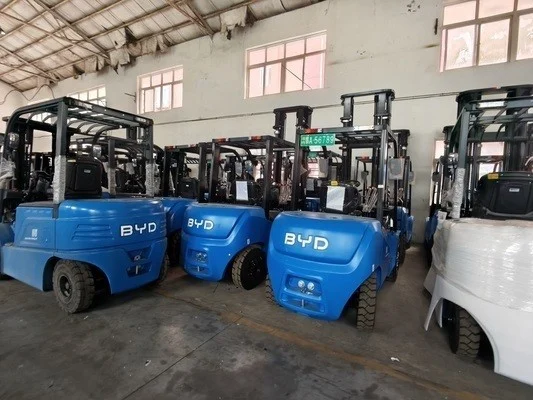
Cell Balance and Temperature
Ask the supplier to show the spread between the highest and lowest cell voltages in the BMS export. A wide spread at rest suggests weak cells or a balancing problem. Temperature data matters too: a pack that has been stored or charged outside its permitted window may show normal voltage but reduced usable capacity. Compare the recorded temperatures against the battery specification sheet rather than a generic rule of thumb.
What the Dashboard Cannot Tell You
Many trucks display a simple bar or percentage. That display is calculated by the BMS and is only as reliable as the calibration behind it. Use it as a cross-check against the BMS export, not as the primary evidence. If the two disagree, ask the supplier to explain the discrepancy before signing.
A Step-by-Step Acceptance Sequence
The following sequence works on a level, clean floor with adequate clearance. It is a general inspection method, not a substitute for the supplier’s own commissioning procedure.
- Visual and mechanical check first. Inspect the pack enclosure, cabling, connectors and charger. Look for impact damage, corrosion, swollen cells or a charger that does not match the pack voltage. Confirm the truck’s data plate matches the ordered model and rated capacity.
- Record the baseline state. With the truck parked and the key off, export or photograph the BMS screen showing SOC, SOH, cell voltages and temperatures. Note the date and time.
- Confirm the charger handshake. Connect the charger briefly and verify the BMS and charger communicate correctly and the charge current is within the specification. Do not run a full charge unless the supplier’s procedure calls for it.
- Run a controlled load test. Using a load equal to the rated capacity at the stated load centre, lift, lower, tilt and travel through a short cycle. This checks hydraulic and drive function. It does not by itself prove battery capacity, so treat it as one part of the inspection.
- Observe voltage sag under load. Ask the supplier to show how much the pack voltage drops during the lift. Compare the figure with the battery specification sheet’s permitted discharge behaviour. A large, sudden drop is a reason to ask questions, not an automatic rejection.
- Re-check the BMS after the test. Confirm no new fault codes appeared and temperatures remain within the permitted window. Record the post-test SOC so you can see how much energy the cycle consumed.
- Document everything. Attach the BMS exports, photographs and test notes to the acceptance record. Both parties should sign.
Common Mistakes That Weaken an Acceptance Decision
Several habits repeatedly undermine delivery inspections:
- Accepting a single SOC reading as proof of health. SOC at delivery says nothing about long-term capacity retention.
- Testing on a slope or uneven floor. Results become hard to compare and can mask drive or brake issues.
- Ignoring stored fault history. Cleared codes may still appear in logs; ask to see the full history rather than the current screen only.
- Skipping the specification cross-check. Without the rated capacity and voltage in hand, no reading can be judged good or bad.
- Relying on verbal warranty promises. Get the SOH or capacity-retention threshold that triggers a claim written into the contract.
A hypothetical example shows why the sequence matters: a buyer receives a truck showing 100% SOC and accepts it on that basis. Months later, the pack delivers noticeably less runtime per shift. Had a BMS export at delivery recorded SOH and cell balance, the buyer would have had a documented baseline to support a warranty discussion. This is an illustration of the risk, not a report of a real case.
Frequently Asked Questions
Can I verify battery health without special equipment?
Partially. The BMS screen and its export give you SOC, SOH and cell-level data, which cover most acceptance needs. A full capacity test requires a controlled discharge procedure and suitable instrumentation; ask the supplier whether they will perform one and provide the results.
What SOH value should I require at delivery?
There is no universal figure. A new pack should be close to its rated capacity, but the acceptable threshold depends on the manufacturer’s specification and the warranty terms. Ask the supplier to state the expected SOH at delivery in writing and compare the BMS export against it.
Does a load test prove the battery is healthy?
No. A short lift and travel cycle confirms the truck operates, but it draws only a small fraction of pack energy. Battery health is better evidenced by BMS data, charge history and, where available, a documented capacity test.
What should I do if the BMS data and the dashboard disagree?
Pause acceptance and ask the supplier to explain the difference and recalibrate or re-export the data. Record the discrepancy in the acceptance notes. Signing without resolution weakens any later claim.
Can I request a specific configuration when ordering?
Yes. Buyers should share their actual duty cycle, load weight, lift height, aisle width, floor and ramp conditions, shift pattern and charging arrangements so the dealer can confirm the appropriate four-wheel counterbalance electric forklift configuration and battery option. Only specifications the supplier confirms in writing should be treated as committed.
Before signing, confirm three things: the BMS export matches the specification sheet, the load test was performed under stated conditions, and the warranty defines how residual capacity is measured. Anything you cannot verify should be listed as an open item rather than assumed acceptable.