Electric Counterbalance Forklift Braking and Coastdown Behavior: What Buyers Should Confirm About Travel Speed, Brake Type, and Load Stability
News 09/11/2026
Braking and coastdown are two of the least documented parts of an electric counterbalance forklift quotation, yet they shape daily safety and cycle time. Buyers often receive a spec sheet listing a travel speed and a brake type, then discover later that neither figure describes how the truck behaves with a load raised, on a ramp, or after the accelerator is released. This guide sets out the points worth confirming before you approve a specification, with the understanding that final values come from the manufacturer’s technical documentation rather than from general expectations.
Why Travel Speed Alone Tells You Little
A maximum travel speed figure is usually measured empty, on level ground, with a fully charged battery. Those conditions rarely match a working shift. Before treating a speed number as meaningful, ask what test condition produced it: laden or unladen, what load, what surface, what state of charge, and whether speed limiting was active.
Equally important is how speed is controlled. Many electric counterbalance trucks offer selectable travel modes, and some allow a supervisor to cap maximum speed. Confirm which modes ship as standard, whether the cap is adjustable, and who can change it. A truck that feels responsive empty can feel very different with a rated load at height, so ask how acceleration and top speed are governed under load.
Brake Type and What It Means in Practice
Electric counterbalance forklifts commonly combine several braking functions, and the quotation should distinguish them clearly. Typical elements include a service brake operated by pedal, a parking brake, and regenerative braking that slows the truck when the operator releases the accelerator. Some designs add automatic braking or hill-hold functions.
Regenerative braking returns energy to the battery, but its feel varies: some trucks decelerate smoothly and predictably, others more abruptly at certain speeds. Because this affects load stability and operator confidence, ask whether regenerative braking strength is fixed or adjustable, and whether the transition to friction braking is progressive. Also confirm the parking brake type and how it is released, since this matters on ramps and during loading.
Coastdown: The Behavior Buyers Overlook
Coastdown describes how the truck slows after the accelerator is released, before any brake pedal input. On a level floor, a long coastdown can feel efficient; on a ramp or in a tight aisle, it can feel like lost control. Ask the supplier to describe the intended coastdown behavior, whether it differs between travel modes, and whether releasing the accelerator triggers any automatic deceleration. If your site has ramps or congested aisles, this is a specification point, not a detail.
Load Stability Questions to Put in Writing
Braking and coastdown interact with load stability, and the honest answer depends on your load, lift height, and floor conditions. Use the following checklist when you request a quotation:
- Rated load and load center: state the actual load and its center of gravity, not just the nominal capacity.
- Lift height and mast type: higher lifts change stability margins, so confirm the configuration you intend to buy.
- Floor and ramp conditions: note slopes, thresholds, dock plates, and surface finish.
- Aisle width: tight aisles make predictable deceleration more important.
- Shift pattern and charging: battery state of charge can influence available power and braking feel, so confirm charging arrangements.
Ask the supplier which of these conditions were considered when the travel and braking figures were produced. If documentation does not cover your combination, request clarification rather than assuming the headline figures apply.
Acceptance Checks and Questions Before Ordering
Before signing, confirm that the quotation states the brake functions included, the travel modes and any speed limiting, and the test conditions behind published figures. During pre-delivery inspection, verify that the truck matches the agreed configuration and that the operator manual explains braking and coastdown behavior. A short supervised trial in your own aisle, with your typical load, is the most reliable way to judge whether the behavior suits your operation; treat it as a check against the agreed specification, not as a substitute for manufacturer data.
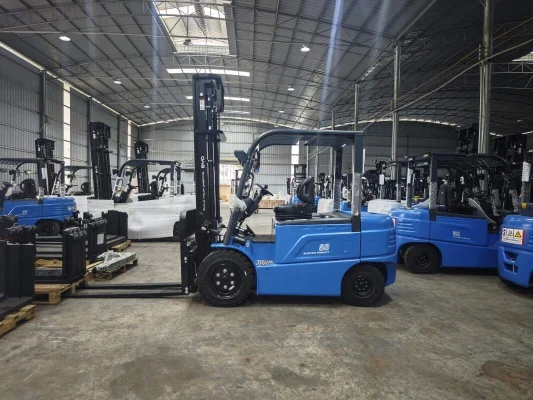
If you are evaluating a four-wheel counterbalance electric forklift, share your load, lift height, aisle dimensions, floor and ramp conditions, and shift pattern with the supplier so the configuration and braking settings can be matched to the actual duty. Where a published value is unavailable, ask what needs to be measured and under which conditions; a clear answer is more useful than an optimistic number.
Frequently Asked Questions
Does a higher travel speed mean a less stable truck?
Not by itself. Stability depends on load, load center, lift height, steering input, floor conditions, and how braking and coastdown are controlled. Travel speed is one factor, and the conditions behind the published figure matter more than the number alone.
Is regenerative braking enough on a ramp?
Regenerative braking can assist deceleration, but it should not be assumed to replace the service brake or parking brake. Confirm the intended use on slopes with the manufacturer, and check that the parking brake is rated for your ramp conditions.
Can travel speed be limited on site?
Many electric counterbalance models offer selectable travel modes or adjustable speed limits. Ask whether this is standard, how it is adjusted, and whether access is restricted, so site rules can be enforced consistently.
What should I request with a quotation?
Ask for the brake functions included, travel modes, the test conditions behind speed and braking figures, and any settings that affect coastdown. Provide your load, lift height, aisle width, floor and ramp details so the supplier can confirm suitability rather than quote in isolation.