Electric Forklift for Sale Near Me: What Industrial Buyers Should Confirm About Load Chart Ratings, Attachments and Derating Before Ordering a Four-Wheel Counterbalance Unit
News 09/11/2026
Searching “electric forklift for sale near me” usually returns a list of dealers and models, but the decisive information sits in documents that rarely appear in an online listing: the load chart, the attachment data and the derating rules that apply to your exact configuration. A four-wheel counterbalance electric forklift is rated against a defined load center, mast and carriage. Change any of those and the safe capacity changes with it. Before you place an order, confirm these ratings in writing and match them to the loads, lift heights and attachments your operation actually uses.
Read the Load Chart as a Set of Conditions, Not a Single Number
A capacity figure on a spec sheet applies only to the configuration it was measured with. The load chart typically shows rated capacity at a stated load center and lift height, with reductions as either value increases. Ask the seller to supply the chart that matches the quoted truck, and check these points:
- Load center: the horizontal distance from the fork face to the load’s center of gravity. Pallets with overhang or loose goods can shift the effective center beyond the rated value.
- Lift height: capacity often falls as the carriage rises, so the rating at floor level is not the rating at full height.
- Mast and carriage type: two-stage, three-stage and other mast configurations carry different residual capacities.
- Tyre and counterweight configuration: confirm the chart belongs to the four-wheel model you are buying, not a three-wheel variant.
Compare the chart against your heaviest realistic load at its highest required lift, not against the average pallet. If your loads vary, document the maximum weight, dimensions and center of gravity you expect.
Attachments Change Capacity and Require Their Own Data
Any attachment mounted on the carriage—side shifters, fork positioners, clamps, rotators or special forks—adds weight ahead of the carriage and moves the load further from the mast. Both effects reduce usable capacity. The attachment manufacturer’s data and the truck manufacturer’s derating information should be combined, and the result should be stated in writing.
Confirm the following when an attachment is part of the order:
- The attachment’s own weight and its lost load capacity, from its technical documentation.
- Whether the truck’s hydraulic system and carriage are rated to carry that attachment.
- The revised load chart that reflects the attachment, issued by the truck or attachment supplier.
- Whether the attachment is included in the quoted price and delivery scope.
Do not accept a verbal assurance that the truck “will handle it.” Ask for the derated capacity at your required lift height and load center.
Questions to Settle Before You Order
Use a written checklist so the quotation and the delivered machine can be compared. The table below lists items buyers commonly need to confirm; the answers should come from the supplier’s technical documents, not from estimates.
| Item | What to confirm |
|---|---|
| Load data | Maximum weight, dimensions and load center of your pallets and goods |
| Lift requirements | Highest lift height and any free-lift need inside containers or trailers |
| Load chart | Chart matching the quoted mast, carriage and attachment |
| Attachment derating | Attachment weight and revised capacity in writing |
| Site conditions | Aisle width, floor surface, ramps and gradients |
| Energy and charging | Shift pattern, battery type and charging arrangements |
| Acceptance | Configuration, capacity plate and documents checked at delivery |
For a hypothetical example, a buyer moving 1,200 kg pallets at floor level may find the quoted capacity adequate, but the same pallets lifted to a high racking level with a clamp attachment could exceed the derated rating. The chart, not the headline number, settles the question.
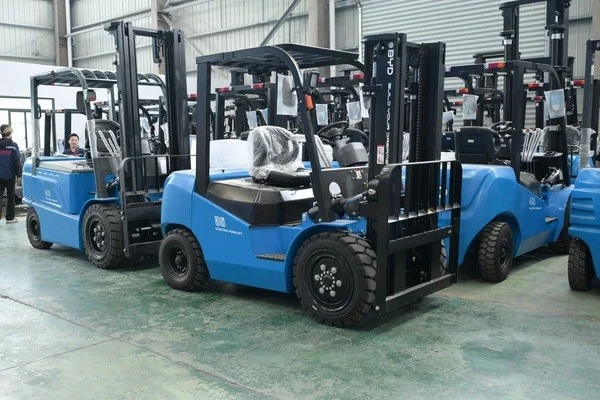
Site conditions also affect whether a four-wheel counterbalance electric forklift suits the job. Narrow aisles, steep ramps and rough floors may call for a different approach, and the supplier should confirm suitability against your measurements rather than a general claim. This site supplies four-wheel counterbalance electric forklifts, including lithium-battery models; share your load, lift height, aisle and shift details so the configuration can be checked against available technical data.
Frequently Asked Questions
Does an attachment always reduce capacity?
In most cases it does, because the attachment adds weight and moves the load center forward. The exact reduction should come from the attachment and truck documentation. Ask for the revised rating at your working lift height.
Can I use the capacity on the data plate as my limit?
The plate reflects a specific configuration. If the mast, carriage, attachment or load center differs, the plate value may not apply. Request the load chart that matches the machine as ordered.
What should I check when the forklift is delivered?
Compare the delivered configuration with the order: mast type, carriage, attachment, capacity plate and accompanying load chart. Confirm that any derating document reflects the attachment actually fitted.
Is a four-wheel counterbalance model suitable for every warehouse?
No. It is a common general-purpose choice, but aisle width, floor condition, gradients and lift height determine suitability. Provide these details and let the supplier confirm against the truck’s specifications.