Electric Forklift UK Sourcing: Assessing Four-Wheel Counterbalance Stability Under Uneven Yard Surfaces
News 04/11/2026
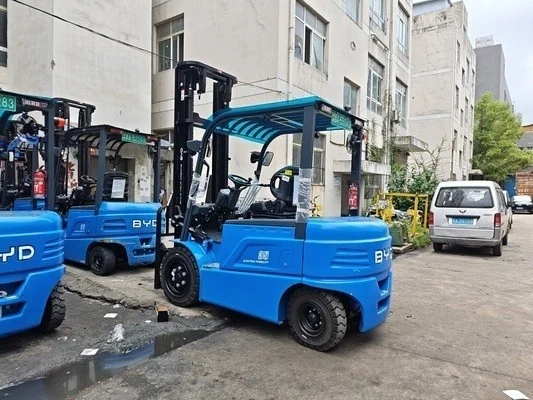
An electric forklift sourced in the UK often spends more time on cracked concrete, gravel hardstanding, and sloped loading aprons than on a polished warehouse floor. Stability on those surfaces depends less on the battery type than on how the truck’s weight, tyres, and mast interact with an uneven base. A four-wheel counterbalance electric forklift can work well outdoors, but only when the buyer matches wheel configuration, tyre compound, ground clearance, and rated capacity to the actual yard. This guide explains which conditions matter, which figures to request from a supplier, and where the limits sit.
Why Uneven Ground Changes the Stability Question
A counterbalance truck stays upright because its counterweight offsets the load around the front axle. That balance assumes the load centre, the mast tilt, and the floor under the wheels are all close to the design case. An uneven yard breaks the third assumption. When one wheel drops into a pothole or rides up on a drain cover, the truck tilts, weight shifts, and the effective load centre moves further forward than the data plate suggests.
Three effects matter in practice:
- Reduced effective capacity. Load charts assume a level surface. A truck rated at a nominal capacity with a stated load centre may only be safe at a lower figure when the chassis is tilted or the mast is raised.
- Loss of drive and braking grip. Loose gravel or wet concrete reduces traction on the drive wheels, which affects steering control as much as stopping distance.
- Frame and mast stress. Repeated impacts from expansion joints and potholes load the mast channels and chassis welds in ways a smooth floor never does.
None of this means a four-wheel counterbalance electric forklift is unsuitable outdoors. It means the specification has to reflect the yard, not just the load.
Yard Conditions to Map Before You Compare Trucks
Start with a walkover of the routes the truck will use, not the catalogue. Record conditions along the full duty cycle, including the yard, ramps, thresholds, and the transition into the building.
Surface type and condition
Note whether surfaces are sealed concrete, block paving, compacted gravel, or mixed. Record cracks, potholes, soft edges, and drainage gullies. A truck that is stable on intact concrete may behave differently after a winter of freeze-thaw damage.
Slopes and cambers
Measure gradients on ramps and loading aprons, and note cross-falls that tilt the truck sideways. Side slope is generally more demanding than a straight incline because it shifts load across the axles rather than along them.
Load details
Confirm the heaviest load, its dimensions, and where its centre of gravity sits relative to the fork face. A compact heavy load and a long light load place very different demands on the truck, even at the same weight.
Lift height and handling cycle
Record the height at which loads are picked up and set down, and whether the truck travels with a raised load. Travel with the mast up is a stability risk on any surface and is worse on uneven ground.
Operating pattern
Shift length, number of lifts per hour, and exposure to rain or grit all affect tyre choice and the practical working day between charging opportunities.
Specification Choices That Support Stability
Once the yard is mapped, the specification conversation becomes concrete. The points below are the ones worth raising with a supplier before a quotation is fixed.
Wheel configuration and tyre type
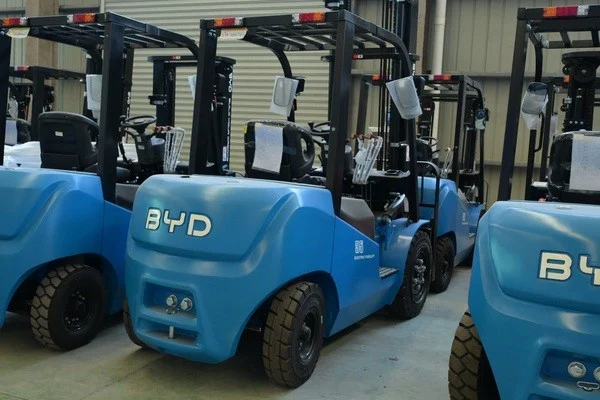
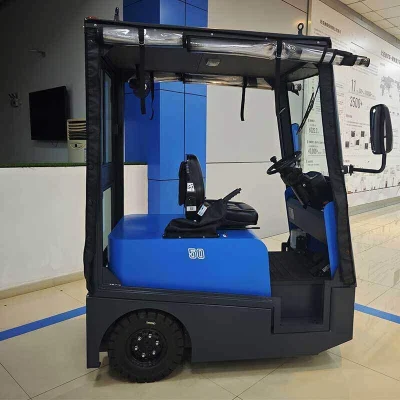
Four-wheel counterbalance trucks distribute weight across four contact points, which generally gives more predictable behaviour on cracked or patched surfaces than a three-wheel layout. Tyre compound then decides how that weight is transferred. Pneumatic or resilient tyres absorb impacts and cope better with gravel and rough concrete; solid or cushion tyres suit smooth indoor floors but transmit shock. Ask which tyre options the supplier offers and how each affects rated capacity, because tyre size and type can change the load chart.
Rated capacity and load centre
Request the load chart, not just the headline capacity. Check the rating at the load centre and lift height you actually need, and ask how the rating is affected by mast type and any attachment such as a side-shifter or clamp.
Ground clearance and underbody protection
Low-slung battery boxes and brake lines are vulnerable on rough yards. Ask about clearance under the chassis and whether guards are available.
Mast and tilt behaviour
Ask how the mast and carriage behave when tilted on a slope, and whether the truck has any tilt-angle limits stated in the operating manual. Do not assume a specification from a different model applies.
Drive, braking, and steering feel
On loose or wet surfaces, progressive braking and smooth acceleration reduce the chance of a skid. Ask whether the truck offers regenerative braking or speed limiting that suits a congested yard.
Charging and battery practicalities
A lithium battery can be opportunity-charged during breaks, which suits multi-shift yards where a single charge window is impractical. Confirm the charger rating, the available power supply at the charging point, and whether charging can take place under cover.
Verification, Trials, and Questions to Put to a UK Supplier
Paper specifications rarely settle a stability question. The useful next step is a supervised trial on your own surface with representative loads, plus a written set of answers to the points below.
- Which load chart applies to the exact configuration quoted, including tyres, mast, and attachments?
- What gradient and side-slope limits does the manufacturer state, and under what load conditions?
- Which tyre options are available, and how does each change capacity or clearance?
- What surface conditions does the warranty exclude, and what maintenance intervals apply to rough-yard use?
- What documentation comes with the truck: operator manual, load chart, and service schedule?
During a trial, watch how the truck behaves when one wheel crosses a depression, how it brakes on a wet apron, and whether the operator feels confident travelling with a load at working height. Record any surface defects that need repair before delivery; fixing a pothole is usually cheaper than adapting a truck to it.
UK buyers should also confirm the supplier’s service coverage, spare-parts arrangements, and lead times in writing. These are commercial facts that should come from the supplier, not from a general article.
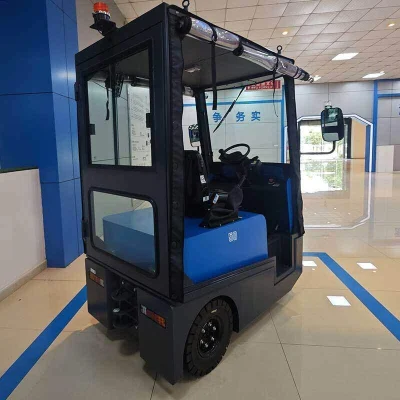
If you are comparing options, describe your yard surface, heaviest load, lift height, and shift pattern to the supplier and ask which four-wheel counterbalance electric forklift configuration they would propose, together with the supporting load chart and tyre recommendation.
Frequently Asked Questions
Can a four-wheel counterbalance electric forklift work on gravel?
It can, provided the surface is firm and reasonably level and the truck is fitted with tyres suited to loose ground. Deep, soft gravel is a different problem, because wheels sink and traction drops. Ask the supplier about tyre choice and any stated surface limits, and test the route with a representative load.
Does a lithium battery affect stability?
The battery is part of the counterweight, so its mass and position matter. A lithium pack that differs in weight or placement from the original design changes the truck’s balance. Confirm that the battery supplied is the one the load chart assumes, and do not swap packs without checking with the supplier.
How do I know whether a slope is too steep?
Measure the gradient and check it against the manufacturer’s stated limits in the operating manual. Side slopes deserve particular attention because they shift load across the truck. No article can give a safe universal figure, and a supplier should confirm limits in writing.
What should I check before signing a UK supply contract?
Confirm the exact configuration, the matching load chart, tyre specification, warranty terms covering surface conditions, service response arrangements, and delivery dates. Ask for these in writing so the quotation and the delivered truck can be compared.