Factory Electric Forklifts: Key Adaptations Supporting Narrow Production Aisle Operations
News 17/10/2026
Many manufacturing facilities prioritize high-density layout to maximize usable production and storage space, which creates narrow production aisles that standard lift trucks cannot navigate. Factory electric forklifts rely on targeted design adaptations to work safely and efficiently in these constrained spaces, without sacrificing lifting capacity or operational longevity. Below we break down core requirements and key adaptations that enable reliable performance.
Core Narrow Aisle Operational Requirements
Before reviewing adaptations, it helps understand baseline constraints narrow production aisles create. Most standard production aisles measure between 3.2 and 4 meters wide, while narrow aisles typically fall between 1.8 and 2.8 meters, depending on facility layout and load size. Any lift truck operating in these spaces must meet three non-negotiable criteria:
- Achieve full 90-degree turns within the aisle width without encroaching on adjacent work cells or stored materials
- Maintain clear operator visibility of load tines and surrounding obstacles at all lifting heights
- Support required load weights and lifting heights without compromising structural stability in the reduced footprint
Factory layouts with fixed production equipment along aisle edges leave little margin of error, so even small gains in turning radius or truck width create big improvements in workflow and safety.
Chassis and Steering Design Adaptations
The most impactful adaptations center on chassis size and steering functionality, the two core factors that determine maneuverability in tight spaces.
Compact Chassis Architecture
Designers shorten overall truck length and reduce chassis width to fit within narrow aisle boundaries. They relocate battery compartments and power components to fit within the smaller footprint, balancing weight distribution to maintain stability when lifting loads. Unlike standard electric forklifts, narrow aisle variants eliminate unnecessary external overhang around the front and rear axles, cutting overall width by 15 to 25 percent in most designs.
Specialized Steering Systems
Most narrow aisle factory electric forklifts include all-wheel steering or crab steering functionality, which lets operators move the truck laterally without turning the front wheels. This adaptation eliminates large turning radius requirements, allowing drivers to position loads precisely with multiple back-and-forth adjustments. Some designs also limit maximum steering angle to prevent the truck’s rear end from swinging outside the aisle during turns, a common hazard in constrained spaces.
Mast and Lift System Modifications
Narrow production aisles often pair with higher storage or work stacking to maximize vertical space, so mast systems require targeted changes to match these needs.
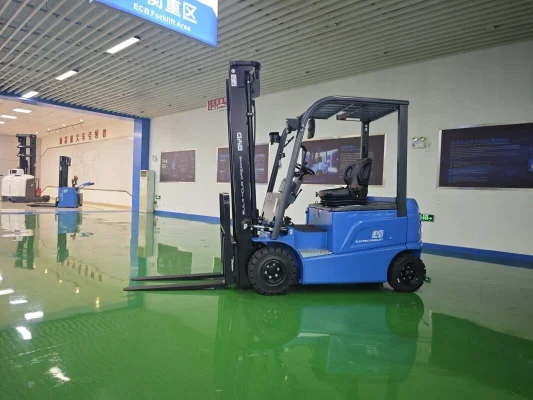
First, masts use narrower, high-strength steel sections to reduce front-end width, which improves operator visibility and cuts overall space requirements when the mast is fully lowered. Designers also integrate free-lift functionality that lets operators raise the load before extending mast sections, useful when working under low overhead ceilings common in production facilities.
Sites that stack materials at greater heights use telescopic masts that add extended lifting capacity without increasing the base footprint. Some designs also include side-shift and fork positioner adjustments built into the mast head, letting operators align loads without repositioning the entire truck. This reduces repeated movement within the narrow aisle, cutting overall cycle time per load.
Integrated Safety and Operator Assistance Features
Operating in tight spaces increases risk of collisions with production equipment, stored materials, or facility infrastructure, so modern adapted electric forklifts add targeted safety features to reduce incidents.
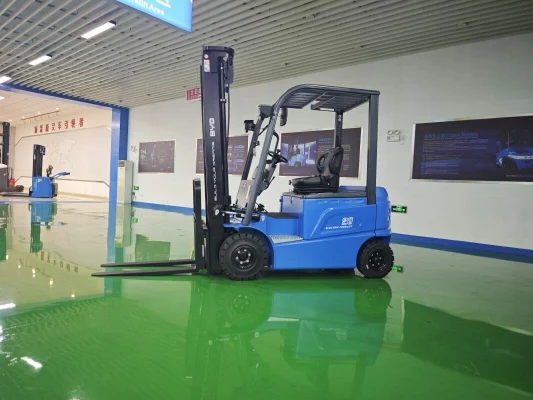
- Automatic speed reduction: Sensors detect aisle boundaries and proximity to obstacles, automatically slowing the truck when it approaches walls or equipment
- Collision avoidance systems: Non-contact sensors trigger automatic braking if an obstacle enters the truck’s path, preventing low-speed impacts that damage products or facility structures
- Camera and display systems: Roof-mounted or mast-mounted cameras feed live footage to an in-cab display, improving visibility around loads that block the operator’s forward view
- Stability monitoring: Systems track load weight and lifting height, reducing power to lift functions if the truck exceeds its stability threshold matching the current footprint
These features do not add significant bulk to the truck’s footprint, so they preserve the maneuverability gains from core design adaptations.
Frequently Asked Questions
Can standard factory electric forklifts work in narrow production aisles?
Smaller standard electric forklifts may operate in the wider end of the narrow aisle spectrum (above 2.5 meters) with light loads, but most lack the turning radius and compact footprint needed to work consistently in narrower spaces. Attempting to use a standard forklift in too narrow an aisle increases collision risk and slows workflow significantly.
Do narrow aisle adapted electric forklifts have lower load capacity?
Many designs maintain comparable load capacity to standard electric forklifts of similar power class, thanks to optimized weight distribution and high-strength chassis materials. Capacity varies by manufacturer and design, so buyers must confirm specific load ratings match their operational needs before purchase.
Are narrow aisle electric forklifts more expensive than standard models?
Narrow aisle adapted models typically carry a higher upfront cost due to specialized steering and mast components. Facility operators often offset this cost through increased usable space within the plant, which supports additional production or storage capacity without expanding facility footprint.
Do narrow aisle electric forklifts require special operator training?
Most specialized features like crab steering and automated safety systems require additional training beyond standard forklift certification. Training focuses on precise positioning and hazard recognition in constrained spaces to reduce incident risk.
When selecting adapted factory electric forklifts, always test units within your facility’s actual aisle widths and with your typical load weights to confirm performance meets your needs. Aisle width measurements must include extra clearance around adjacent equipment and pedestrian traffic, not just the space the truck itself requires.