Selecting a BYD Counterbalance Forklift Attachment Package: Load Center, Capacity Derating, and Hydraulic Flow Checks
News 31/10/2026
A bolt-on attachment can change the safe working capacity of a four-wheel counterbalance electric forklift long before the carriage bolts are tightened. Clamp position, fork length, side shift, and rotator weight all move the combined center of gravity forward and upward, and every one of those changes reduces what the truck can lift at a given height. Choosing a BYD counterbalance forklift attachment package therefore starts with three checks that must agree: the rated capacity at the actual load center, the derated capacity at the required lift height, and the hydraulic flow and pressure the attachment needs from the truck.
This guide explains how to run those checks in sequence, which figures to collect before ordering, and where the limits usually appear. It applies to four-wheel counterbalance electric forklifts. Attachments designed around other truck types may have different mounting and stability assumptions, so confirm compatibility rather than assuming it.
Start With the Load, Not the Attachment
Attachment catalogs are organized by function, but the selection decision is organized by load. Before comparing clamps, rotators, or fork positioners, write down the following details. They determine whether any attachment is viable and, if so, how much capacity remains.
- Load weight: the heaviest unit handled, not an average.
- Load dimensions: width, depth, and height in the handling position, plus whether the load is rigid or can sag.
- Load center: the horizontal distance from the fork face to the load’s center of gravity, measured with the load seated normally.
- Lift height: the maximum height at which the load must be raised, carried, and placed.
- Handling cycle: how often the attachment opens, closes, rotates, or shifts per shift, and how long each action lasts.
- Environment: aisle width, floor condition, ramps, door heights, and any dust, moisture, or temperature extremes.
Two of these deserve extra attention. First, the load center in real handling is often larger than the nominal figure printed on a pallet because loads overhang, drums bulge, or cartons compress. Second, the required lift height should include the extra elevation needed to clear rack beams or trailer floors, not just the shelf height.
Load Center and Capacity Derating on a Counterbalance Truck
A counterbalance forklift stays upright because the load and the counterweight sit on opposite sides of the front axle. Moving the load forward increases the overturning moment, and the manufacturer’s capacity plate reflects that: it states a rated capacity at a specific load center, commonly 500 mm or 600 mm depending on the truck. An attachment adds its own weight ahead of the carriage and pushes the effective load center further out. The result is a derated capacity, and the derating must be applied before the truck is matched to the job.
How the derating calculation works
The widely used method treats the truck and attachment as a balance of moments about the front axle. In simplified form:
- Take the truck’s rated capacity and rated load center from its capacity plate.
- Add the attachment’s weight and its own center of gravity, measured from the fork face or carriage face as the manufacturer specifies.
- Add the load weight at the actual load center, including any forward offset the attachment creates.
- Compare the resulting moment with the truck’s rated moment. The remaining capacity at the actual load center is the derated value.
Attachment suppliers usually publish a capacity chart that already performs this arithmetic. Use the supplier’s chart when it covers your truck model, and ask how the figures were derived if the chart is unclear. Do not substitute a rule of thumb such as a fixed percentage reduction; the correct value depends on attachment weight, attachment thickness, and the load center you actually need.
Height matters as much as distance
Capacity also falls as lift height rises, because the mast and carriage geometry change the stability margin. A truck that handles a load comfortably at low height may be marginal at full mast extension. Check the derated capacity at the highest point of the handling cycle, not at floor level. If the load must be tilted, rotated, or carried with the mast raised during travel, include those conditions in the check.
A worked example using placeholder figures
The following table shows the structure of a check, not real product data. Replace every value with figures from the truck capacity plate and the attachment supplier’s published chart.
| Item | Placeholder value | What to confirm |
|---|---|---|
| Truck rated capacity | Value A at load center B | Capacity plate on the specific truck |
| Attachment weight | Value C | Supplier datasheet, including hydraulic components |
| Attachment load offset | Value D | Distance from carriage face to load face |
| Actual load center | Value E | Measured load, not nominal pallet size |
| Required lift height | Value F | Highest point in the cycle, plus clearance |
| Derated capacity | Result G | Supplier chart or verified calculation |
If the derated capacity at the required height is below the heaviest load, the options are to reduce the load, reduce the load center, choose a lighter attachment, or move to a truck with more rated capacity. Each option has cost and cycle-time consequences, so decide before the attachment is ordered.
Hydraulic Flow and Pressure Checks
An attachment is a hydraulic consumer. Clamps, rotators, and fork positioners need a supply of oil at a usable flow and pressure, and they need it without starving the mast and steering circuits. The check has three parts: what the attachment requires, what the truck can deliver, and how the two are connected.
What the attachment requires
Ask the attachment supplier for the required flow range, working pressure, and number of hydraulic functions. Some attachments need one auxiliary circuit; others need two, or a circuit with a specific pressure limit. Also ask whether the attachment uses a pressure-reducing valve or flow control, because those components affect the setting at the truck.
What the truck can deliver
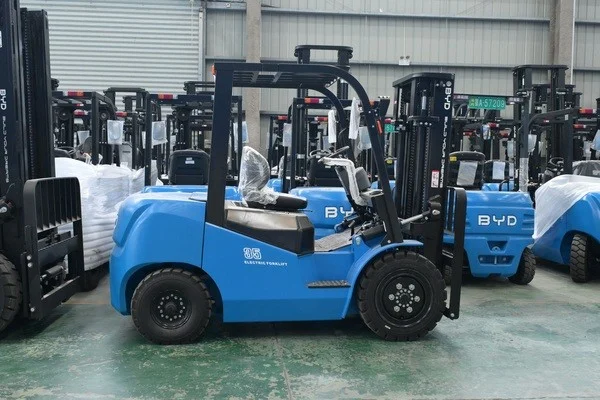
On a four-wheel counterbalance electric forklift, auxiliary hydraulic supply depends on the pump, the valve block, and how many functions operate at once. Confirm the auxiliary flow available at the carriage, the relief pressure setting, and whether the truck has the correct number of auxiliary lines and couplers. Where the truck is ordered new, specify the attachment requirement at the ordering stage so the hydraulic configuration matches; retrofitting lines and valves later is usually more disruptive than specifying them initially.
Matching the two
Flow that is too low slows clamp and rotate functions and can extend cycle time beyond what the job allows. Flow that is too high can overheat the oil or make fine control difficult, depending on the valve arrangement. Pressure that is too low prevents the attachment from holding a load; pressure that is too high may exceed the attachment’s rating. The practical check is to confirm that the attachment’s stated working range sits inside the truck’s delivered range across the operating temperature the site expects.
Also verify hose routing and coupler type. Hoses that are too short restrict mast movement; hoses that are too long can snag on the carriage or the load. Confirm that the chosen couplers match the truck and that the attachment can be removed and refitted without special tools if the truck must switch between tasks.
Matching the Attachment Package to the Job
Once capacity and hydraulics are confirmed, the remaining decisions concern fit and productivity. The table below lists common attachment families and the checks each one usually triggers. It is a starting point, not a substitute for the supplier’s compatibility data.
| Attachment type | Typical selection checks |
|---|---|
| Fork positioner | Added weight and forward offset; number of auxiliary functions; whether sideshift is combined |
| Sideshifter | Lost capacity from the side shift carriage; hose routing; aisle width |
| Clamp | Load center with the clamp closed and open; clamping force versus load fragility; hydraulic pressure setting |
| Rotator | Rotated load envelope; capacity at the rotated position; flow needed to complete rotation within the cycle |
| Integral fork extensions | Revised load center; visibility; whether the extension is approved by the truck manufacturer |
Productivity checks deserve equal weight. An attachment that adds a hydraulic function may add seconds to every cycle; over a shift, that time accumulates. Estimate the number of actuations per hour and compare it with the attachment’s rated cycle capability and the truck’s available flow. If the attachment is used only occasionally, a lighter or simpler design may preserve more capacity and cost less.
Visibility is another practical limit. Clamps and large rotators can obscure the load and the fork tips. Where operators must see the load to place it accurately, confirm visibility from the normal driving position before committing to a design.
FAQ
Can I use the attachment capacity chart without checking my truck’s plate?
No. The chart is only valid when it matches your truck model, mast, and carriage configuration. Compare the chart’s assumptions with the capacity plate and ask the attachment supplier to confirm any difference.
Does a sideshifter reduce lifting capacity?
It can, because the sideshift carriage adds weight and moves the load forward. The amount depends on the specific carriage and truck. Use the derated figure at your actual load center and lift height rather than the truck’s base rating.
What happens if the truck’s auxiliary flow is lower than the attachment specifies?
Clamp, rotate, and shift functions will operate more slowly, and the attachment may not reach its rated clamping force within the expected time. Confirm the minimum flow the attachment needs and compare it with the flow available at the carriage.
Should the attachment be specified when the truck is ordered?
Where possible, yes. Specifying auxiliary lines, valves, couplers, and flow requirements at the ordering stage avoids later modification and helps ensure the hydraulic configuration matches the attachment. Provide the attachment supplier’s requirement sheet with your enquiry.
To move from general checks to a specific configuration, gather the load weight and dimensions, actual load center, maximum lift height, handling cycle, and the attachment supplier’s hydraulic requirement. Those details let a BYD four-wheel counterbalance electric forklift configuration be matched to the attachment package and the job, with capacity and flow figures confirmed against the relevant technical documentation rather than assumed.