How Many Types of Forklift Are There: Using Duty Cycle Data to Specify a Four-Wheel Counterbalance Electric Truck
News 08/11/2026
Forklift families are usually counted by body style: counterbalance trucks, reach trucks, order pickers, pallet trucks, stackers, tow tractors and automated guided vehicles. The exact number depends on how narrowly each category is split, so the more useful question is which type fits a given duty cycle. Readers who need a practical answer usually want a four-wheel counterbalance electric forklift, because that design handles outdoor yards, trailer loading and mixed indoor work with one chassis. Duty cycle data — load weight, lift height, run time, floor and ramp conditions — is what turns that general answer into a specification.
Why the Type Count Matters Less Than the Duty Cycle
Every forklift category describes a structure and a working envelope. A reach truck suits narrow aisles, an order picker suits piece picking at height, and a pallet truck suits horizontal moves. None of those descriptions tells a buyer whether a truck will survive a shift. That answer comes from the duty cycle: how often the truck lifts, how high, how far it travels, and how much of the shift it spends moving versus waiting.
Counting types is still useful as a first filter. If your work involves lifting loads onto trailers, stacking in a yard, or moving between indoor and outdoor surfaces, the counterbalance layout is the natural starting point. The four-wheel version adds stability on uneven ground and in wind-exposed yards compared with a three-wheel design, at the cost of a larger turning circle. That trade-off belongs in the specification discussion, not in a general list.
Reading Duty Cycle Data Before You Choose a Truck
A duty cycle is a description of one repeating work pattern. Record it in plain numbers rather than adjectives, because vague terms such as “heavy use” cannot be checked against a manufacturer’s technical data.
- Load weight: the heaviest load, including attachments and pallets, not the average.
- Lift height: the highest shelf or stack level the forks must reach.
- Load center: the distance from the fork face to the load’s center of gravity; a long load reduces rated capacity.
- Travel distance and speed: meters or feet per trip and trips per hour.
- Floor and ramp conditions: smooth concrete, expansion joints, gravel, dock plates, slope percentage.
- Aisle width: the narrowest point the truck must turn within.
- Shift pattern: hours per shift, shifts per day, and breaks when the truck can charge.
These figures let a supplier match a truck’s rated capacity at the actual load center and lift height. A capacity printed on a data plate applies to a stated load center and mast height; it does not automatically hold at a greater height or with a longer load. Ask which conditions the rating assumes.
Where a Four-Wheel Counterbalance Electric Truck Fits
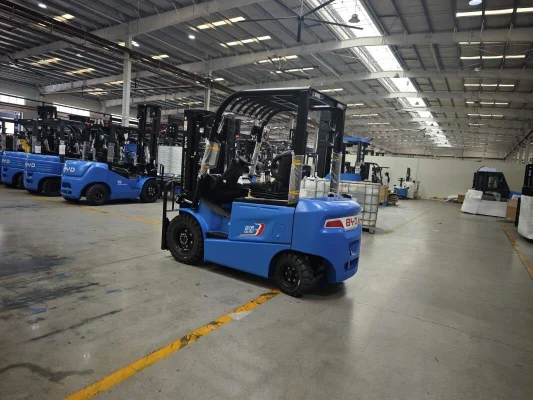
The four-wheel counterbalance electric design is a general-purpose choice in factories, warehouses and loading yards. It can lift and stack, travel between buildings, and work at a dock. Its weight and wheelbase give it stability with heavy loads, and electric drive suits enclosed spaces where exhaust emissions are a concern.
It is not the answer to every layout. Very narrow aisles favor a reach truck. Pure horizontal transport over long distances may favor a tow tractor or pallet truck. Very high lifts in tight aisles are a different design problem. Where those conditions dominate, the counterbalance truck may be the wrong tool, and saying so is part of an honest selection.
The following table shows how duty cycle data changes the specification conversation. Values are placeholders that must be replaced with your own measurements and the manufacturer’s published data.
| Duty cycle input | What it affects | What to confirm |
|---|---|---|
| Maximum load and load center | Rated capacity and stability | Capacity at the actual load center, not the nominal figure |
| Lift height | Mast type and residual capacity | Capacity at full height with the chosen mast |
| Aisle width | Turning radius and chassis size | Right-angle stacking aisle dimension |
| Ramp or dock slope | Traction and braking | Permitted slope and surface condition |
| Shift length and charging windows | Battery capacity and charging approach | Runtime data and charging time from the supplier |
Specification Steps and Common Mistakes
A workable sequence is to measure first, shortlist second, and verify third. Measure the loads, heights, aisles and surfaces on site. Shortlist trucks whose published capacities cover those figures with a margin you can justify. Then verify the details with the supplier before ordering.
Common mistakes are easy to list and expensive to fix:
- Using average load weight instead of the heaviest load.
- Quoting capacity at a standard load center when the real load is longer.
- Ignoring lift height when comparing capacity figures.
- Assuming a battery will last a full shift without checking runtime data and charging breaks.
- Overlooking floor joints, dock plates or ramps that affect traction and tire choice.
- Buying attachments without confirming how they change capacity and visibility.
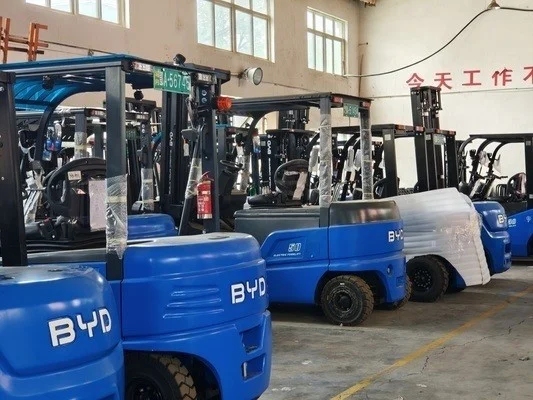
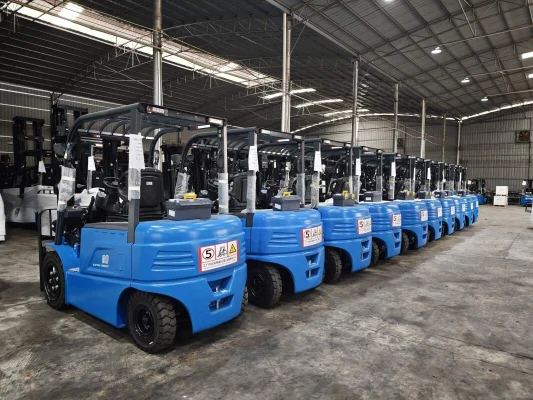
This site supplies BYD four-wheel counterbalance electric forklifts, including lithium-battery models. Selection support starts with your actual duty cycle: load weight, lift height, aisle width, floor and slope conditions, and shift and charging pattern. With those figures, the configuration discussion can focus on published technical data rather than guesswork. Where a specification is not available in the supplied documentation, treat it as an open item to confirm in writing.
Frequently Asked Questions
How many types of forklift are there in common use?
Most working lists name six to eight broad families, including counterbalance trucks, reach trucks, order pickers, pallet trucks, stackers and tow tractors. Subtypes and attachments multiply the count, so treat any single number as a convention rather than a standard.
Is a four-wheel counterbalance electric truck suitable outdoors?
It can work outdoors on prepared surfaces such as concrete yards and loading areas. Performance on slopes, gravel or wet ground depends on the specific model, tires and manufacturer’s stated limits, which should be checked before use.
What duty cycle information should I send a supplier?
Send the heaviest load and its dimensions, required lift height, narrowest aisle, floor and ramp conditions, trips per hour, and shift and charging pattern. These details let the supplier check capacity at the real load center and lift height.
Can one truck cover both indoor and outdoor work?
Often it can, provided the surfaces, slopes and aisle widths fall within the model’s published limits. Where indoor aisles are very narrow, a different design may be more efficient, so compare the actual layout before deciding.