How Many Types of Forklift Are There: Evaluating Four-Wheel Counterbalance Electric Models When Load Center and Attachment Weight Push Past Standard Ratings
News 05/11/2026
Forklift families are usually sorted by how they carry a load: counterbalance trucks that lift a load ahead of the operator, reach trucks that extend a mast into racking, pallet trucks that move loads low to the ground, order pickers, tow tractors, and automated guided vehicles. The count depends on how finely you split categories, so a practical answer is that several broad families exist, and each family contains further variants. This article narrows the question to one family: the four-wheel counterbalance electric forklift. Its focus is a problem that general type lists rarely explain well — what happens when the load center moves forward or an attachment adds weight, so the load a truck can safely handle drops below its nominal rating.
Where Four-Wheel Counterbalance Electric Trucks Fit Among Forklift Types
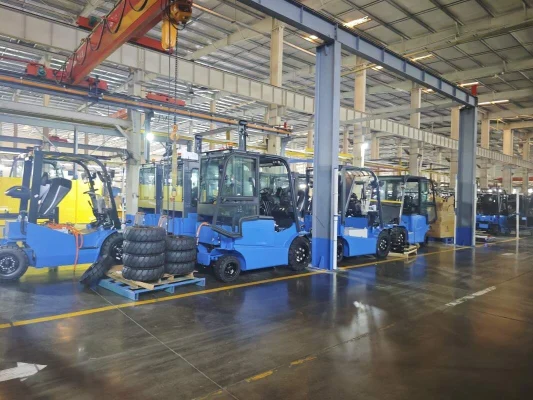
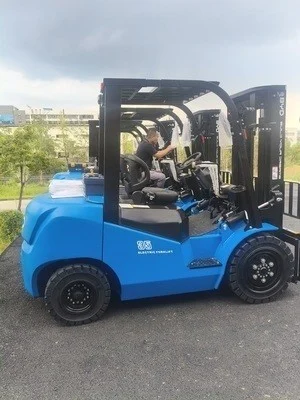
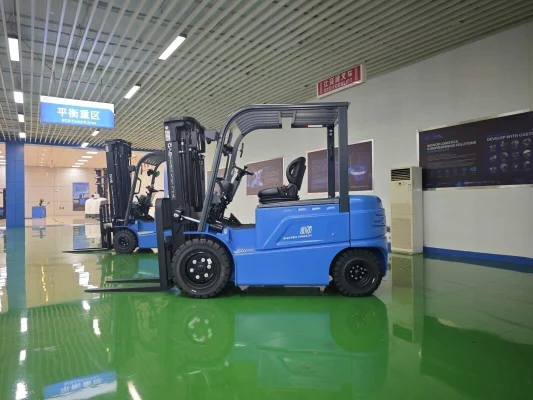
A four-wheel counterbalance electric forklift carries a pallet on forks ahead of the front axle, with the battery and chassis acting as counterweight. Four wheels give a stable footprint on firm, level floors, which suits loading docks, trailer loading, yard-to-warehouse transfers, and block stacking in manufacturing plants. The family is a common general-purpose choice, though it is not automatically the right answer everywhere.
The boundary matters. Narrow aisles, very high racking, and tasks that are mostly horizontal pallet movement often push buyers toward other designs. A four-wheel counterbalance truck needs aisle width that accommodates its turning radius and mast, and its rated capacity is tied to a stated load center. When the aisle is tight or the lift is very high, a different truck type may be the better fit; the honest answer is to check dimensions rather than assume one family covers every job.
Why the Nominal Rating Is Only a Starting Point
Manufacturers publish a rated capacity at a defined load center, typically a distance measured from the fork face to the load’s center of gravity. That rating assumes a standard fork setup and a specified lift height. Add a clamp, a rotator, a bale handler, or a long load, and two things change: the load’s center of gravity moves forward, and the attachment itself adds weight at a distance from the mast. Both effects reduce the load the truck can safely lift.
This is the point where a type count becomes less useful than a capacity check. A truck rated at a nominal figure with standard forks may have a noticeably lower residual capacity once the attachment is fitted. The exact reduction depends on the attachment’s weight, its own load center, and the truck’s data, so it must come from the manufacturer’s capacity charts — not from a rule of thumb applied across models.
Reading Load Center and Attachment Weight in Real Operations
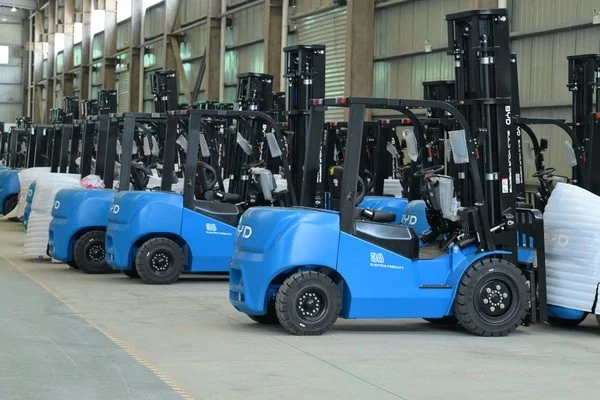
Consider a hypothetical manufacturing plant that receives raw material on oversized pallets and uses a carton clamp to handle bundled goods. The plant’s floor is level concrete, the racking is moderate in height, and trucks move between dock and production. That profile is a reasonable fit for a four-wheel counterbalance electric forklift, provided the capacity with the clamp at the actual load center and lift height is confirmed. The same plant would need a different conversation if its aisles were narrow or its racks very high.
Three variables drive the evaluation:
- Actual load center. Measure the distance from the fork face to the true center of gravity of the heaviest load, including pallet overhang and any load shift.
- Attachment weight and offset. The attachment’s mass sits forward of the carriage, so it consumes part of the truck’s capacity even before a load is picked up.
- Lift height. Capacity charts often show reduced ratings at higher lift heights because mast and hydraulic behavior change. Confirm the rating at the height where the load is actually handled, not only at ground level.
A fourth factor is the duty cycle. Battery capacity, charging windows, and shift patterns affect whether a given truck keeps up, but those are separate from the structural capacity question. Treat them as parallel checks, not substitutes.
A Comparison Table to Structure the Inquiry
| Item to confirm | Why operations care | What to request from the supplier |
|---|---|---|
| Rated capacity at stated load center | Nominal figures mislead when the real load center is farther forward | Capacity chart showing the load center used and any derating curve |
| Residual capacity with the attachment fitted | Attachment weight and offset reduce usable load | Attachment-specific capacity data, including attachment weight and its load center |
| Capacity at working lift height | Handling at height may differ from ground-level ratings | Rating table by lift height, or written confirmation of the height used |
| Aisle and turning dimensions | Four-wheel trucks need room to maneuver | Turning radius, overall width, and recommended aisle width |
| Floor and grade conditions | Slopes and uneven surfaces affect stability and braking | Guidance on permissible floor condition and grade, plus tire options |
| Battery and charging plan | Shift length and charging windows affect availability | Battery capacity data, charger requirements, and charging-time information |
Some items above are standard published data; others, such as attachment-specific residual capacity, may require the manufacturer or attachment supplier to confirm. Do not treat any cell as a default value across models.
Configuration Choices and Limits When Ratings Are Tight
When the load center or attachment pushes close to the limit, the first step is not to add counterweight or assume a bigger model solves it. The first step is to document the real load: weight, dimensions, center of gravity, lift height, and the attachment to be used. With those numbers, the supplier can state whether a given four-wheel counterbalance electric model remains within its capacity chart.
Configuration decisions then follow the data. Fork length and carriage type must match the load and attachment. Tire choice depends on floor condition and whether the truck works indoors, outdoors, or across both. Battery and charging arrangements depend on shift length and available charging time. Each of these is a trade-off: a longer fork or a heavier attachment reduces usable capacity, and a larger battery may change the truck’s weight and dimensions. Confirm every change against the manufacturer’s documentation rather than assuming it is available on all models.
Common Mistakes to Avoid
- Comparing trucks by nominal capacity alone, without the load center and attachment conditions attached to that number.
- Assuming an attachment can be added without recalculating residual capacity.
- Using ground-level ratings when the real task involves lifting to height.
- Choosing a truck type before measuring aisle width, turning needs, and floor conditions.
- Treating a general type list as a substitute for a capacity check on the specific configuration.
To move from general categories to a workable specification, share your actual load weight, load center, lift height, attachment details, aisle width, floor and grade conditions, and shift pattern. That information lets this site’s team discuss configuration options within the four-wheel counterbalance electric range and identify where the data still needs confirmation.
Frequently Asked Questions
How many types of forklift are there in practice?
There is no single agreed number, because families can be split into many sub-variants. A useful approach is to group trucks by load handling method — counterbalance, reach, pallet movement, order picking, towing, and automated — then narrow to the family that matches your aisle, lift height, and load. This article treats the four-wheel counterbalance electric forklift as its subject.
Does an attachment always reduce capacity?
An attachment adds weight ahead of the carriage and usually moves the effective load center forward, so it typically reduces the load the truck can handle. The amount depends on the attachment and the truck, and it should be confirmed from the manufacturer’s capacity data rather than estimated.
Can a four-wheel counterbalance electric forklift work in a narrow aisle?
It can work in aisles that accommodate its turning radius and mast dimensions, but very narrow aisles may call for a different truck design. Measure the aisle and compare it with the truck’s published dimensions before deciding.
What should I prepare before asking about a configuration?
Gather the heaviest load weight, its dimensions and center of gravity, the lift height, attachment details, aisle width, floor and grade conditions, and your shift and charging pattern. These inputs let a supplier check capacity honestly instead of quoting a nominal rating that may not apply.