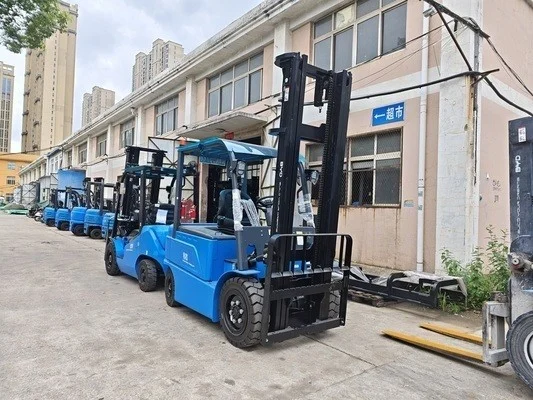
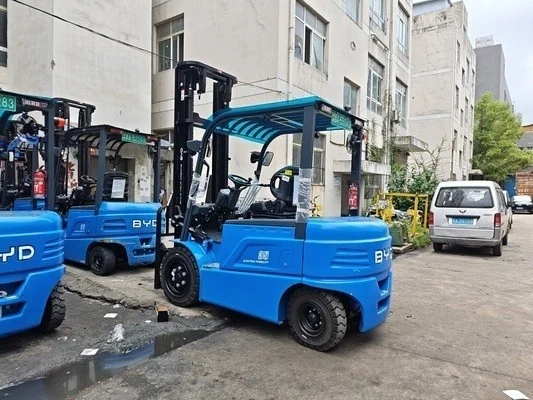
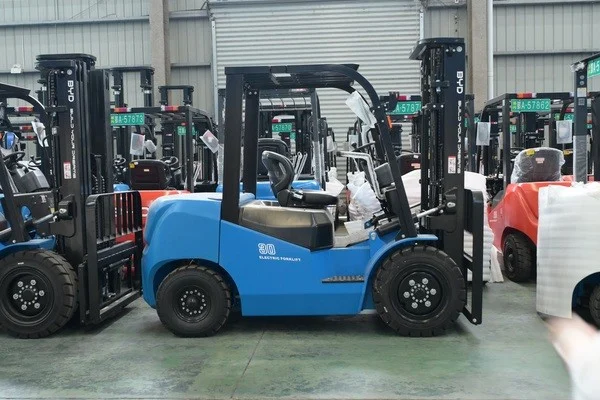
How Many Types of Forklift Are There: Mapping Facility Door Clearances and Aisle Widths to a Four-Wheel Counterbalance Electric Forklift
News 09/11/2026
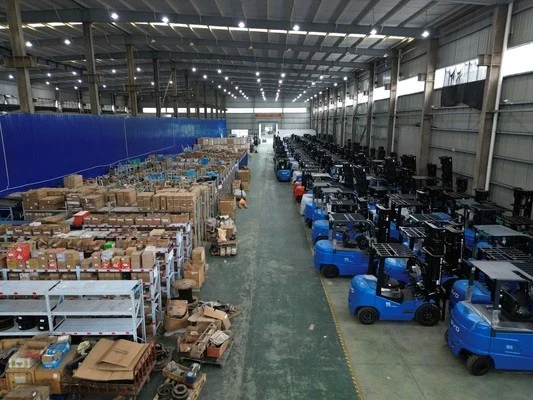
There is no single official count of forklift types. Classifications vary by power source, chassis configuration, mast design, and task. What matters more to a facility planner is a narrower question: given my door openings, aisle widths, floor conditions, and loads, which configuration actually fits? This article answers the “how many types” question at a practical level, then narrows the discussion to the four-wheel counterbalance electric forklift, the configuration this site sells, and shows how building dimensions decide whether that configuration is viable.
The Type Landscape: A Working Count and Why It Matters
Most industrial buyers encounter forklift families grouped roughly as follows: counterbalance trucks (electric, internal combustion, and sometimes three-wheel variants), reach trucks, order pickers, pallet trucks and stackers, tow tractors, and automated guided vehicles. Within counterbalance trucks alone, you can further split by power source, tire type, mast type, and operator compartment. That is why published counts differ so widely: one source counts chassis families, another counts every configuration.
A useful way to frame the question is by constraint. Each family is defined by how it carries a load and how much room that method demands:
- Counterbalance trucks carry the load cantilevered ahead of the front wheels, so the machine needs a counterweight and a turning envelope behind the drive axle.
- Reach trucks place the operator and load inside the footprint and extend a mast forward, which suits very narrow rack aisles but depends on rack-mounted guidance or defined aisle geometry.
- Pallet trucks and stackers handle loads on the floor or at low lift heights and are not general-purpose rack service machines.
- Tow tractors and automated platforms move loads without lifting them onto racking.
The practical takeaway: the number of types is less important than the fact that each type trades aisle width against lift height, load center, and throughput. A facility that narrows aisles to save floor space usually narrows its choice of truck at the same time.
Door Clearances, Aisle Widths, and the Four-Wheel Counterbalance Decision
This section uses a generic warehouse and manufacturing transfer scenario as an illustrative planning exercise, not a documented case study. The goal is to show which dimensions you must collect before a supplier can confirm fit.
Start with the building, not the truck
Measure and record the following before discussing models:
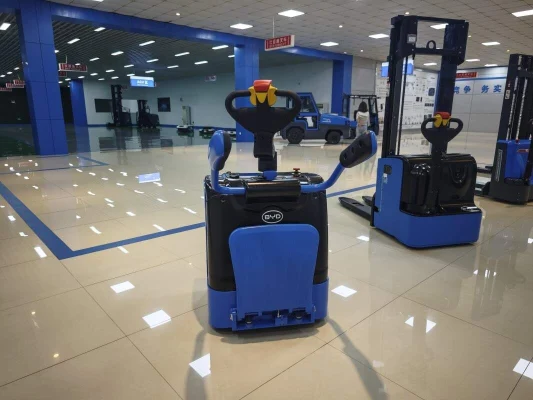
- Clear door opening width and height. Note the narrowest point, including door frames, roll-up door tracks, and any threshold or dock leveler lip. A mast in the travel position and the overhead guard determine the height envelope; the widest part of the truck determines the width envelope.
- Aisle width at the tightest point. Include rack uprights, column protrusions, sprinkler risers, and pedestrian gates. Distinguish between aisles where the truck travels straight and aisles where it must turn into a rack bay.
- Right-angle stacking aisle. This is the dimension that most often rules a counterbalance truck in or out. It depends on the truck’s turning radius, the load length, and the required clearance on each side.
- Floor flatness, joints, and slope. Ramps and dock plates affect both traction and the safe handling of a loaded mast.
- Load data. Weight, pallet or container dimensions, load center, and the lift height at which the load must be handled.
Why the four-wheel counterbalance layout suits general transfer work
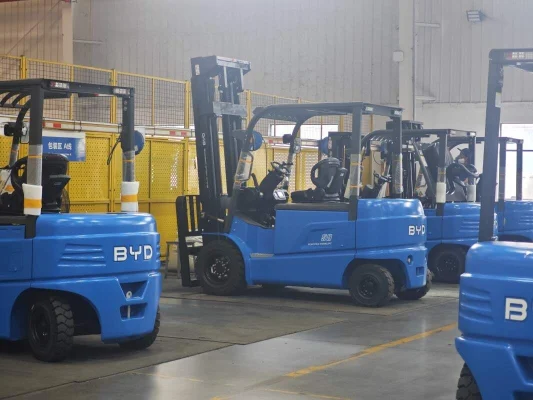
A four-wheel counterbalance electric forklift is a common general-purpose choice in factories and warehouses because it can pick from the floor, stack into racking, and travel between zones on one chassis. Its limits are equally clear: the counterweight and rear steering geometry mean it needs more right-angle stacking room than a reach truck, and its stability depends on the load center staying within the rating conditions the manufacturer specifies.
Three-wheel counterbalance trucks turn more tightly in some layouts, and reach trucks serve very narrow aisles, but this site does not sell those configurations. If your measured stacking aisle is genuinely too tight, the honest answer is that a four-wheel counterbalance truck may not be the right fit, and the layout or racking may need review instead.
Match the mast and overhead guard to the door
Door height is frequently overlooked. A mast that fits the rack height may still be too tall in its collapsed position to pass under a low doorway or mezzanine edge. Ask the supplier to confirm the collapsed mast height, the overhead guard height, and whether a different mast stage or a low-profile guard is available. These are configuration questions that depend on the specific model and cannot be assumed from a general family description.
Specifications and Configuration Checks That Decide Fit
The table below summarizes what to verify. Values are intentionally left as items to confirm because they depend on the specific model and the manufacturer’s technical data.
| Parameter or configuration | Why the facility cares | What to confirm with the supplier | Standard, optional, or to verify |
|---|---|---|---|
| Rated load and load center | Determines whether the pallet can be lifted at the required height | Rating at the actual load center and lift height; derating with attachments | To verify per model |
| Turning radius and right-angle stacking aisle | Decides whether the truck can enter rack bays in the existing aisle | Published turning radius plus the aisle calculation method the supplier uses | To verify |
| Collapsed mast and overhead guard height | Door and mezzanine clearance | Exact travel-position dimensions; alternative mast stages | Configuration-dependent |
| Truck width and tire type | Door opening and floor surface compatibility | Overall width with the specified tires; suitability on smooth or rough floors | To verify |
| Battery and charging arrangement | Shift pattern and available charging time and space | Battery capacity options, charger requirements, and charging area needs | Configuration-dependent |
| Attachments (if any) | Changes load center and residual capacity | Effect on rating and aisle envelope | To verify before ordering |
Questions that separate a good quote from a guess
When you request pricing, provide the measured door width and height, the tightest aisle, the stacking aisle, the load weight and dimensions, the load center, the required lift height, floor slope, shift length, and charging location. A supplier who quotes without these details is guessing. Ask specifically how the quoted model’s residual capacity changes at your lift height and load center, and ask which dimensions are standard and which require a different mast or configuration.
Also clarify the scope of any site assessment. A supplier can review drawings and measurements; confirming real clearances on site is a separate step, and responsibility for final verification should be agreed in writing.
Common planning errors
- Measuring the aisle at mid-height but ignoring rack uprights and floor-level obstructions.
- Comparing load ratings without checking the load center and lift height at which they apply.
- Assuming a truck that fits the door also fits the turn into the first rack bay.
- Forgetting that attachments reduce available capacity.
- Planning charging capacity without confirming the charger and battery options the supplier actually offers.
Frequently Asked Questions
How many types of forklift are there in practice?
Counts vary because sources classify by different criteria. A workable approach is to group by load-handling method: counterbalance trucks, reach trucks, order pickers, pallet trucks and stackers, tow tractors, and automated platforms, then subdivide by power source and configuration. The exact number matters less than matching the handling method to your aisles and loads.
Can a four-wheel counterbalance electric forklift work in a narrow aisle?
Sometimes, but it depends on the measured right-angle stacking aisle, the load length, and the truck’s turning radius. If the aisle is tighter than the calculated requirement, a counterbalance truck is the wrong tool and the layout should be reviewed rather than forced.
What door dimensions should I send a supplier?
Send the clear opening width and height at the narrowest point, including door tracks and thresholds, plus the collapsed mast height and overhead guard height you can accommodate. Also note any low mezzanines or pipework along the travel route.
Does a bigger load rating always mean a better choice?
No. A higher nominal rating may come with a larger chassis that no longer fits your aisles or doors. The relevant figure is the residual capacity at your actual load center and lift height, within the envelope your building allows.
Before ordering, assemble a data pack: door and aisle measurements, load and lift requirements, floor and slope conditions, shift and charging details, and any attachment needs. Then ask the supplier to confirm which quoted dimensions and capacities apply to your exact configuration, and to state clearly what remains to be verified on site. If you share those details with us, we can review whether a BYD four-wheel counterbalance electric forklift configuration fits your operating conditions.