Four-Wheel Counterbalance Electric Forklift Specification Guide: Matching a 2.5 Ton Electric Forklift to Your Load Profile and Duty Cycle
News 10/11/2026
A 2.5 ton electric forklift is a common nominal capacity class, but the number on the data plate does not tell you whether the truck will handle your loads safely all shift. Real capacity depends on load weight, load center, lift height, attachment weight, battery condition, and the duty cycle you expect. This guide explains how to match a four-wheel counterbalance electric forklift to your actual load profile and work pattern, and which specifications to confirm before you request a quote.
What a 2.5 Ton Rating Actually Means
Forklift capacity ratings follow a defined test condition: a specified load weight at a specified load center, usually 500 mm or 600 mm from the fork face, with the mast vertical and the load at a defined height. The rated capacity is not a constant across all lift heights or load positions. As the load center moves forward, or as the carriage rises, the allowable load decreases. The manufacturer’s load chart, not the headline number, defines the safe envelope.
When you evaluate a 2.5 ton electric forklift, ask for the capacity chart at the actual lift height you need and at the load center your pallets create. A truck rated 2,500 kg at 500 mm may have a lower rating at 600 mm or at high lift. If your loads are dense or your pallets are deep, the effective capacity may fall below what the model name suggests.
Load Profile: The Variables That Change Capacity
Load profile is more than weight. Four variables determine whether a given truck can handle your loads:
- Load weight and stability: A compact, stable load is easier to handle than a tall, loose load of the same weight. Off-center loads reduce effective capacity.
- Load center: Measure from the vertical face of the forks to the center of gravity of the load. Standard pallets often produce a load center near 500–600 mm, but long or irregular loads can push it further forward.
- Lift height: Higher lift reduces capacity. If you stack to 4–6 m, confirm the rating at that height.
- Attachments: Clamps, rotators, and side shifters add weight and move the load center forward, reducing net capacity. The attachment supplier’s data and the truck manufacturer’s derating information should be combined.
Write down the heaviest load, its dimensions, the load center, and the highest lift you perform. These four numbers form the basis of a realistic capacity check.
Duty Cycle: How Work Pattern Affects Battery and Motor Choice
Duty cycle describes how hard the truck works: hours per shift, lifts per hour, travel distance, ramp grades, and ambient conditions. A light duty cycle may suit a smaller battery and a standard motor. A heavy duty cycle with continuous lifting and long travel may require a larger battery, a more robust thermal design, and careful attention to charging logistics.
Lithium-ion batteries change the duty cycle calculation. They can often be opportunity charged during breaks without the memory effects associated with some older battery technologies, but the charger and battery management system must support the pattern. Confirm the manufacturer’s recommended charging window and the available charging infrastructure at your site. Do not assume a battery will complete a full shift without verifying the energy consumption at your actual workload.
Also consider the floor and ramp conditions. Four-wheel counterbalance electric forklifts are common in general warehousing and manufacturing, but gradients, dock plates, and poor floor surfaces affect traction and energy use. Provide these details when discussing specifications.
Specifications to Confirm Before You Request a Quote
Use the following checklist to structure a specification request. The list separates information you can gather internally from information the supplier must provide.
| Category | Details to confirm | Source |
|---|---|---|
| Load | Max weight, dimensions, load center, load stability | Your operation |
| Lift | Max fork height, free lift, mast type | Your racking or stacking plan |
| Duty cycle | Hours per shift, lifts per hour, travel distance, ramp grade | Your operation |
| Battery and charging | Battery voltage and capacity, charger type, charging window, available power | Supplier data and site electrical capacity |
| Dimensions | Aisle width, door heights, turning radius, overall width | Your facility layout |
| Attachments | Type, weight, derating effect | Attachment supplier and truck manufacturer |
| Environment | Indoor/outdoor, floor surface, dust, temperature, hazardous area classification | Your site conditions |
For a four-wheel counterbalance electric forklift, the supplier should provide a capacity chart, battery specifications, charger requirements, and dimensional drawings. If any of these are missing, request them before comparing models. Do not accept a nominal capacity alone as proof of suitability.
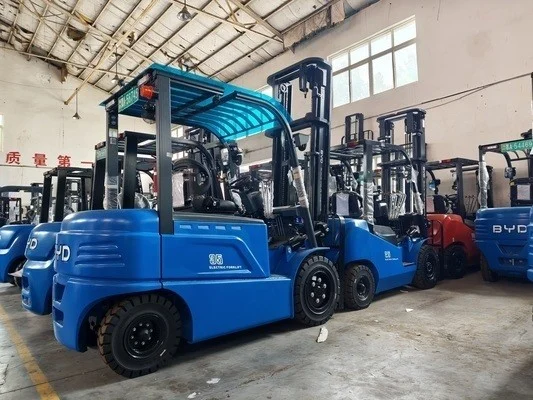
If your application involves attachments or very high lift, ask specifically how the rated capacity is affected. A responsible supplier will show the derated capacity at your load center and lift height.
Frequently Asked Questions
Can a 2.5 ton electric forklift lift 2.5 tons at any height?
No. The rated capacity applies at a specified load center and often at a specified lift height. Capacity typically decreases as lift height increases or as the load center moves forward. Always check the load chart at your actual lift height and load center.
How do I calculate the load center of my pallet?
Measure from the vertical face of the forks to the center of gravity of the load. For a uniformly stacked pallet, the center is usually near the middle of the load depth. Irregular or offset loads require a more careful estimate, and the effective load center may be greater than the physical midpoint.
What duty cycle information should I provide to a supplier?
Provide hours per shift, lifts per hour, average travel distance, ramp gradients, and the longest continuous operating period between breaks. Also state whether the truck will be charged during breaks or only between shifts. This helps the supplier recommend a suitable battery and charging configuration.
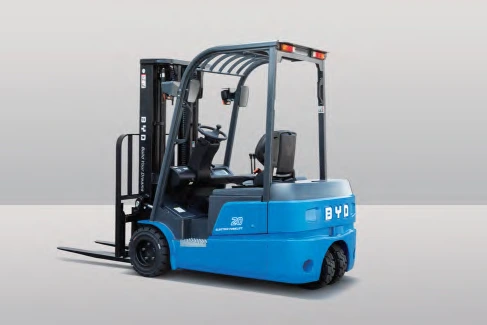
Do attachments reduce capacity on a four-wheel counterbalance electric forklift?
Yes. Attachments add weight and often move the load center forward. The net capacity is reduced, and the manufacturer’s derating information should be applied. Confirm the combined effect of the attachment and the load before specifying the truck.
Next Steps: Turning Your Data into a Specification
Start with a written load profile and duty cycle summary. Include the heaviest load, its load center, the highest lift, the number of shifts, and any ramp or floor constraints. Then request a capacity chart and battery specification from the supplier at those conditions. If the supplier cannot provide derated capacity information, treat the nominal rating as unverified.
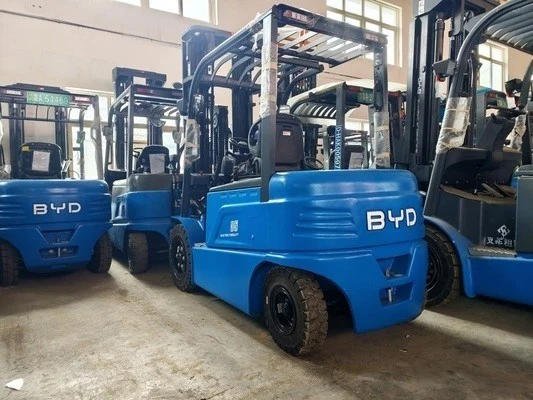
Our sales scope covers BYD four-wheel counterbalance electric forklifts, including lithium-ion models. If you are evaluating a 2.5 ton electric forklift, share your load weight, load center, lift height, and duty cycle with us so we can help you confirm which configuration matches your operation. We will not quote a model until the capacity and battery requirements are clear.