Four-Wheel Counterbalance Electric Forklift Specification Review: Confirming Axle Load Limits and Floor Bearing Pressure Before Installation
News 09/11/2026
Installing a four-wheel counterbalance electric forklift is a floor-loading decision as much as a vehicle-selection decision. Before the machine arrives, the buyer should confirm two things: whether each axle will carry its share of the load under the worst realistic condition, and whether the floor beneath the wheel paths can accept the resulting pressure. Both answers come from the manufacturer’s specification sheet plus a site survey, not from a generic catalog. This review explains how to read those documents, what to request, and where the common mistakes occur.
Why Axle Load and Floor Pressure Are Separate Checks
Axle load and floor bearing pressure are related but not interchangeable. Axle load describes the vertical force a wheel pair transfers into the chassis and then into the ground. Floor bearing pressure describes how that force is distributed across the contact area where tire meets floor. A machine can pass one check and fail the other.
A four-wheel counterbalance electric forklift carries most of its own weight over the rear axle when empty, and shifts load toward the front axle when lifting. The counterweight sits at the rear, the mast and battery placement affect the distribution, and an attachment changes the effective load center. This is why a single “operating weight” figure is not enough. The specification sheet should list axle loads in defined states, and the buyer should know which state applies to the installation.
Floor pressure then depends on tire type, wheel count, and contact patch. Pneumatic and solid pneumatic tires spread load differently from press-on or cushion types. The same axle load can produce very different pressure under a small hard wheel than under a larger resilient tire. Neither number can be assumed; both should come from the supplier’s documentation or a qualified structural assessment.
Reading the Specification Sheet Correctly
States That Change the Numbers
Ask the supplier to identify the load states behind any axle figure. Useful states include:
- Unladen, mast lowered, no attachment
- Unladen with the rated attachment fitted
- Laden at rated capacity with the load center stated
- Laden with the mast raised, if the site will travel or stack at height
The laden state matters most because the front axle load rises as the load center moves forward. If the site uses a clamp, a push-pull, or a side-shifting carriage, the attachment’s weight and its own load center must be included. A capacity plate rated at a given load center does not automatically apply to a different load center or a heavier attachment.
Parameters Worth Confirming Before Sign-Off
The following table groups the items that most often go unchecked. It is a checklist, not a set of default values; every figure must come from the supplier’s technical data or a site assessment.
| Item | Why It Matters | What to Request |
|---|---|---|
| Axle load, unladen and laden | Sets the force entering the floor | Supplier data sheets stating load state, load center, and attachment |
| Tire type and size | Determines contact area and pressure distribution | Fitted tire specification and recommended floor type |
| Rated capacity at actual load center | Derating changes real axle load | Capacity chart covering the intended attachment and lift height |
| Floor slab or deck information | Governs allowable bearing pressure | Structural drawings, slab thickness, reinforcement, and any mezzanine rating |
| Wheel path and aisle layout | Concentrates load along travel lines | Layout drawing showing turning radius and wheel tracks |
| Battery and charger placement | Affects weight distribution and charging area loading | Battery weight, charging position, and charger footprint |
Where the supplier cannot provide a figure, treat it as an open item. Do not substitute a typical industry value. A missing number is a reason to pause the order, not a gap to fill with an estimate.
Applying the Numbers to a Real Installation
An Illustrative Scenario: Pallet Handling in a Distribution Warehouse
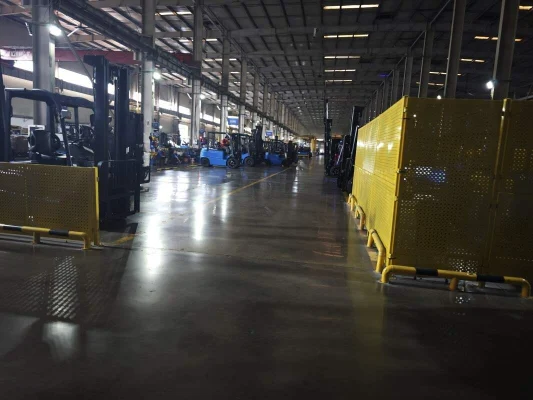
Consider a hypothetical distribution warehouse that receives palletized goods and moves them from dock to racking. The floor is a suspended slab over a service level, which makes bearing pressure the critical constraint. The intended four-wheel counterbalance electric forklift will work two shifts and charge in a corner of the marshalling area.
In this scenario, the review sequence would run as follows:
- Define the duty: maximum pallet weight, actual load center, lift height, and whether the truck travels with a raised load.
- Obtain axle loads from the supplier in the unladen and laden states that match that duty, including any attachment.
- Confirm tire type and the contact area the supplier expects on the warehouse floor.
- Pass the axle loads and tire data to the structural engineer who holds the slab drawings, and obtain a written allowable pressure assessment along the actual wheel paths.
- Compare the assessed pressure against the slab capacity, allowing for any point-load concentration at racking legs and column bases near the aisles.
- Confirm the charging area floor and the route between charger and work zone carry the same checks.
This is a planning example, not a report of a completed project. The point is the order of operations: vehicle data first, structural assessment second, layout adjustment third. Changing the route or the truck after the floor assessment usually costs more than doing the sequence correctly once.
Where Balance and Layout Interact
Aisle width, turning radius, and racking clearances affect where the wheels actually travel. If the layout forces tight turns, the wheel paths may concentrate on a smaller floor area than the plan suggests. Share the final layout drawing with both the forklift supplier and the structural reviewer so the pressure assessment reflects the real travel lines rather than a nominal aisle.
Ground conditions also belong in this review. Slopes, dock levelers, expansion joints, and floor coatings influence traction and braking, and some coatings have their own load limits. Ask the supplier whether the proposed tire compound suits the floor finish, and confirm any slope or ramp limits from the technical data.
Configuration Choices That Change the Load Case
Several configuration decisions shift the numbers and should be settled before the floor assessment is finalized:
- Attachment: adding a clamp or side-shifter increases front axle load and reduces remaining capacity at a given load center.
- Battery: battery weight and position affect unladen distribution; confirm the intended battery configuration with the supplier.
- Mast: a taller mast adds weight and raises the center of gravity when elevated.
- Tires: the fitted tire type must match the pressure calculation; a later tire change invalidates the earlier assessment.
Treat these as change-control items. If any one changes after the structural review, the review should be revisited.
Frequently Asked Questions
Can I use the operating weight on the data plate as the floor load?
No. Operating weight is a total, while the floor sees the load through individual wheel paths. The axle load in the relevant laden or unladen state, combined with tire contact area, is the starting point. The structural assessment then converts that into pressure along the actual travel lines.
What if the supplier provides axle loads but not floor pressure?
That is common and not necessarily a problem. Axle loads plus tire specification are the inputs a structural engineer needs. Ask the supplier to confirm the tire type and size fitted to the quoted configuration, and pass those details to the engineer together with the slab drawings.
Does a higher-rated capacity always mean higher floor pressure?
Not automatically. Pressure depends on weight distribution and tire contact area as well as capacity. A heavier machine with larger tires may distribute load differently from a lighter one with small hard wheels. Compare the actual axle loads and tire data, not the capacity rating alone.
How should the charging area be checked?
The charger footprint, battery handling equipment, and the parked truck all impose load on the floor. Include the charging position in the layout drawing and confirm its floor capacity with the same reviewer who assessed the main aisles. Confirm charging temperature requirements and ventilation needs with the supplier at the same time.
What information should I gather before requesting a quotation?
Prepare the maximum pallet weight, actual load center, required lift height, attachment details, aisle and turning dimensions, floor construction and slab drawings, any slopes or dock levelers, shift pattern, and charging location. With those inputs, the supplier can confirm the suitable four-wheel counterbalance electric forklift configuration and the data needed to complete the floor review. Share the site conditions with our team to discuss selection and configuration against your actual duty.