Choosing a Four-Wheel Counterbalance Electric Forklift Truck: Duty Cycle, Battery Capacity, and Charging Strategy Trade-Offs
News 31/10/2026
An electric forklift truck purchase usually starts with a load chart and ends with a charger question. The practical middle ground is a three-way trade-off: how hard the truck works, how much energy the battery must hold, and how quickly that energy can be restored between shifts. None of these can be settled independently. A truck sized around a light single-shift routine will struggle if the same unit is later pushed into two-shift work, and a battery sized to cover a full week of opportunity charging may cost more than the operation needs. This guide walks through the decision order and the points where buyers most often misjudge their own requirements.
Start with the duty cycle, not the truck
Duty cycle describes how the truck is actually used: hours per shift, shifts per day, lift height, average load weight, travel distance, and how much of the shift involves lifting versus driving. Two operations that both report “eight hours a day” can have very different energy demands.
Record the following before comparing any models:
- Operating hours per shift, excluding breaks, and the number of shifts per day or week.
- Average and peak load weights, plus the load center at which they are handled. A load chart is valid only at the stated load center.
- Lift height and frequency — how many lifts per hour and the typical and maximum heights.
- Travel distance and floor conditions, including ramps, dock plates, rough surfaces, and doorway or aisle clearances.
- Attachments, which add weight and shift the effective load center.
- Ambient conditions such as cold storage, freezers, or dusty and humid areas, which affect both battery behavior and component selection.
A useful first filter is the shift pattern. Single-shift work with a long overnight charging window is the most forgiving case. Multi-shift work, or any pattern where the truck cannot be taken out of service long enough to charge, changes the battery and charging decision entirely.
Matching battery capacity to real energy demand
Battery capacity is expressed in ampere-hours at a stated voltage, and the usable energy depends on the battery chemistry and how deeply it is discharged. Rated capacity alone does not tell you how long a truck will run; consumption depends on the work performed. The honest answer is that consumption must be estimated from the duty cycle and then confirmed against the manufacturer’s technical data and, ideally, a trial.
What the battery must cover
Think in terms of a charging window rather than a single number. If a truck runs one shift and then has ten to twelve hours connected to a charger, the battery needs to absorb one shift of energy plus a margin. If the truck runs two or three shifts with only short breaks, the battery must either hold enough energy to finish the pattern or be sized and specified to accept energy during breaks.
Lithium versus lead-acid implications
Lithium-ion batteries generally accept opportunity charging without the watering and equalizing routines associated with flooded lead-acid types, and they can often be charged during breaks. That flexibility is valuable in multi-shift work, but it does not remove the need to size the battery correctly. Confirm with the supplier which charging profiles the specific battery and charger support, the permitted depth of discharge, and any temperature limits. Where documentation is missing, treat the figures as unconfirmed and ask the supplier to provide them in writing.
Common sizing errors
- Sizing from a truck’s rated capacity instead of the actual average load and lift height.
- Ignoring attachments when calculating the load center.
- Assuming a battery that performed well in summer will behave the same in a freezer or an unheated dock area.
- Buying the largest battery available as a substitute for understanding the duty cycle, which adds cost and weight without solving a scheduling problem.
Charging strategy: where the real trade-offs appear
Three broad strategies are common: overnight charging, opportunity charging during breaks, and battery exchange. Each has conditions under which it works well and conditions where it creates problems.
| Strategy | Works well when | Watch out for |
|---|---|---|
| Overnight charging | Single shift; a dedicated charging area; adequate time between shifts | Limited flexibility if a second shift is added; charger and ventilation requirements must be met |
| Opportunity charging | Breaks are long enough and predictable; battery and charger support partial charging; lithium chemistry is used | Requires discipline and the right charger; unsuitable charging habits can shorten battery life |
| Battery exchange | Continuous multi-shift operation; space and handling equipment are available | Capital cost, floor space, and a safe exchange procedure are needed |
Charging infrastructure is often the most underestimated line item. Confirm the available electrical supply, the distance from the charger to the parking position, ventilation, and whether charging will take place in a cold or wet area. Ask the supplier how the charger interacts with the battery management system and what the recommended charging window looks like in practice.
A short decision sequence
- Map the duty cycle over a full week, including peaks such as seasonal shipping periods.
- Estimate energy demand from hours, load, lift height, and travel, then compare with the supplier’s documented consumption figures.
- Choose a charging strategy that fits the shift pattern and the building’s electrical capacity.
- Size the battery to the strategy, not the other way around.
- Verify the load chart at the actual load center, including attachments.
- Confirm aisle width, floor condition, ramps, and door clearances against the truck’s dimensions.
Turning the analysis into a specification
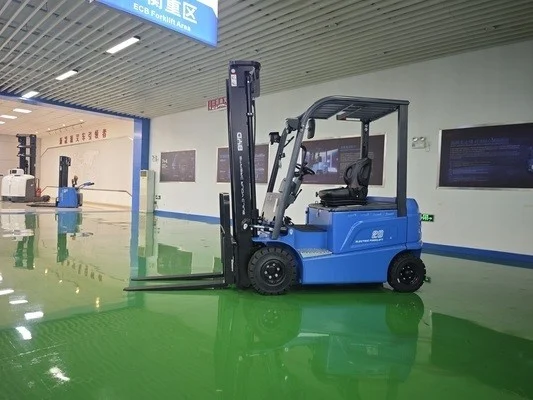
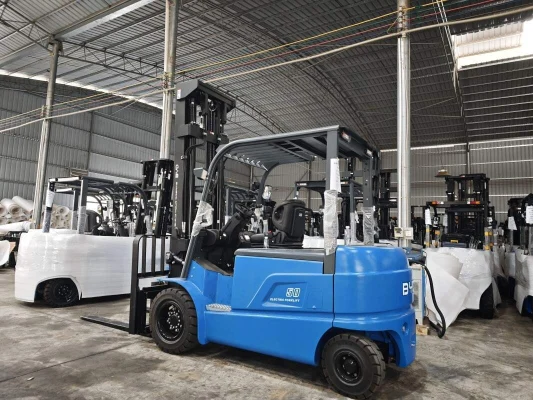
Once the duty cycle, battery, and charging approach are settled, the remaining choices are more straightforward. A four-wheel counterbalance electric forklift is a common general-purpose choice in factories, loading docks, and warehouse transfer work because it handles pallets from the floor and can lift to racking heights. Whether it suits a particular site still depends on the load, lift height, load center, aisle width, floor and ramp conditions, shift pattern, and charging arrangements.
Provide the supplier with the following so the configuration can be checked rather than guessed:
- Load weights, load dimensions, and the load center in use.
- Required and maximum lift heights, and any attachment details.
- Shift pattern, operating hours, and charging windows.
- Aisle widths, doorway dimensions, floor surface, and ramp gradients.
- Environmental conditions, including temperature range and exposure to dust or moisture.
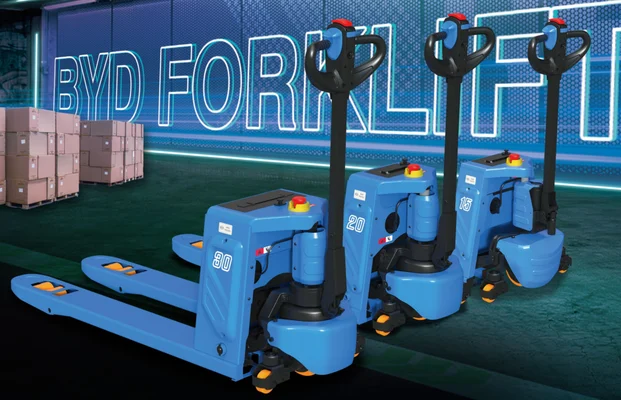
Where the site needs a different truck category — such as a reach truck in a narrow aisle, or a pallet truck for horizontal transport only — that is a sign the counterbalance truck may not be the right fit, and the requirement should be discussed openly rather than forced into one model. Buyers considering BYD four-wheel counterbalance electric forklifts can ask the supplier to match these parameters to documented model data and to state clearly which figures are confirmed and which require a site assessment.
Frequently asked questions
Can one battery cover two shifts?
Sometimes, but it depends on the energy consumed per shift, the battery’s usable capacity, and whether breaks allow partial charging. Do not assume a two-shift pattern is covered without checking documented consumption and charging data with the supplier.
Is opportunity charging always better than overnight charging?
No. Opportunity charging adds flexibility, but it requires a battery and charger specified to accept partial charging and a routine that keeps charging predictable. A single-shift operation with a long overnight window may be better served by a simpler charging schedule.
How does lift height affect battery choice?
More lifts and greater heights generally mean more energy consumed per hour, and they also affect the load chart. The battery should be sized from the actual work profile rather than from the truck’s headline capacity.
What should I confirm before ordering a charger?
Confirm the electrical supply available at the charging location, the charger’s compatibility with the battery management system, ventilation and safety requirements, and the charging window the operation can realistically provide.