Indoor Electric Forklift Buying Guide: Questions to Ask About Four-Wheel Counterbalance Capacity, Battery, and Aisle Fit
News 03/11/2026
An indoor electric forklift purchase usually goes wrong at the specification stage, not at the delivery stage. The most useful preparation is a short list of questions you put to your own team before you contact any supplier. This guide covers the questions that decide whether a four-wheel counterbalance electric forklift fits your building, your loads, and your charging routine, and it explains which answers you need in writing before you request a quote.
Start With the Load, Not the Truck
Capacity ratings are easy to misread. A counterbalance forklift is rated at a stated load center, and the rated capacity applies to that load center at a stated lift height. Move the load center outward, and the safe capacity falls. Ask these questions before you compare models:
- What is the heaviest load, including pallet, packaging, and any attachment?
- How deep is the load from the vertical face of the fork carriage? This is your actual load center.
- What is the highest lift height at which you will handle a full load, not just the highest rack beam in the building?
- Will you use any attachment, such as a sideshifter or fork positioner, that adds weight and shifts the load center?
Write the answers down as a range, not a single figure. A truck that only meets your heaviest load at the lowest height may be inadequate at the top beam. Ask the supplier to confirm the capacity at your stated load center and lift height in writing, and check that the data plate matches the quotation.
Battery and Charging Questions That Affect Daily Operation
Battery choice shapes shift patterns, charging space, and the electrical work needed in the building. Lithium-ion models are common in indoor fleets, but the right questions stay the same regardless of chemistry.
Shift and charging pattern
Ask how many hours the truck will run per shift, whether opportunity charging is possible during breaks, and whether the truck must operate across multiple shifts without a battery change. Then ask the supplier to state the usable capacity and charging time from the actual battery data sheet, not from a general brochure claim.
Electrical supply and charging location
Confirm the available voltage and current at the proposed charging point, who will install the charger, and whether the charger needs ventilation or a dedicated circuit. If charging will happen in a busy aisle, ask about cable routing and whether the charger can be placed away from traffic. For lithium-ion trucks, ask which charger model the supplier specifies and whether the battery management system limits charging at high ambient temperatures.
Battery handling and replacement
If you plan to swap batteries, ask whether the truck is configured for side extraction, what equipment is needed, and where the spare battery will be stored and charged. If you do not plan to swap, say so clearly; it changes the battery specification and the charging strategy.
Aisle Fit: Measurements You Need Before You Shortlist
Aisle fit is where indoor projects most often stall. The right questions are about your building, not about the truck alone.
- What is the narrowest aisle the truck must work in, measured between rack uprights or between a rack and a wall?
- What is the right-angle stacking aisle, meaning the space needed to turn a load into or out of a rack position?
- What is the doorway, gate, and lift opening width and height along the route?
- Are there ramps or slopes, and what is the gradient?
- What is the floor condition and floor loading limit?
Give these figures to the supplier and ask which chassis width, fork length, and turning radius the proposed model has. Ask for the manufacturer’s aisle requirements at your load length. Do not accept a general statement that a model “fits standard aisles.” A four-wheel counterbalance electric forklift generally needs more turning space than a three-wheel design, so the aisle figure matters more, not less.
Site Conditions and Safety Details to Confirm
Indoor operation adds constraints that outdoor buyers can ignore. Ask about overhead obstructions, sprinkler clearance, and the height of the mast when fully lowered and fully raised. Confirm whether the truck will work in cold storage, wash-down areas, or dusty zones, because these conditions affect battery choice, sealing, and maintenance intervals.
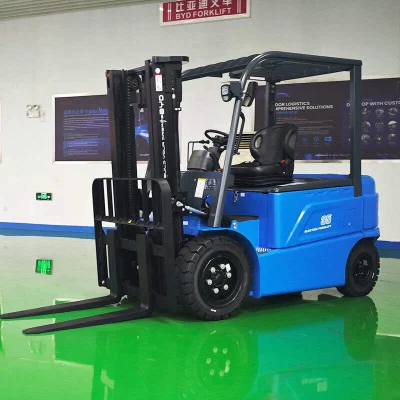
Ask what lighting and warning devices the supplier includes, such as work lights, a horn, and a reverse alarm, and whether the building has any noise or emission limits that shape the specification. Electric trucks produce no exhaust emissions at the point of use, but battery charging areas still need suitable ventilation and fire precautions; ask the supplier what the battery data sheet and local rules require.
Finally, ask who provides operator training and what the handover includes. A written checklist of pre-use inspections and a clear maintenance schedule are part of the purchase, not an optional extra.
Frequently Asked Questions
How do I know if a four-wheel counterbalance electric forklift suits my indoor aisle?
Measure the narrowest aisle and the right-angle stacking aisle, then give those figures plus your load length to the supplier. Ask for the model’s aisle requirement at that load length. If the figures do not meet your layout, the model is not suitable, regardless of its capacity rating.
What capacity should I request when my loads vary?
Specify the heaviest load, its actual load center, and the highest lift height at which you handle it. Request the rated capacity at those conditions in writing. A single headline capacity figure does not describe what the truck can safely handle across your racking.
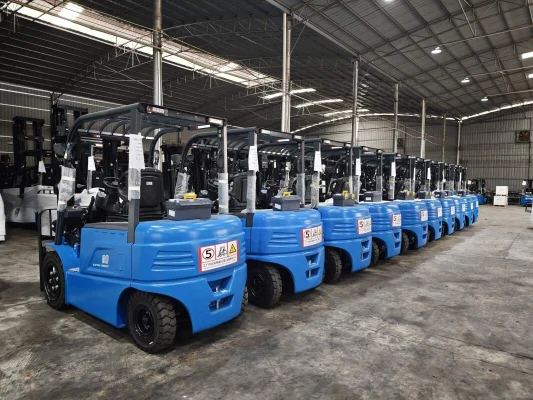
Can I charge a lithium-ion truck during short breaks?
Opportunity charging depends on the battery and charger specification. Ask the supplier to confirm the permitted charging pattern and any limits from the battery data sheet. Do not assume that partial charging is allowed without that confirmation.
Which documents should I request before placing an order?
Ask for a quotation that states the model, rated capacity at your load center and lift height, battery and charger details, aisle requirement, included safety devices, delivery scope, warranty terms, and the maintenance schedule. Compare quotations on those points, not on price alone.
If you share your aisle measurements, load weights, lift heights, and shift pattern with our team, we can help you check which configuration of our four-wheel counterbalance electric forklifts matches your indoor operation and identify the details still to be confirmed.