LiFePO4 Forklift Battery Room Design: Ventilation, Charging Zones, and Fire Planning Considerations
News 05/11/2026
A LiFePO4 forklift battery changes how a battery room behaves, but it does not remove the need to plan that room. Lithium iron phosphate cells release no noticeable hydrogen during normal charging and need no watering, so the classic acid-room layout no longer fits the equipment. The room still has to manage heat, electrical risk, charging congestion, and emergency response. This guide covers the practical decisions: airflow, zoning, fire planning, and the data you should collect before ordering a four-wheel counterbalance electric forklift.
Design decisions depend on the charger, the battery management system (BMS), the truck model, and local codes. Confirm those details with the manufacturer and the authority having jurisdiction before construction begins.
How LiFePO4 Chemistry Changes Battery Room Priorities
Flooded lead-acid batteries gas during charge and need dilution airflow, eyewash stations, and acid-resistant surfaces. LiFePO4 cells are sealed and do not produce an explosive hydrogen mixture under normal operating conditions. That shifts the design emphasis toward thermal control, charger placement, and electrical protection.
Three practical consequences follow:
- Ventilation becomes a heat-management question. Chargers and batteries generate heat, and the BMS may limit charge or discharge when cell temperatures rise. Airflow should keep the charging zone within the temperature range stated in the manufacturer’s documentation.
- Spill containment shrinks but does not vanish. Coolant, cleaning chemicals, and damaged components still warrant a contained, washable floor. Confirm whether the battery supplier requires any specific spill or cleanup provisions.
- Fire planning still applies. Lithium cells can enter thermal runaway under abuse conditions. The room needs detection, isolation, and a response plan that matches the actual product, not a generic template.
Do not assume a LiFePO4 battery is risk-free. The design goal is to control heat, prevent electrical faults, and give responders a clear, documented procedure.
Ventilation and Thermal Control in the Charging Zone
Ventilation serves two purposes here: removing heat and keeping airborne dust and moisture away from chargers and battery contacts. Neither goal has a universal airflow figure. Required air changes, temperature limits, and humidity ranges come from the charger datasheet, the battery documentation, and local mechanical codes.
What to specify and verify
- Operating temperature range: Ask the supplier to state the permitted ambient range during charging, during discharge, and during storage. These are often different.
- BMS thermal behavior: Confirm how the BMS derates or pauses charging at high or low cell temperatures, and whether the charger communicates that status to the operator.
- Airflow path: Position supply and exhaust so air moves across chargers and battery compartments rather than short-circuiting between them. Avoid directing unconditioned outdoor air onto battery surfaces in cold climates.
- Humidity and condensation: In humid or wash-down environments, ask about enclosure ratings and condensation protection on charger and truck electronics.
A simple temperature logger in the charging zone gives you evidence during commissioning. Record the readings against the manufacturer’s stated limits rather than an assumed target.
Common mistakes
Two errors recur. The first is sealing a room tightly to keep it clean, then discovering that charger heat accumulates. The second is over-ventilating with unfiltered air in a dusty plant, which coats contacts and heat sinks. Balance filtration against heat removal and confirm the approach with the equipment supplier.
Zoning the Charging Area and Traffic Flow
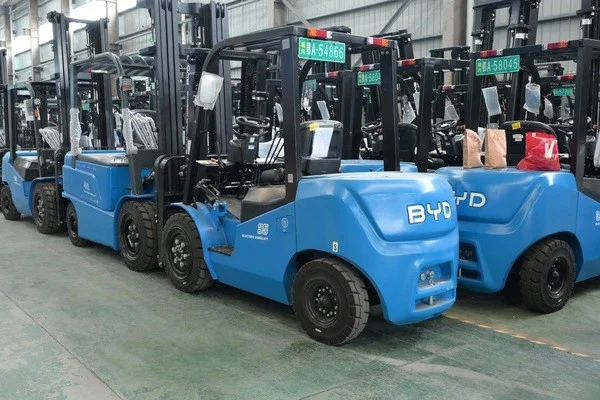
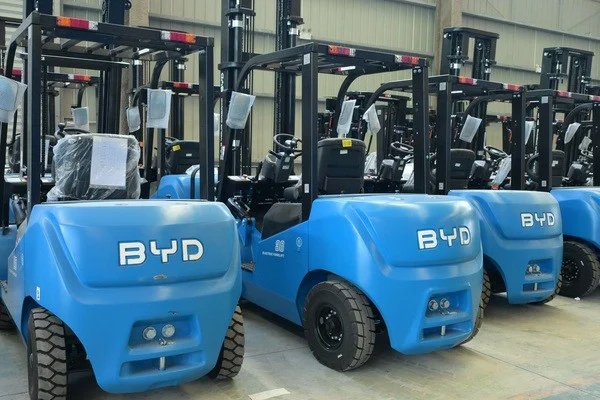
A four-wheel counterbalance electric forklift is a large vehicle with a long turning envelope. The charging zone must accommodate that envelope plus clearance around chargers, cable routes, and fire equipment. Layout should follow the truck’s actual dimensions, not a generic parking bay.
Layout principles
- Separate charging from storage and picking. Keep chargers out of aisles where pallets are staged and pedestrians walk.
- Protect chargers from impact. Use bollards, kerbs, or recessed mounting. A counterbalance truck turning in a tight bay is the main collision risk.
- Keep cables off the floor. Route charging cables overhead or on retractors so they are not driven over or tripped on.
- Provide a clear approach. The operator should be able to align the truck and connect the charger without reversing into traffic.
- Mark the zone. Floor marking, signage, and a defined pedestrian boundary reduce accidental entry during charging.
If the fleet runs multiple shifts, charging time affects how many trucks you need. Ask the supplier about charger output and the battery’s recommended charging window, then match that against your shift pattern. Do not assume opportunity charging suits every battery or every warranty.
Fire Planning and Emergency Response Considerations
Fire planning should be based on the specific battery and charger documentation, the building’s fire strategy, and guidance from the local fire authority. This article cannot substitute for a site-specific assessment. What it can do is list the questions that shape the plan.

Detection and isolation
- Does the room have smoke or heat detection connected to the building alarm?
- Can the charger supply be isolated from a safe location outside the charging zone?
- Is there a documented shutdown sequence that the BMS and charger support?
Response planning
- What extinguishing media does the battery supplier recommend, and what does the fire authority accept?
- Are responders trained on the difference between a battery fire and an electrical or charger fire?
- Is there a safe way to move an unaffected truck away from a affected one?
Ask the battery and charger suppliers for written guidance on thermal events, including warning signs the BMS reports. Keep that guidance with the emergency plan and review it when equipment changes. Avoid copying a plan written for lead-acid rooms; the hazards and response steps differ.
Data to Collect Before You Specify the Room
The table below summarizes the decisions and the information you need. Treat every entry as a confirmation item, not a default value.
| Design area | Why it matters | Confirm with supplier or authority |
|---|---|---|
| Ambient temperature during charge and storage | BMS may limit charging outside permitted range | Permitted ranges and derating behavior |
| Charger heat output and electrical supply | Drives ventilation and circuit design | Charger datasheet, supply requirements, isolation points |
| Truck dimensions and turning envelope | Sets bay size and clearance | Model-specific dimensions, including any attachment |
| Humidity, dust, wash-down | Affects enclosures and condensation risk | Ingress protection ratings and cleaning guidance |
| Fire detection and response | Required by building strategy and local rules | Fire authority guidance and supplier thermal-event advice |
Before ordering, gather your shift pattern, peak truck count, available floor area, ceiling height, and electrical capacity. Share these with the supplier so the charger and battery configuration matches the room. If your aisle widths or lift heights point toward a different truck type, say so honestly; a four-wheel counterbalance model is not the right answer everywhere.
To discuss configuration of a BYD four-wheel counterbalance electric forklift and its LiFePO4 battery, provide your load weights, lift heights, aisle dimensions, floor conditions, and charging schedule. Those inputs let the supplier confirm what the documentation actually supports.
Frequently Asked Questions
Does a LiFePO4 forklift battery need hydrogen ventilation?
Under normal charging, LiFePO4 cells do not produce the hydrogen that flooded lead-acid batteries do. Ventilation is still needed to manage charger and battery heat and to meet local mechanical codes. Confirm the required airflow and temperature limits with the manufacturer and the authority having jurisdiction.
Can I charge a LiFePO4 forklift in a general warehouse area?
That depends on the charger, the battery documentation, and local fire and electrical rules. Some sites allow charging in defined zones within a warehouse; others require a dedicated room. Ask the supplier what environmental conditions the equipment needs, then confirm the location with the fire authority.
What temperature should the battery room stay at?
There is no single figure. Charging, discharge, and storage may each have different permitted ranges, and the BMS may reduce charging outside them. Request the written ranges and record actual room temperatures during commissioning.
How much space does a charging bay need?
Bay size depends on the truck’s dimensions and turning envelope, charger placement, cable routing, and clearance for pedestrians and fire equipment. Use the model-specific dimensions from the supplier rather than a generic allowance.
What should the fire plan include?
At minimum, detection, a safe isolation point, a documented shutdown sequence, recommended extinguishing media, and responder training. Base the plan on the battery and charger documentation and local fire authority guidance, and update it whenever equipment changes.