Different Size Forklifts: How Load Center and Mast Configuration Change Capacity on Four-Wheel Counterbalance Electric Models
News 30/10/2026
Two four-wheel counterbalance electric forklifts can carry the same nominal load on paper and behave very differently once a pallet sits high on the mast or far out on the forks. Capacity is not a single number attached to a chassis; it is a rating defined at a stated load center and a stated lift height. Change either condition, and the safe working load changes with it. This guide explains why different size forklifts behave the way they do, which specifications actually govern capacity, and what buyers should verify before matching a truck to a task.
Why Nominal Capacity Is Only the Starting Point
Forklift capacity ratings assume a standard load center, commonly 24 inches (600 mm) measured from the vertical face of the forks to the center of gravity of the load. The rating also assumes a particular mast and carriage configuration, and often a particular lift height. A truck rated at a given load is rated that way under those conditions, not under every condition.
Three practical consequences follow:
- A load whose center of gravity sits farther out than the rated load center reduces the allowable weight.
- An attachment such as a side shifter, clamp, or rotator adds weight and moves the load forward, both of which reduce remaining capacity.
- Lifting to greater heights affects stability, so some manufacturers publish capacity at more than one height.
None of these effects can be estimated safely by rule of thumb. The correct source is the manufacturer’s capacity plate and data sheet for the exact configuration being purchased. If a supplier cannot provide a capacity chart covering the mast, carriage, and attachment combination, that is a warning sign rather than a detail to sort out later.
How Load Center Shifts the Working Load
The load center is the horizontal distance from the fork face to the load’s center of gravity. It depends on the pallet, the goods, and how they are stacked, not only on the truck. A compact, dense load on a standard pallet may sit close to the fork face. A long load, an offset load, or goods stacked toward the fork tips push the center of gravity outward.
Because the truck’s stability depends on the moment created by the load, moving the center of gravity outward reduces the weight that can be handled at a given distance. This is why a truck that feels comfortable with one pallet may feel light at the steer axle with another of the same weight but different geometry. Buyers should treat the load center as a property of the real load, then compare it against the rated figure.
Practical checks on load center
- Measure the actual pallet depth and estimate where the goods’ center of gravity falls.
- Note whether loads are uniform or vary by supplier and season.
- Account for any attachment that moves the load forward.
- Ask the supplier to confirm capacity at the load center you actually expect, not only at the standard figure.
In a hypothetical warehouse scenario, a buyer receiving mixed pallets from several suppliers might find that most loads sit near the standard load center while a minority sit farther out. The sensible approach is to base the purchase on the worst realistic case, or to restrict the truck to loads within its derated capacity and handle exceptions another way.
Mast Configuration and Lift Height Effects
The mast is not a neutral accessory. Its type, closed height, extended height, and number of stages influence both the truck’s dimensions and the capacity available at height. Common configurations include two-stage masts, which offer moderate lift with a relatively low closed height, and three-stage or full-free-lift masts, which reach higher while keeping the collapsed height low enough to pass under doorways and rack beams.
A full-free-lift mast lets the forks rise within the outer channels before the inner stages extend, which helps in low-clearance areas. That capability comes with added structure and weight, and the capacity rating at height must be checked rather than assumed. Taller lifts generally mean the manufacturer publishes reduced capacity at the maximum height, because stability margins change as the load rises.
What to confirm about the mast
- Required lift height to the top of the rack beam, plus clearance to insert and withdraw the pallet.
- Collapsed (closed) mast height against doorways, mezzanine openings, and trailer entries.
- Whether free lift is needed to enter low-clearance areas with the forks raised.
- Published capacity at the intended lift height and load center, not only at ground level.
- Overall lowered and extended height against the building’s clear height.
A common error is specifying lift height to the shelf surface and forgetting the extra height needed to clear the beam. Another is choosing a tall mast without checking the collapsed height against the routes the truck must travel. Both mistakes surface after delivery, when they are expensive to correct.
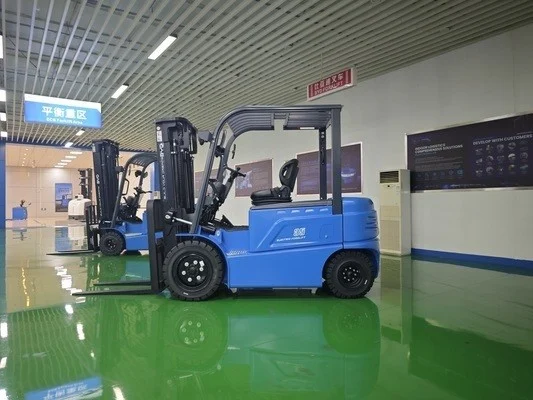
Matching Truck Size to the Real Duty Cycle
Different size forklifts exist because duty cycles differ. A truck working in a wide-aisle loading dock with low racks has different requirements from one serving narrow racking with high bays. The following table summarizes the parameters that most often decide whether a four-wheel counterbalance electric model suits a task, along with the risks and the documents to request. It reflects general selection practice; specific values must come from the manufacturer’s data for the model and configuration offered.
| Parameter or configuration | Why the operation cares | What to confirm with the supplier | Typical status |
|---|---|---|---|
| Rated capacity and load center | Determines the heaviest safe load at the standard distance | Capacity plate and chart showing rating at the expected load center | Standard specification |
| Capacity at lift height | High racks reduce allowable load | Derated capacity at the intended lift height | Standard specification |
| Mast type and stages | Affects lift height, closed height, and free lift | Mast drawing with collapsed and extended dimensions | Configuration choice |
| Attachment weight and forward offset | Reduces remaining capacity | Attachment data plus revised capacity rating | Optional, needs confirmation |
| Aisle width and turning radius | Determines whether the truck can maneuver at the rack face | Turning radius and right-angle stacking data | Standard specification |
| Battery and charging arrangement | Affects uptime across shifts | Battery capacity, charger type, opportunity-charging guidance | Configuration choice |
| Floor and ramp conditions | Affects traction, braking, and stability | Permitted floor loading and grade guidance | Needs confirmation |
Note that aisle width, turning radius, and floor conditions are not capacity figures, but they can rule out a truck just as decisively. A four-wheel counterbalance electric truck is a common general-purpose choice in factories, loading docks, and warehouses, yet it is not the right answer where aisles are very narrow or where loads must be handled at extreme heights. In those cases the honest conclusion may be that a different truck category fits better, and a buyer should hear that before signing rather than after.
Steps to size a truck correctly
- List the heaviest loads and the load centers they actually present, including attachments.
- Record the highest lift height needed and the clearance above the rack beam.
- Measure the narrowest aisle and the tightest doorway or trailer entry on the route.
- Describe the floor surface, any ramps, and the shift pattern, including charging windows.
- Compare these figures against the capacity chart and dimensional drawing for the proposed configuration.
- Confirm which items are standard, which are optional, and which need factory confirmation.
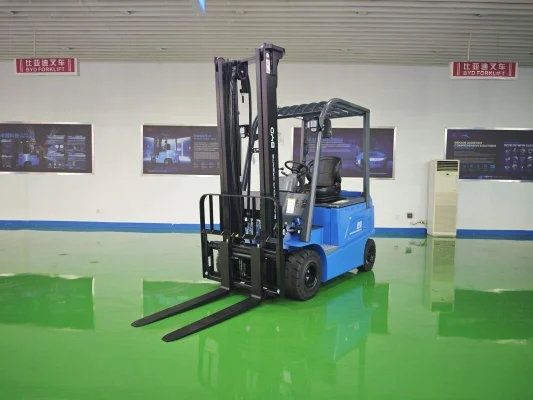
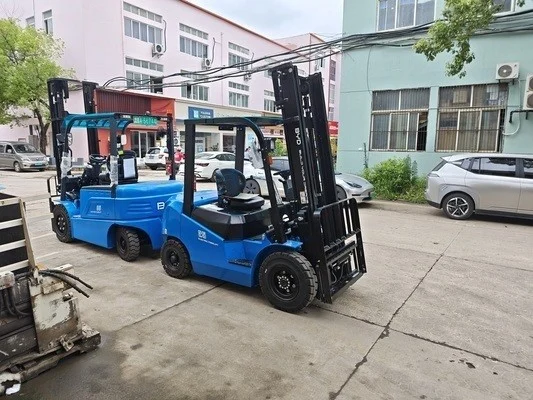
Buyers considering BYD four-wheel counterbalance electric forklifts, including lithium battery models, can shorten this process by sending the load weights, load centers, lift heights, aisle dimensions, and shift pattern to the supplier before a model is proposed. That information, rather than a general impression of truck size, is what allows a configuration to be checked against the real job.
Frequently Asked Questions
Does a bigger forklift always carry more at height?
Not necessarily. Capacity at height depends on the specific mast and the rating the manufacturer publishes for that configuration. A larger chassis with a tall mast may have a lower derated capacity at height than expected. Always compare the capacity chart at the intended lift height, not the headline number.
How do I know the load center of my pallets?
Estimate it from the pallet depth and where the goods’ weight actually sits. Uniform, dense loads centered on a standard pallet are simpler to judge than long or offset loads. When loads vary, base the purchase on the worst realistic case and confirm the rating with the supplier.
Does adding a side shifter reduce capacity?
Attachments add weight and move the load forward, so remaining capacity is typically reduced. The amount depends on the attachment and the truck. Ask the supplier for the revised capacity rating with the attachment fitted, and do not assume the base rating still applies.
What if my aisles are too narrow for a four-wheel counterbalance truck?
Then the task may call for a different truck category, and that should be stated plainly. Provide the aisle width and turning requirements to the supplier so the fit can be assessed honestly before purchase, rather than after delivery.