Choosing the Right Battery Charger Configuration for a 2 Ton Electric Forklift: Matching Charger Output to Shift Patterns and Site Power
News 01/11/2026
A 2 ton electric forklift is only as productive as the charger behind it. The charger decision is not a matter of buying the biggest unit available; it is a matching exercise among three variables: the battery’s capacity and chemistry, the shift pattern the truck actually works, and the electrical supply your site can deliver. Get the match right and the truck starts each shift with a full battery and a healthy pack. Get it wrong and you face long charge windows, shortened battery life, or an electrical upgrade you did not budget.
This guide walks through the selection logic a four-wheel counterbalance electric forklift buyer should follow, using the information a charger supplier or forklift dealer will ask you to confirm.
Start With the Battery, Not the Charger
Charger output is defined relative to the battery it serves, so the battery label comes first. Record the nominal voltage, the rated capacity in ampere-hours (Ah), the number of cells, and the chemistry. A 2 ton counterbalance truck commonly runs a 48 V or 80 V pack, but the exact figure depends on the model and must come from the manufacturer’s technical data, not from assumption.
Two further details matter. First, confirm whether the battery is lead-acid or lithium-ion, because the charging profile differs fundamentally. Second, note the maximum charge current the battery manufacturer permits. Charging above that limit stresses the pack; charging far below it wastes time. The battery data sheet is the authority here, and the charger setting must respect it.
If you are specifying a new truck, ask the supplier to state the battery capacity and permitted charge current in writing alongside the truck specification. This single step prevents most charger mismatches later.
Match Charger Output to Your Shift Pattern
The shift pattern determines how much energy the truck consumes between charging opportunities, and therefore how much charger output you need. Think in terms of the daily duty cycle rather than a single number of hours.
Single-shift operation
A truck working one shift per day usually has a long overnight window available. In this case a conventional charger sized to the battery capacity is normally adequate, and the priority shifts to charging discipline: a full charge, a cool-down period where the battery type requires it, and a consistent routine. Oversizing the charger here adds cost without adding usable uptime.
Two- and three-shift operation
Multi-shift work removes the long overnight window. The options are battery exchange, opportunity charging during breaks, or a combination. Opportunity charging requires a charger whose output suits the partial-charge profile the battery manufacturer permits, and it requires the battery to be specified with that duty in mind. Do not assume a standard pack tolerates frequent partial charging; confirm the permitted profile with the battery supplier.
Peak-season or variable demand
Where throughput swings seasonally, document the busiest week rather than the average. A charger sized to the average will be the bottleneck exactly when the operation cannot afford it. If the peak is short, battery exchange may be more economical than a larger charger and a heavier electrical supply.
Check the Site Power Before You Commit
Charger output is limited by what the building can supply. Before choosing a model, collect the following from your electrical drawings or a qualified electrician:
- Available supply voltage and phase configuration at the intended charging location.
- Spare capacity on the relevant distribution board, allowing other loads on the same circuit.
- Distance from the board to the charging point, since cable runs affect installation.
- Ventilation and any local requirements that apply to the battery chemistry in use.
- Whether charging will occur in a dedicated area or at scattered points on the floor.
A high-output charger can require a supply upgrade that costs more than the charger itself. Where the supply is constrained, a lower-output charger combined with a longer charging window or a battery exchange routine is often the more practical configuration. These trade-offs should be settled before the purchase order, not after delivery.
Configuration Choices and Common Mistakes
Once battery, duty cycle, and supply are known, the remaining choices are usually about how charging fits the working day. The table below summarises the decision logic; the specific figures must come from your battery and charger documentation.
| Site condition | Charger approach to examine | Point to verify |
|---|---|---|
| One shift, long overnight window | Conventional charger matched to battery capacity | Full-charge routine and cool-down requirement |
| Two shifts, breaks available | Opportunity charging with a permitted partial-charge profile | Battery manufacturer’s approval of the profile |
| Continuous operation | Battery exchange plus a dedicated charging area | Handling equipment and spare pack cost |
| Limited electrical capacity | Lower-output charger with a longer window | Whether the window actually exists in the schedule |
Recurring errors include choosing a charger by truck capacity alone without checking the battery label, ignoring the supply limit until installation day, and assuming that faster charging is always better. Faster charging is only useful if the battery permits it and the shift schedule can use the saved time. Another frequent mistake is mixing charger settings between lead-acid and lithium-ion packs; the profiles are not interchangeable.
When you request a quotation, give the supplier the battery voltage and capacity, the chemistry, the shift pattern, the charging window, and the available supply. Ask them to confirm the charger output and settings against the battery data sheet. If any of these inputs is missing, the quotation is provisional at best.
Frequently Asked Questions
Can one charger serve several 2 ton electric forklifts?
It can, provided the charging schedule allows each truck its required window and the charger output matches one battery at a time. Sharing a charger across a fleet usually means scheduling charging rather than plugging in at will. Confirm the arrangement with the battery and charger suppliers.
Is a higher-output charger always the better choice?
No. Output must stay within the battery manufacturer’s permitted charge current, and the site supply must support it. A charger that exceeds either limit creates risk without a usable benefit.
How do I know whether opportunity charging suits my operation?
It depends on the battery chemistry and the manufacturer’s permitted charging profile, together with whether your breaks are long and regular enough to add meaningful charge. Ask the battery supplier to confirm suitability before building a schedule around it.
What information should I gather before requesting a charger quotation?
Battery voltage, capacity and chemistry; the truck’s daily duty cycle and shift pattern; the charging window available; and the supply voltage, phases and spare capacity at the charging point. With these, a supplier can propose a configuration you can check rather than a guess.
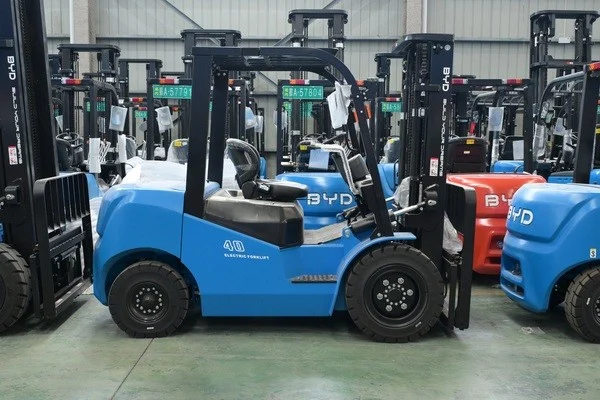
To move from general guidance to a specific recommendation, share your actual load weight, lift height, shift pattern, and site power details with our team so the charger configuration can be matched to a BYD four-wheel counterbalance electric forklift and its battery specification.