Specifying a 2 Ton Electric Forklift: Key Questions on Load Center, Mast Configurations, and Lithium Battery Options
News 12/11/2026
A 2 ton electric forklift is a common starting point when a buyer knows the load but not yet the configuration. The rating itself is only one number. A truck rated at 2,000 kg at a stated load center will not necessarily handle that load at every lift height or with every attachment. This guide walks through the questions that decide whether a four-wheel counterbalance electric forklift fits your operation, and which details to confirm with the supplier before ordering.
Load Center and Rated Capacity: The First Question
Manufacturers rate capacity at a specific load center, usually the distance from the front face of the forks to the center of gravity of the load. A longer load, a non-standard pallet, or an attachment that moves the load forward reduces the capacity the truck can safely handle. The rated figure on the data plate applies to the standard fork position and the stated load center only.
Why the load center changes the answer
When the load center moves forward, the turning moment on the mast and chassis increases. The truck’s stability limit is reached at a lower weight. This is why a 2 ton rating should always be read together with its load center and lift height. Ask the supplier to state the capacity at the load center your pallets actually produce, and at the maximum lift height you need, not only at ground level.
What to measure before you request a quote
- Maximum weight of the heaviest load, including packaging and any pallet or stillage
- Depth and width of the load, to estimate the real load center
- Required lift height and whether loads are handled at height or only at floor level
- Any attachment planned, such as a side shifter, clamp, or fork extension, and whether it affects residual capacity
Attachments are a frequent source of error. A side shifter adds weight and shifts the load, and both effects reduce the usable capacity. The supplier should confirm the residual capacity with the exact attachment fitted. If that figure is not available in writing, treat it as unconfirmed until you receive it.
Mast Configurations and the Space Around the Truck
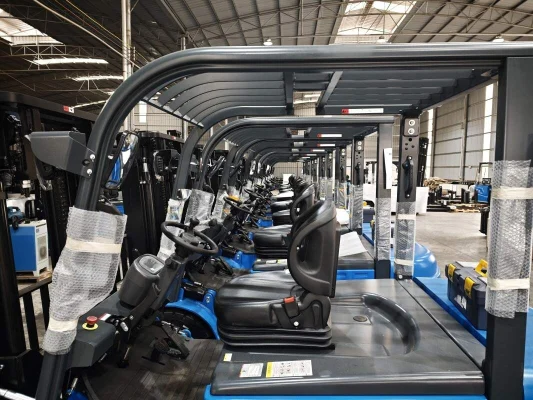
The mast determines lift height, overall height when lowered, and visibility. It also interacts with the building: door heights, racking beams, sprinkler clearance, and overhead obstructions all constrain the choice. A taller mast does not automatically solve a height problem, because the collapsed height and the free lift matter as much as the maximum lift.
Matching the mast to the building
Start from the highest shelf or rack beam you must reach, then add clearance. Confirm the collapsed mast height against the lowest doorway or ceiling the truck must pass under. If the truck works inside containers or low-clearance areas before lifting, ask about free lift, the height the forks can rise before the mast sections extend. Duplex, triplex, and quad mast designs differ in collapsed height and visibility, and the right choice depends on your racking, not on a general preference.
Channel width, turning radius, and floor conditions
A four-wheel counterbalance truck needs aisle space to turn. Measure the narrowest aisle and the turning radius of the candidate model, and allow clearance for the load and the operator. Floor condition matters too: smooth concrete, expansion joints, ramps, and wet areas all affect safe operation and tire choice. If your aisles are very narrow or your lift height is very high relative to the load, a counterbalance truck may not be the best fit, and it is worth saying so early rather than forcing the configuration.
Visibility and operator environment
Mast profile, hose routing, and any fitted lights or mirrors affect what the operator can see. Ask to see the truck with the mast you intend to buy, or at least confirm the visibility characteristics of that mast type. In cold stores or outdoor yards, cab options, heating, and defogging become part of the specification rather than an afterthought.
Lithium Battery Options and Charging Practice
Lithium batteries change how a fleet is scheduled. Opportunity charging during breaks can keep a truck working across shifts, provided the charger and the site’s electrical supply support it. The practical questions are about duty cycle, charging windows, and the temperature range the battery and charger are rated for. These are configuration details to confirm with the supplier, not assumptions to carry over from another site.
Duty cycle and charging windows
Estimate the truck’s actual working hours per shift and the length of breaks available for charging. A truck that works continuously with no charging window has different requirements from one that returns to a charging point several times a day. Ask the supplier to confirm the battery capacity offered against your duty cycle, and to state the charging time and any limits on partial charging. Do not assume a runtime figure until it is confirmed in writing against your measured duty cycle.
Temperature, storage, and charging conditions
Battery and charger temperature limits vary by product. If the truck works in a cold store, a freezer, or an outdoor yard, confirm the permitted operating, storage, and charging temperature ranges with the supplier, along with any low-temperature charging restrictions or heating provisions. The same applies to hot environments. Condensation and moisture protection for electrical components should also be confirmed when the truck moves between temperature zones.
Chargers, power supply, and site readiness
Confirm the charger type, the supply voltage and current available at the charging point, and whether the installation needs work. Charging location affects cable routing, ventilation, and fire safety arrangements, which are site responsibilities. Ask what documentation the supplier provides on battery handling and charging, and plan operator training around it.
Comparison points to confirm with the supplier
| Item | Why it matters | What to confirm in writing |
|---|---|---|
| Rated capacity and load center | Determines whether the heaviest load is safe at height | Capacity at your load center and maximum lift height; residual capacity with attachments |
| Mast configuration | Affects reach, collapsed height, and visibility | Maximum lift, collapsed height, free lift, and visibility characteristics of the chosen mast |
| Aisle and turning | Determines whether the truck can work in your building | Turning radius and recommended aisle width against your measured aisles |
| Battery and charging | Affects shift coverage and site electrical work | Battery capacity against your duty cycle, charging time, charger supply requirements |
| Temperature limits | Affects suitability in cold stores, freezers, or outdoor work | Operating, storage, and charging temperature ranges; any cold-environment provisions |
Standard and optional features differ between models and markets. Treat every item in the table as a question to resolve, not as a feature that is included by default.
Frequently Asked Questions
Is a 2 ton rating enough if my loads are sometimes heavier?
No. The rating applies at a stated load center and lift height. If your heaviest load, including packaging and attachments, exceeds the rated capacity under those conditions, choose a higher-capacity model or change the handling method. Ask the supplier to confirm capacity at your actual load center and lift height.
Can a four-wheel counterbalance truck work in very narrow aisles?
It depends on the measured aisle width, the load dimensions, and the truck’s turning radius. Narrow aisles and high lifts can push a counterbalance truck beyond its comfortable operating envelope. Provide exact aisle measurements and racking layout so the supplier can confirm whether the configuration fits.
What should I check about lithium battery charging on site?
Confirm the charger’s supply requirements, the available power at the charging point, the charging time, and the permitted charging temperature range. Also confirm where charging will take place and what ventilation and fire safety arrangements your site needs. These are site and supplier questions together, not a single product decision.
Which details should I send before requesting a configuration?
Send the heaviest load and its dimensions, required lift height, aisle widths, floor and ramp conditions, shift pattern and charging windows, and any temperature extremes. With those inputs, the supplier can propose a configuration and state which figures still need confirmation.