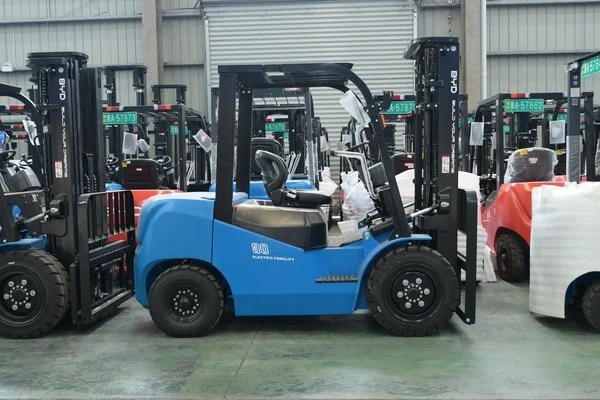
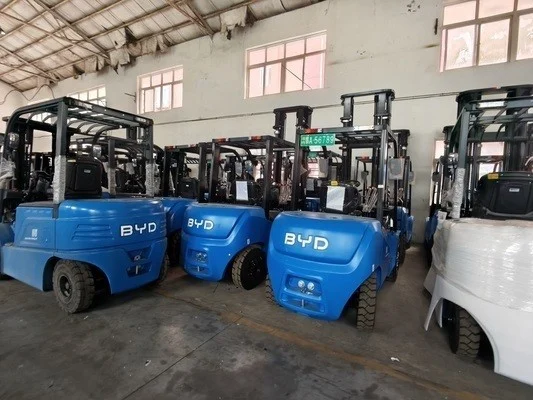
How to Read a 3.5 ton electric forklift Load Chart When Attachments Change Real Lifting Capacity
News 05/11/2026
A 3.5 ton electric forklift is rated at its rated capacity only under the conditions printed on its data plate and load chart, and those conditions rarely match a real job once an attachment is fitted. The load chart tells you how much the truck can lift at a given load center and lift height; an attachment moves the load forward and adds its own weight, so the number you started with no longer describes what the truck can safely handle. Reading the chart correctly means separating three things: the truck’s published ratings, the attachment’s effect on load center and weight, and the actual load you intend to lift.
The steps below apply to four-wheel counterbalance electric forklifts, including lithium-battery models. Where a specific figure is needed, use the manufacturer’s technical documentation; do not infer it from a similar model or a sales summary.
Start With the Three Numbers on the Chart
Most load charts present capacity as a set of related values rather than a single figure. Before anything else, identify these three:
- Rated capacity at the standard load center, usually stated with the mast vertical and the load at a defined height.
- Load center, the horizontal distance from the front face of the forks to the center of gravity of the load. Standard ratings assume a specific value, commonly 500 mm or 600 mm depending on the truck and region.
- Lift height, because capacity typically decreases as the carriage or forks rise and the mast and hydraulic system take on a different load case.
These values describe the truck alone. They do not include an attachment, and they do not include a load whose center of gravity sits further forward than the rated load center. That is the gap where most misreading happens.
How an Attachment Shifts the Real Lifting Capacity
An attachment changes the geometry and the mass of the load-handling system in two ways that both reduce usable capacity.
Lost load center: the load moves forward
A fork positioner, side shifter, clamp, or rotating device adds thickness between the carriage and the forks. The load sits further from the truck, so its center of gravity moves forward. A load chart expresses capacity at a fixed load center; moving the load forward is equivalent to asking the truck to lift more than its rating at that distance. The further forward the center of gravity, the lower the safe capacity, and the effect grows quickly because the load moment increases with distance.
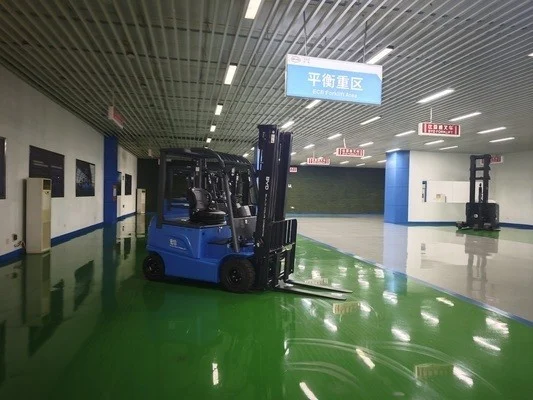
Attachment weight: a permanent deduction
The attachment itself hangs on the carriage and must be carried on every lift. Its weight is a fixed deduction from the capacity available to the payload. A heavier attachment leaves less capacity for the goods, even before the load center shift is considered.
Together, these two effects mean the attachment’s own rated capacity is not the answer either. An attachment rated to a certain load does not raise the truck’s capacity; it can only reduce it. The usable figure is the truck’s capacity at the new, forward load center, minus the attachment weight, checked against the lift height you actually use.
A Practical Reading Procedure
The following sequence works as a general method. It uses the truck’s load chart and the attachment supplier’s data, and it deliberately stops short of guessing numbers that only the manufacturer can confirm.
- Confirm the truck’s chart values. Note rated capacity, rated load center, and how capacity changes with lift height. Record the mast type and any derating already shown on the plate.
- Get the attachment’s added load center. Ask the attachment supplier how far the load center moves forward when the device is fitted. This is a dimensional value, not a capacity claim.
- Add the attachment weight. Obtain the attachment’s own weight from its specification sheet.
- Recalculate the load center. Add the forward shift to the load’s own center-of-gravity distance from the fork face. The result is the load center you must read against the chart.
- Read capacity at that load center and your working lift height. Use the chart’s reduced value, not the headline rating.
- Subtract the attachment weight from that reduced capacity to find the payload you can actually lift.
- Compare with the real load, including pallet, packaging, and any fluid or loose material. Leave margin rather than planning to the last kilogram.
If any of the first three inputs is missing, the calculation cannot be completed. In that situation the honest answer is to request the data, not to assume the attachment is light or that the shift is small.
Where the Chart Stops and Judgment Begins
A load chart is a capacity document, not a stability guarantee. Several conditions sit outside it and still affect whether a lift is sensible:
- Ground and floor conditions. Soft surfaces, uneven joints, and ramps change how the truck carries a load. A chart value does not certify performance on a slope.
- Dynamic effects. Starting, stopping, lowering quickly, and turning with a raised load add forces the static chart does not describe.
- Visibility and handling. A bulky attachment or an oversized load can obstruct the operator’s view, which is a safety issue independent of capacity.
- Battery and duty cycle. On a lithium-battery truck, voltage behavior and remaining charge affect available power through a shift; plan charging around the actual workload rather than the rated capacity alone.
Two common errors are worth naming. The first is treating the attachment’s rated capacity as the truck’s new capacity. The second is reading the chart at the standard load center while the attachment has clearly moved the load forward. Both overstate what the machine can lift. A third, subtler error is ignoring lift height: a load that is fine at low height may exceed the chart at the height the job actually requires.
When the numbers are close, the right move is to send the actual load weight, load dimensions, required lift height, attachment type and weight, and site conditions to the truck supplier so the configuration and any derating can be confirmed against the published technical data. Our range covers four-wheel counterbalance electric forklifts, and a selection check against your real duty is more useful than a headline capacity figure.
Frequently Asked Questions
Does fitting an attachment increase a 3.5 ton electric forklift’s capacity?
No. An attachment adds weight and usually moves the load center forward, so the payload the truck can lift is reduced. The attachment’s own rating describes the attachment, not the combination.
Can I use the rated capacity if I lift only to low height?
Only if the load center also matches the chart’s rated value. Lift height is one variable; load center is another. An attachment typically changes the load center, so the low-height figure may still be lower than the headline rating.
What information should I collect before asking about a configuration?
Gather the load weight and dimensions, the load’s center of gravity, the required lift height, the attachment type and weight, and the floor, ramp, and aisle conditions. These let the supplier check the chart and any derating accurately.
Is a lithium-battery model read differently on the load chart?
The capacity method is the same. Battery chemistry affects charging and energy management, not how load center and attachment weight reduce payload. Confirm any model-specific figures in the manufacturer’s documentation.