Planning Battery Room Throughput and Spare Pack Rotation When Scaling a BYD Counterbalance Forklift Fleet
News 13/11/2026
Scaling a fleet of BYD counterbalance forklifts changes the battery room from a quiet corner into a scheduling problem. Each added truck raises energy demand, charger occupancy, and the number of packs that must be tracked. Throughput planning answers one question: can the room return a depleted pack to service before the next shift needs it? Spare pack rotation answers a second: are all packs being used and rested evenly, or are a few carrying the load while others sit idle? Both questions should be settled before the fleet grows, because layout, charger count, and pack inventory are easier to adjust on paper than during a busy production week.
The guidance below applies to four-wheel counterbalance electric forklifts with lithium packs, the configuration this site supplies. Exact charge times, pack capacities, and charger ratings must come from the manufacturer’s technical documentation; the planning method is the same regardless of those numbers.
How Much Battery Room Throughput Does a Growing Fleet Need?
Throughput is the number of packs a room can move from depleted to ready in a given period. A simple planning identity helps: available charging positions multiplied by completed cycles per position per shift must be at least equal to the number of packs the fleet consumes in that shift. If the result is short, trucks wait, and a counterbalance forklift that waits is not lifting loads.
Build the estimate from four inputs:
- Fleet energy demand: how many packs each truck depletes per shift, based on duty cycle and the manufacturer’s stated runtime under comparable conditions.
- Charge cycle length: the time a pack needs on a compatible charger to reach the level your operation requires, not a generic figure.
- Charger and position count: how many packs can charge simultaneously without exceeding the electrical supply.
- Buffer time: the realistic gap between a pack leaving a truck and reaching a charger, including travel and connection.
Multiply the first figure by the number of trucks to get shift demand, then divide by the number of charging positions to see how many cycles each position must complete. Compare that with the time available in the shift. The gap between the two is your margin, and margin is what absorbs late returns, breakdowns, and peak weeks.
An Illustrative Calculation, Not a Performance Claim
Consider a hypothetical operation adding counterbalance trucks to an existing line. Suppose each truck uses one pack per shift, the fleet reaches ten trucks, and the room has six charging positions. Demand is ten pack cycles per shift; each position must complete roughly 1.7 cycles. If a full cycle plus handling fits comfortably inside the shift with time to spare, the room can absorb the growth. If it barely fits, the next truck will create a queue. These figures are illustrative only; substitute your own measured duty cycle and the pack data supplied with your equipment.
Where Throughput Plans Usually Fail
Three mistakes recur. The first is planning from nameplate charge time while ignoring the time a pack spends waiting to be connected. The second is assuming every truck returns its pack at the same moment, which concentrates demand at shift change. The third is sizing chargers to the average rather than the peak, leaving no capacity when several trucks return together. Staggering break schedules and pack swaps is often cheaper than adding chargers.
How Should Spare Pack Rotation Work as the Fleet Scales?
A spare pack exists to keep a truck working while another pack charges. Rotation means every pack in the pool takes its turn in trucks and on chargers, rather than a few packs cycling continuously while spares rest unused. Uneven use concentrates wear on part of the inventory and leaves the rest as unknown quantity, which complicates planning and warranty discussions.
A practical rotation scheme has four elements:
- Unique identification: label each pack and record which truck and charger it visits. Without records, rotation is guesswork.
- A defined order: return charged packs to the front of the queue and send the longest-rested pack out next. This is simpler to follow than a scoring system.
- State-of-charge discipline: define the level at which a pack leaves a truck and the level at which it returns to service, based on manufacturer guidance.
- Periodic review: check the records at a fixed interval and correct any pack that is being used far more or less than its peers.
Rotation also affects throughput. A pool with balanced use has a predictable number of packs available at any hour. A pool where two packs do most of the work looks adequate on paper but fails when those packs are charging at the same time.
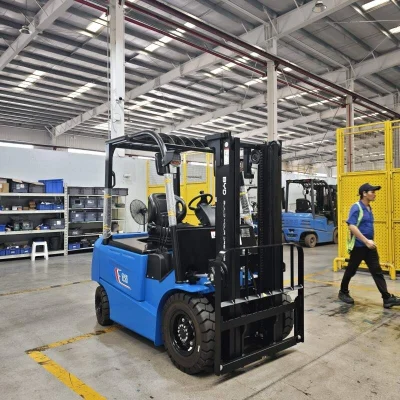
Matching Spare Inventory to Shift Patterns
The number of spares should follow the shift pattern, not the truck count alone. Single-shift operations with a long overnight window may need few spares because charging fits between shifts. Multi-shift operations need enough packs to cover the overlap when one shift ends and another begins. The honest answer depends on measured cycle times and your charger configuration, and it should be revisited whenever the fleet or schedule changes.
What to Confirm Before Adding Trucks, Chargers, or Packs
Scaling decisions are easier when the battery room is described in numbers rather than impressions. Before committing to more four-wheel counterbalance electric forklifts, gather the following and compare them with the manufacturer’s documentation.
| Item to confirm | Why it matters |
|---|---|
| Measured packs used per truck per shift | Sets the real demand figure instead of an assumption |
| Charge cycle time at your required state of charge | Determines how many cycles each position can complete |
| Electrical supply available to the charging area | Limits how many chargers can run at once |
| Peak return times and break schedule | Reveals whether demand clusters and creates queues |
| Pack identification and rotation records | Shows whether spares are genuinely being used |
| Floor space and travel distance to chargers | Adds handling time that plans often omit |
If any row cannot be answered, that is the first task. A throughput plan built on missing data tends to overstate capacity, and the shortfall appears as idle trucks rather than as a visible battery room problem. Sharing your duty cycle, load weight, lift height, and charging conditions with a supplier is the practical way to turn these questions into a configuration discussion about BYD counterbalance forklifts and their charging arrangements.
Common Questions
Does adding chargers always solve a throughput shortfall?
No. Chargers help only if the electrical supply, floor space, and handling time support them. If packs queue to be connected or the supply cannot feed more units, additional chargers add cost without adding completed cycles. Fix scheduling and rotation first, then size hardware to the remaining gap.
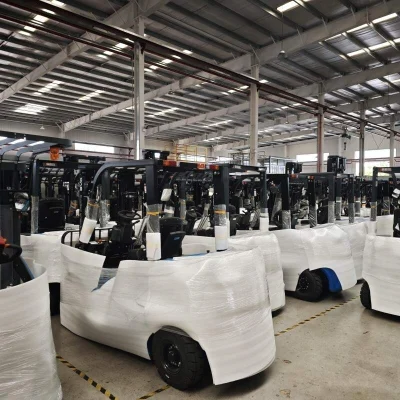
How often should spare packs be rotated?
Rotation should be continuous rather than periodic: the longest-rested pack goes out next, every time. Review the usage records at a fixed interval, such as monthly, and correct any imbalance. The right interval depends on fleet size and how much variation your records show.
Can a growing fleet share the same battery room layout?
Sometimes, but the layout should be rechecked against the new demand. More trucks mean more pack movements, longer queues at peak times, and more traffic in a confined area. A layout that worked at five trucks may create congestion at twelve even when charger count is adequate.
What information should be gathered before requesting a configuration review?
Provide the number of trucks planned, shift pattern, measured packs used per shift, required lift height and load weight, available charging time, and the electrical capacity of the charging area. These details let a supplier respond with relevant options rather than generic figures.