Cold Storage Duty Cycles: Specifying a BYD Counterbalance Forklift That Handles Freezer Transitions and Condensation Risk
News 04/11/2026
A BYD counterbalance forklift working cold storage duty cycles must be specified around two linked problems: sustained low-temperature operation and the moisture that appears every time the truck crosses between freezer air and warmer, humid air. Neither problem is solved by a single option. The practical approach is to define the duty cycle first — temperature band, time in each zone, shift pattern, load and lift height — then match battery, cabin, sealing and charging arrangements to that profile. This article explains the conditions to measure, the specification points worth confirming with the supplier, and the limits that remain even after careful configuration.
What Makes Freezer Work Different From Ordinary Warehouse Duty
Cold storage is not simply a warehouse at a lower temperature. Three conditions change the equipment requirement.
First, the truck may spend most of its shift inside a freezer, or it may cross a dock threshold dozens of times per shift. Those are different duty cycles. Continuous cold exposure stresses lubricants, seals, hydraulic behaviour and battery performance. Repeated transitions add a second stress: condensation.
Second, ice and frost change floor conditions. Traction, braking distance and steering response can differ from a dry ambient warehouse, and the difference depends on floor material, drainage, door management and traffic volume. These are site-specific and should be assessed on site rather than assumed.
Third, maintenance access is harder. A truck that must be brought out of a freezer to a warm workshop, or serviced in the cold, affects uptime planning. Ask how routine checks will be performed and where.
None of these points can be resolved from a brochure alone. They are inputs to a specification conversation.
Map the Duty Cycle Before Choosing Any Option
Write down the operating profile before discussing configuration. A four-wheel counterbalance electric forklift can be adapted to cold work, but the right adaptation depends on the numbers below.
Temperature bands and dwell time
Record the coldest and warmest air temperatures the truck will experience, not just the nominal freezer setpoint. Note how long the truck stays in each zone during a typical shift, and whether it parks inside the freezer during breaks or returns to ambient air.
Transition frequency
Count door crossings per hour. A truck that enters a freezer once per shift faces a very different condensation profile from one that crosses a threshold every few minutes. Door type, air curtains, strip curtains and vestibule design all influence how much moisture reaches the truck.
Load, lift height and attachment
Confirm rated capacity at the actual load centre, the lift height required, and whether any attachment is used. Attachments change the effective capacity and should be declared to the supplier so the truck is rated correctly. Do not assume a nominal capacity figure applies to a non-standard load centre.
Shift pattern and charging window
State the hours per shift, shifts per day, and when charging can occur. Battery and charger selection depends on whether opportunity charging is possible, whether the truck can be charged inside the cold zone, and what the site’s electrical supply allows.
Floor, ramps and aisle geometry
Describe floor surface, any slopes, doorway widths and aisle dimensions. These determine whether a four-wheel counterbalance truck is the right platform at all, and they inform tyre and configuration choices.
Specification Points That Address Condensation Risk
Condensation forms when a cold surface meets moist air. On a forklift, the surfaces that matter are electrical enclosures, connectors, display panels, hydraulic components and the battery compartment. The goal is not to eliminate moisture but to keep it away from sensitive parts and to let it drain or evaporate where it does appear.
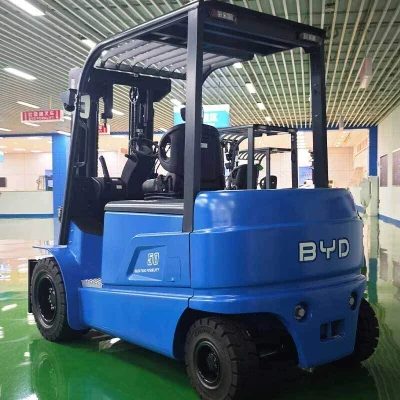
Raise the following with the supplier and ask which are available on the BYD counterbalance forklift configuration you are considering:
- Enclosure sealing and IP rating. Ask which enclosures are sealed, to what rating, and whether that rating is maintained after service access. A rating on a datasheet should be tied to a specific component.
- Anti-condensation measures. Ask whether heaters, breathers or desiccant arrangements are offered, and under what temperature and humidity conditions they are intended to work.
- Connector and terminal protection. Confirm how connectors are protected and whether dielectric grease or similar measures are part of the cold-store build.
- Drain paths. Confirm that meltwater from the truck after leaving the freezer has somewhere to go and does not pool on electrical or braking components.
- Cabin and operator protection. Ask about heated or insulated cabins, heated seats, windscreen demisting and door arrangements, and whether these are factory options or dealer fitments.
- Lubricants and hydraulic fluid. Confirm that the fluids specified are appropriate to the lowest temperature in the duty cycle, and ask what the supplier recommends when the truck regularly operates below the standard range.
Where a supplier cannot confirm a point in writing, treat it as unverified and plan a trial or a staged introduction rather than assuming performance.
Battery, Charging and Transition Routines
Lithium-ion batteries behave differently from lead-acid in cold conditions, but the specific limits depend on the battery management system and the manufacturer’s published operating envelope. Do not rely on general statements about lithium performance. Ask the supplier to confirm the permissible charging and discharging temperature range, what the system does when those limits are approached, and whether charging inside the freezer is permitted.
Practical routines matter as much as hardware:
- Decide where charging takes place. Charging in a cold zone may be restricted; charging in ambient air may require a dedicated bay and traffic plan.
- Allow the truck to stabilise before service work. Moving a cold truck into a warm workshop invites condensation on cold internal surfaces; ask the supplier how long to wait and which covers to leave in place.
- Inspect after transitions. A short check of connectors, display panels and the battery compartment after the first weeks of operation will reveal whether moisture is reaching places it should not.
- Keep door discipline consistent. Operators who leave freezer doors open change the humidity exposure of every truck on site.
These are general operating practices, not validated results from a specific site. Their value depends on how closely they match your actual layout.
Frequently Asked Questions
Can a standard four-wheel counterbalance electric forklift work in a freezer?
It depends on temperature, dwell time, condensation exposure and the options fitted. Many cold-store applications need a configuration adapted to low temperature — fluids, sealing, cabin and battery arrangements. A standard ambient-specification truck should not be assumed suitable without written confirmation from the supplier against your measured duty cycle.
How do I reduce condensation when the truck leaves the freezer?
Reduce moisture exposure at the doorway first: manage door openings, use air curtains or strip curtains where appropriate, and avoid unnecessary crossings. Then confirm the truck’s enclosure sealing, connector protection and drain paths. Finally, allow a stabilisation period before opening compartments in a warm area.
Is lithium battery performance affected by cold storage work?
Cold affects battery behaviour, but the exact limits and protections are set by the battery management system and the manufacturer’s specification. Ask for the permitted charging and discharging temperature ranges and the system’s response when limits are reached. Do not rely on generic claims about lithium technology.
What information should I give a supplier before requesting a quotation?
Provide temperature bands, dwell time in each zone, door crossings per hour, load weight and load centre, lift height, attachments, shift pattern, charging window, floor and ramp conditions, and aisle dimensions. With those details, a supplier can propose a BYD counterbalance forklift configuration and state clearly which figures still need verification.
Next Steps: Verify Before You Commit
Cold storage specification is a process of narrowing uncertainty. Start with a written duty-cycle summary, ask the supplier to confirm each cold-weather option against that summary, and request documentation for any performance claim that affects your decision. If your site involves frequent freezer transitions or sustained sub-zero operation, share the measured temperatures, loads and lift heights with the supplier so the proposed four-wheel counterbalance electric forklift is matched to the real cycle rather than a generic cold-store description. Where documentation is missing, plan a trial period and define what you will inspect — connectors, seals, cabin comfort, battery behaviour and floor grip — before committing to a fleet decision.