BYD Forklift Procurement: What to Confirm About Mast Free Lift and Overhead Clearance Before Ordering a Four-Wheel Counterbalance Electric Truck
News 04/11/2026
Mast free lift and overhead clearance are two of the most consequential details to settle before you place an order for a four-wheel counterbalance electric forklift. Free lift is the distance the inner mast channels raise the fork carriage before the outer mast starts to extend. Overhead clearance is the vertical space above the truck and its load. When you compare BYD forklift units available on the market, these two figures decide whether the truck can enter a trailer, pass under a rack beam, work inside a container, or operate in a building with low door frames. Get them wrong and the truck may be technically capable of lifting the load yet unable to reach the place where the load must go.
Why Free Lift and Overhead Clearance Are Separate Checks
Free lift and overall lowered height are not the same measurement, and buyers often treat them as interchangeable. A mast with no free lift raises the carriage and the outer mast together, so the truck needs full overhead clearance as soon as lifting begins. A mast with full free lift raises the carriage inside the outer channels first, which allows the truck to lift a pallet while remaining under a low obstruction.
Overhead clearance, by contrast, is a site condition. It includes the lowest beam, door header, pipe, sprinkler head, or trailer roof along the travel path. The relevant number is not the truck’s lowered height alone but the highest point of the truck plus load during the entire lift and travel cycle. Confirm both values against the actual route, not just the storage aisle.
Site Measurements to Collect Before You Request a Quote
Accurate site data shortens the specification process and reduces the risk of ordering a mast that cannot serve the application. Record the following before contacting a supplier:
- Lowest overhead obstruction on every route, including doorways, mezzanine edges, rack beams, and trailer or container roofs.
- Required lift height and the load center at which the load will be handled, since rated capacity changes with load center and lift height.
- Pallet and load dimensions, including load height, so the combined truck-and-load profile can be checked.
- Aisle and doorway widths, plus any ramps or slopes on the route.
- Floor condition and surface, because outdoor yards, dock plates, and uneven surfaces affect stability and tyre choice.
- Shift pattern and charging windows, which influence battery and charger configuration rather than mast choice.
A simple sketch of the route with measured heights is more useful than a verbal description. If a trailer or container is involved, measure the interior height rather than relying on the nominal external size.
Mast Configurations and What Each One Requires
Mast choice follows from the clearance data. The table below describes general mast behaviour; specific heights and capacities must come from the manufacturer’s technical data the supplier provides.
| Mast type | Free lift behaviour | Typical clearance implication |
|---|---|---|
| Standard (no free lift) | Outer mast extends as lifting begins | Needs the greatest overhead clearance during lifting |
| Limited free lift | Carriage rises partway before outer mast extends | Suitable where some but not full free lift is needed |
| Full free lift | Carriage rises to full free lift inside the outer mast | Allows lifting under low obstructions, common in trailers and containers |
Full free lift usually means a more complex mast with additional channels, which can affect overall height, weight, and cost. It is not automatically the right answer. If the route has generous clearance and the lift height is modest, a simpler mast may serve the application with fewer components to maintain. The decision should follow measured clearance, not a preference supplied by habit.
Information to Put in the Inquiry and Confirm at Acceptance
When you request pricing on a BYD forklift, describe the application rather than asking only about a model number. A useful inquiry states the load weight and load center, required lift height, lowest overhead clearance on the route, aisle width, floor and slope conditions, and shift and charging pattern. Ask the supplier to confirm the mast type, free lift, lowered height, and rated capacity at your load center, and to identify which figures come from published technical data and which depend on the final configuration.
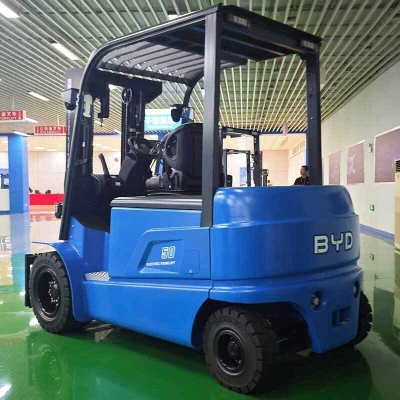
At delivery, check the truck against the agreed specification: mast type and free lift, lowered height, capacity plate values, battery and charger configuration, and any attachments. Confirm that the delivered configuration matches the quotation, and ask how the capacity plate should be read at your actual load center and lift height. Retain the technical documentation with the purchase record.
If the site data is incomplete, say so and request the parameters that must be measured before a firm configuration can be quoted. A supplier who asks for clearance and load-center details is helping you avoid a costly mismatch.
Frequently Asked Questions
Does full free lift reduce load capacity?
Capacity depends on the mast and carriage configuration, lift height, and load center. A more complex mast can add weight and change the capacity rating, so compare the rated capacity at your actual load center rather than assuming a figure from a different configuration. Ask the supplier to confirm the capacity plate values the delivered truck will carry.
Can I use the lowered height as my overhead clearance figure?
No. Lowered height describes the truck at rest. During lifting, the mast or carriage rises, and the load adds height as well. The clearance check must use the highest point reached during the full lift and travel cycle, including the load.
What if my trailer or container height is close to the truck’s lowered height?
This is exactly the case where free lift matters. Measure the interior height precisely and share it with the supplier, along with the load height. The supplier can then confirm whether a free-lift mast is needed and what the combined profile will be. Do not rely on nominal external dimensions.
Which measurements should I send with a quote request?
Send load weight and load center, required lift height, the lowest overhead obstruction on every route, aisle and doorway widths, floor and slope conditions, and shift and charging details. These let the supplier propose a mast and battery configuration that fits the site rather than a generic model.