BYD Lithium Forklift: What Procurement Teams Should Confirm About Battery Cycle Life and Warranty Terms Before Ordering Four-Wheel Counterbalance Electric Forklifts
News 01/11/2026
A BYD lithium forklift purchase usually stalls on two questions: how long the battery will actually last under your duty cycle, and what the warranty really covers. Neither answer can be settled by a brochure figure alone. Cycle life depends on depth of discharge, charging habits, ambient temperature and shift patterns, while warranty terms depend on how the truck is used, serviced and documented. Procurement teams get better outcomes by treating both as items to confirm in writing before the purchase order, not after delivery.
Why Cycle Life Claims Need a Usage Context
Battery cycle life is normally expressed as a number of charge and discharge cycles before capacity falls to a defined percentage of its original value. That definition matters: a cycle count means little unless you also know the depth of discharge used in the test, the temperature, the charge rate and the capacity fade criterion. Two suppliers can quote very different numbers while both being accurate under their own test conditions.
Your real duty cycle is rarely a clean laboratory pattern. A four-wheel counterbalance electric forklift working two shifts may be opportunity-charged during breaks, partly discharged, and left at varying states of charge. That pattern differs from a single daily full discharge. Before comparing claims, map your operation:
- Shift length and number of shifts per day
- Average and peak load weight, plus the load centre you actually handle
- Lift height and how often the mast reaches it
- Travel distance and floor conditions
- Ambient temperature in the warehouse, yard or cold store
- Charging windows available and whether opportunity charging is realistic
These inputs let the supplier translate a general cycle-life statement into an expectation that fits your site. Ask what assumptions sit behind any figure you are given, and ask that those assumptions be written into the quotation or technical annex.
Warranty Terms to Verify Before Signing
Warranty language is where procurement teams most often find gaps later. A truck warranty and a battery warranty are usually separate documents with different durations, exclusions and claim procedures. Read them as a set and check the following points.
Duration, coverage and capacity thresholds
Confirm the warranty period measured in months or years, and whether the battery term is also limited by operating hours or energy throughput. Check the capacity threshold that triggers a claim, how capacity is measured, who performs the test and at whose cost. If a capacity guarantee exists, ask what remedy applies: repair, module replacement or pro-rata credit.
Exclusions that affect real fleets
Typical exclusions include damage from incorrect charging equipment, operation outside rated capacity, immersion, accident damage, unauthorised repairs and use of non-approved parts. Ask specifically how the supplier treats:
- Opportunity charging and partial charging patterns
- Operation in high or low ambient temperatures
- Multi-shift use and extended daily hours
- Storage periods when the truck is idle
- Water ingress, dust and wash-down practices
If your intended use conflicts with an exclusion, resolve it before ordering rather than relying on a verbal assurance.
Service obligations and claim evidence
Warranty validity often depends on scheduled maintenance being performed by approved personnel and recorded. Confirm the required service intervals, who is authorised to carry out work, what records must be kept, and how a claim is submitted. Ask how long a response takes and whether labour and transport are covered or charged separately. Clarify whether replacement parts carry a new warranty period or inherit the remainder of the original term.
Documents to request with the quotation
Use a short checklist so the commercial package is complete before evaluation:
| Item | What to confirm |
|---|---|
| Battery specification sheet | Chemistry, voltage, capacity, usable energy, charging temperature range |
| Cycle-life statement | Test conditions, depth of discharge, capacity fade criterion |
| Battery warranty document | Duration, hour limits, capacity threshold, remedy, exclusions |
| Truck warranty document | Covered components, labour terms, transferability |
| Charger specification | Compatibility, charge profile, installation requirements |
| Maintenance schedule | Intervals, authorised service providers, record keeping |
Where a document is unavailable, record it as an open item and ask the supplier to provide it. Do not fill gaps with assumptions.
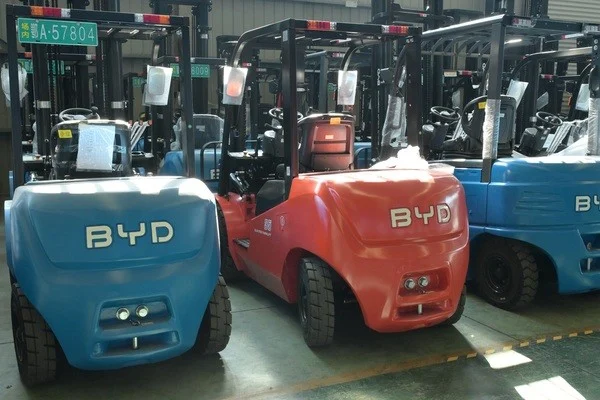
Matching Configuration to Your Operation
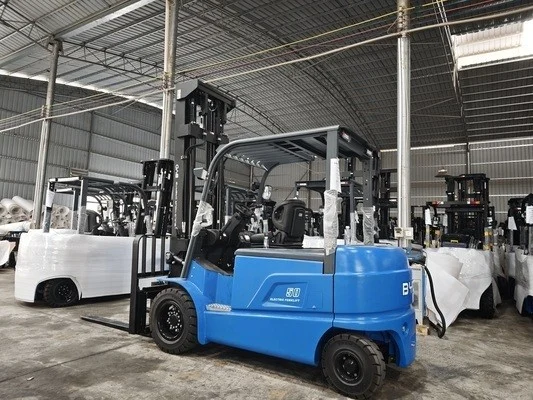
Cycle life and warranty exposure both improve when the truck is correctly specified. A four-wheel counterbalance electric forklift that regularly works near its rated capacity at a long load centre will place different demands on the battery and drivetrain than one handling lighter loads at short distances.
An illustrative scenario: a distribution centre running two shifts with mixed pallet weights and moderate lift heights may suit opportunity charging during breaks, provided the charger and battery specification support it and the warranty does not exclude that pattern. A different site with heavy loads, high lifts and limited charging windows may need a larger battery or a different charging arrangement. These are examples of how to frame the question, not predictions of performance at any specific site.
Share your actual load weights, lift heights, aisle widths, floor and ramp conditions, shift pattern and available charging time with the supplier. That information is what allows a meaningful recommendation on capacity, charger selection and configuration within the BYD four-wheel counterbalance electric forklift range. Ask which parameters remain unverified and what testing or documentation would settle them.
Acceptance checks at delivery
Before signing acceptance, verify that the delivered battery and charger match the approved specification, that serial numbers are recorded, that the warranty registration is completed, and that operators receive handover training on charging and daily checks. Confirm the service contact and the process for raising a warranty claim. Keep copies of all approved documents with the asset record.
Frequently Asked Questions
Can a supplier guarantee a specific number of cycles?
A guarantee should state the test conditions and the capacity threshold that defines end of life. Without those details, a cycle count is not a meaningful commitment. Ask for the warranty document that sets out the remedy if the threshold is not met.
Does opportunity charging affect battery warranty coverage?
It can, depending on the terms. Some warranties assume a particular charging pattern. Confirm in writing whether partial and opportunity charging are permitted and whether any conditions apply to the charger used.
What records should we keep to protect a claim?
Keep maintenance records, charging logs where available, operator training records, delivery documentation and correspondence about approved use. Many claim processes depend on demonstrating that service and operating requirements were followed.
Should the battery and truck warranties be evaluated together?
Yes. The battery is central to the cost of ownership of an electric truck, so a strong truck warranty with a narrow battery warranty may offer less protection than it appears. Compare durations, exclusions and remedies across both documents.